

Most car owners assume that skipping the dealership for an oil change or swapping in an aftermarket air filter will instantly kill their warranty. That belief is wrong, and it costs people real money when they avoid necessary maintenance out of fear. Federal law protects your right to service your vehicle wherever you choose, but serious owner mistakes can still trigger a full or partial warranty denial. This guide breaks down the real rules, the genuine risks, and the practical steps you can take to keep your coverage intact.
Table of Contents
- Understanding car warranties: Types and protections
- What voids coverage? The most common mistakes explained
- Debunking the myths: Aftermarket parts, non-dealer service, and your rights
- Documentation and maintenance: How records can protect or void your warranty
- Special cases: Emissions, recalls, and accident exclusions
- Protect your coverage: Smart moves for long-term peace of mind
- Frequently asked questions
Key Takeaways
| Point | Details |
|---|---|
| Neglect voids warranties | Failure to perform or document basic upkeep like oil changes can lead to a denial or a voided warranty. |
| Aftermarket parts rights | Federal law protects you from losing warranty coverage just by using non-OEM parts or shops unless they're proven at fault. |
| Titles and accidents matter | Salvage/rebuilt titles and major accidents can permanently void coverage for your vehicle. |
| Documentation is critical | Missing service records is the top reason extended warranty claims get rejected. |
| Know your exclusions | Warranties never cover damages from racing, natural disasters, or neglecting recalls. |
Understanding car warranties: Types and protections
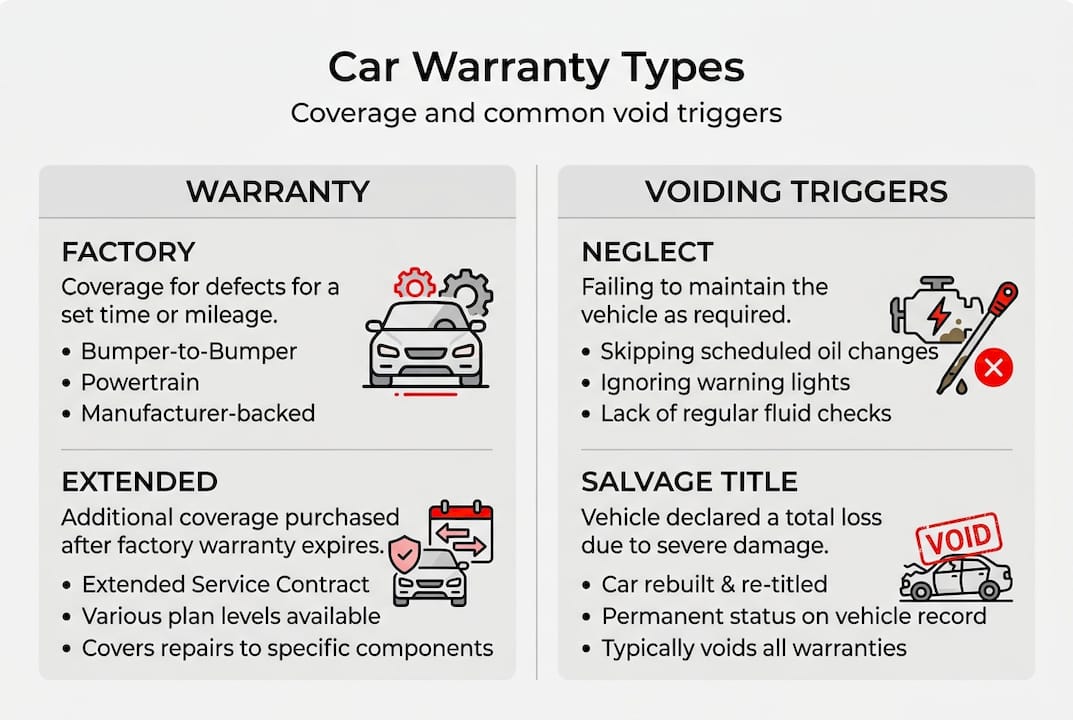
Many myths come from confusion over what each type of warranty actually covers. Before you can protect your coverage, you need to know which warranty you are dealing with.
There are three main types every vehicle owner should understand:
- Factory warranty (bumper-to-bumper): Covers most components for a set period, typically 3 years or 36,000 miles. Excludes wear items like brake pads and tires.
- Emissions warranty: Federally mandated coverage for pollution control components. The EPA requires two tiers: a 2-year/24,000-mile period for most parts and an 8-year/80,000-mile period for major components like catalytic converters.
- Extended warranty (service contract): Coverage you purchase separately to protect your vehicle after the factory warranty expires. Terms vary widely by provider and plan.
Here is a quick comparison of what each covers:
| Warranty type | What it covers | Key voiding triggers |
|---|---|---|
| Factory/bumper-to-bumper | Most mechanical and electrical parts | Neglect, salvage title, misuse |
| Emissions | Pollution control components | Improper modifications, neglect |
| Extended/service contract | Varies by plan; engine, transmission, more | Missing maintenance records, excluded events |
Understanding auto warranty basics is the first step toward making sure you never accidentally forfeit coverage you paid for.
What voids coverage? The most common mistakes explained
Once you know your warranty type, it is essential to avoid these costly pitfalls. Some actions void your entire warranty. Others only affect a specific claim. Knowing the difference matters.
Here are the most common causes of voided coverage, ranked by severity:
- Salvage or rebuilt title: If your car is declared a total loss and receives a salvage or rebuilt title, the factory warranty is voided entirely. This is one of the most overlooked risks when buying a used car.
- Severe neglect: Skipping oil changes and ignoring basic maintenance can lead to claim denial if the manufacturer documents that neglect caused the failure.
- Accidents, fire, and natural disasters: Damage from collisions, vandalism, floods, or fire is excluded from warranty coverage across virtually all manufacturers.
- Racing or off-road misuse: Using your vehicle in ways outside its intended purpose, like track racing or extreme off-roading, can void coverage for related damage.
- Unauthorized modifications: Major engine or drivetrain modifications that alter the vehicle's original design can give manufacturers grounds to deny claims.
Here is a side-by-side look at voiding causes by severity:
| Cause | Scope of impact | Reversible? |
|---|---|---|
| Salvage/rebuilt title | Full warranty void | No |
| Severe neglect | Specific claim denial | Partially, with records |
| Accident/disaster damage | Excluded damage only | No |
| Racing/misuse | Related damage denied | No |
| Unauthorized modification | Related claim denied | Depends on plan |
Pro Tip: Always check the title history of any used car before you buy. A rebuilt or salvage title is a permanent red flag that no extended warranty can fully erase.

Knowing which important warranty features to look for in a plan can also help you avoid gaps in coverage before they become expensive surprises.
Debunking the myths: Aftermarket parts, non-dealer service, and your rights
Not every maintenance choice puts your warranty at risk. This is where most car owners get it wrong, and where knowing the law actually saves you money.
Under the Magnuson-Moss Warranty Act, using aftermarket parts or taking your car to an independent mechanic does not automatically void your warranty. The manufacturer must prove that the specific part or service directly caused the failure before they can deny a claim.
Here is what you are legally allowed to do without risking your full warranty:
- Take your car to any licensed independent repair shop for routine maintenance
- Use aftermarket or recycled parts that meet OEM specifications
- Perform basic maintenance yourself, like oil changes, as long as you keep receipts
- Choose your own brand of motor oil, provided it meets the manufacturer's specifications
Here is what can legitimately put a specific claim at risk:
- Installing a performance chip that alters engine management and then claiming an engine failure
- Using a non-spec fluid in the transmission and then filing a transmission claim
- Fitting oversized tires that stress the drivetrain and then claiming drivetrain damage
"The manufacturer or its authorized dealer must demonstrate that the aftermarket equipment caused the need for repairs before a warranty claim can be denied." — Federal Trade Commission
The key word is caused. The burden of proof sits with the manufacturer, not with you. When choosing the right warranty, look for plans that spell out exactly what modifications or parts will affect coverage so there are no surprises.
Documentation and maintenance: How records can protect or void your warranty
Even if you follow all the key rules, a single missing record can cost you thousands. Documentation is not just paperwork. It is your legal defense.
Extended warranty rejections have hit record highs in recent years, with missing maintenance records cited as the leading cause. And the numbers behind warranty denials are striking: denial rates range from 18 to 30% across major manufacturers, and appeals only succeed about 40% of the time. That means your records are often your only shot at getting paid.
Here is a step-by-step process for building a documentation system that holds up:
- Save every service receipt, whether from a dealership, independent shop, or auto parts store.
- Log the date, mileage, and work performed for every service visit in a dedicated notebook or app.
- Photograph your odometer at each service interval to create a timestamped record.
- Store digital copies in cloud storage so they cannot be lost if your car is stolen or damaged.
- Keep the owner's manual and warranty booklet together with your records so you can reference required intervals.
For extended warranty requirements, the documentation bar is often higher than for factory warranties. Read your contract carefully to understand exactly what records your provider expects.
Pro Tip: Many modern service apps like Carfax Car Care or your dealership's app automatically log service history. Even these digital records count as proof. Back them up to a second location just in case.
If your factory coverage is running out, understanding your after factory warranty options before a gap opens is far smarter than scrambling after a breakdown.
Special cases: Emissions, recalls, and accident exclusions
Not every loss is covered. Federal and factory rules carve out major exclusions that all drivers should know before they assume they are protected.
Some exclusions are universal across nearly every warranty:
- Damage from accidents, collisions, or rollovers
- Fire, vandalism, and natural disasters like floods or hail
- Damage caused by racing, towing beyond rated capacity, or off-road use
- Wear items: brake pads, rotors, wiper blades, tires, and filters
- Damage caused by using the wrong fuel or fluids
Emissions warranties follow a separate federal framework. The EPA mandates coverage for two distinct periods: 2 years or 24,000 miles for most emissions parts, and 8 years or 80,000 miles for major components. But if you modify your exhaust system or neglect maintenance that leads to an emissions failure, the manufacturer can deny that specific claim.
Recall notices are a separate issue that many owners overlook. If a recall is issued for your vehicle and you ignore it, any damage that results from the recalled defect may not be covered under your warranty. Worse, if the unaddressed recall causes secondary damage, that damage could also be excluded. Always respond to recall notices promptly.
Knowing the full scope of understanding exclusions in your specific plan is the only way to avoid a nasty surprise when you file a claim.
Protect your coverage: Smart moves for long-term peace of mind
Now that you know what truly voids coverage, the next step is making sure you have a plan that works as hard as you do to protect your vehicle.
At RPM Warranty, we built our extended warranty solutions around the exact risks outlined in this guide. Our Elite, Advanced, and Essential plans cover engines, transmissions, cooling systems, electrical components, and high-tech parts, so you are not left exposed when something goes wrong. Every plan comes with roadside assistance and straightforward claims processing. We also make it easy to understand exactly what your contract requires so your documentation stays clean and your claims get approved. Ready to see what fits your vehicle and budget? Get a free warranty quote today and take the guesswork out of staying protected.
Frequently asked questions
Does getting service at an independent shop void my car warranty?
No. Federal law protects your right to use independent shops, and the manufacturer must prove the shop's work directly caused a problem before denying any claim.
What is the impact of missing oil changes on my car warranty?
Failing to perform oil changes or basic maintenance can lead to a denied claim if the manufacturer documents that neglect caused the damage, and in serious cases it can void coverage entirely.
Will a salvage or rebuilt title void my car's warranty?
Yes. A salvage, rebuilt, or total loss title voids the factory warranty completely, with no exceptions under most manufacturer policies.
Why are extended warranty claims often denied?
Most denials happen because owners cannot provide the complete maintenance and service records their contract requires, a problem that record-high rejection rates confirm is growing every year.