

Most vehicle owners assume their engine warranty covers everything that can go wrong under the hood. That assumption can be expensive. Engine repair costs can easily run into thousands of dollars, and if your warranty excludes the specific failure you're facing, you're paying every cent out of pocket. The gap between what you think is covered and what actually is covered is where most warranty surprises happen. This article breaks down exactly which engine components are protected, what gets excluded, how long coverage lasts, and how to make sure a claim actually gets approved when you need it most.
Table of Contents
- Key components covered by engine warranties
- What's not covered under engine warranties
- Engine warranty terms: How long coverage lasts and who provides it
- How engine warranties protect against expensive repairs
- Why engine warranty details matter more than most car owners think
- Find the right engine warranty for your vehicle
- Frequently asked questions
Key Takeaways
| Point | Details |
|---|---|
| Major engine parts covered | Engine warranties cover the block, cylinder heads, pistons, crankshaft, and most internal parts. |
| Exclusions matter | Routine maintenance, wear items, and improper use can void your coverage and claims. |
| Factory vs. extended terms | Factory warranties last 5-10 years; extended warranties offer post-factory protection. |
| Repairs can cost thousands | Engine warranties protect you from expensive breakdowns, but only for covered failures. |
| Claim success requires diligence | Maintain records and follow care guidelines to maximize your engine warranty benefits. |
Key components covered by engine warranties
Not all engine warranties are created equal, and the difference between a powertrain warranty and a more bumper-to-bumper coverage plan can mean thousands of dollars in protected repairs. Understanding exactly which parts fall under your coverage is the first step to using your warranty effectively.
According to the KBB car warranty guide, most extended warranties and powertrain warranties cover the following major engine components:
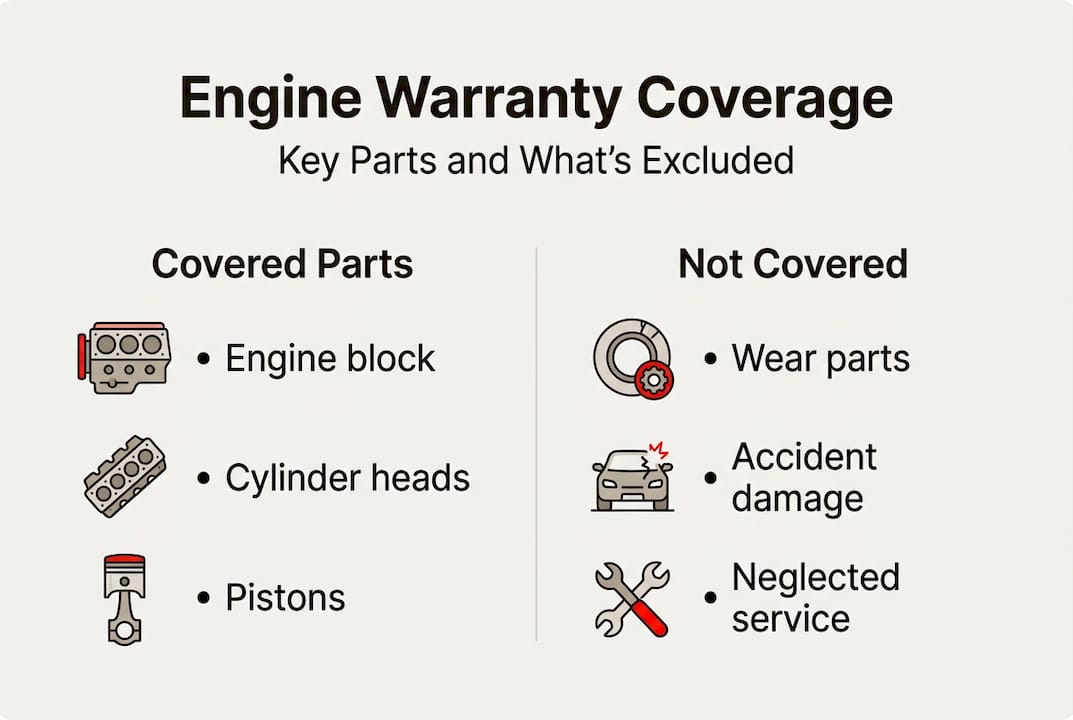
- Engine block and cylinder heads
- Internal lubricated parts (pistons, crankshaft, valves, and bearings)
- Timing chain, timing gears, and timing belt
- Oil pump and water pump
- Intake and exhaust manifolds
- Turbocharger or supercharger (if your vehicle is equipped)
- Seals and gaskets related to covered components
These are the parts most likely to cause a catastrophic, wallet-draining failure. A crankshaft replacement alone can run $1,500 to $3,000 in labor and parts. Cylinder head repairs often exceed $2,000. Coverage for these components is the core value of any engine warranty.
The type of warranty you hold changes how much of that list is actually protected. Here's a quick comparison:
| Component | Powertrain warranty | Bumper-to-bumper warranty |
|---|---|---|
| Engine block | Covered | Covered |
| Internal lubricated parts | Covered | Covered |
| Timing components | Covered | Covered |
| Turbocharger/supercharger | Sometimes | Usually covered |
| Seals and gaskets | Covered | Covered |
| Sensors and wiring | Not covered | Often covered |
| Cooling system parts | Not covered | Often covered |
As you can see, the bumper vs powertrain warranty distinction matters significantly when it comes to edge components like sensors and cooling system parts. A powertrain plan is leaner but still covers the most expensive mechanical failures.
Pro Tip: If your vehicle has a turbocharged or supercharged engine, always confirm in writing whether those components are included. Some plans list them as optional add-ons, and skipping that confirmation is a costly mistake.
What's not covered under engine warranties
Knowing what your warranty excludes is just as important as knowing what it covers. Many claim denials happen not because the part failed, but because of how or why it failed.
The most common exclusions for engine warranty coverage include:
- Wear and tear items such as belts and hoses
- Routine maintenance like oil changes, filters, and spark plugs
- Pre-existing conditions present before the warranty began
- Neglect, abuse, or misuse of the vehicle
- Aftermarket modifications or non-factory parts
- Accident or environmental damage (flood, fire, collision)
- Consequential damage caused by a non-covered component failing first
- Emissions components and most cooling system parts under powertrain plans
- Sensors and wiring outside the core engine assembly
That last point about consequential damage deserves extra attention. Say your radiator fails (not covered under a powertrain plan) and the resulting overheating warps your cylinder head (normally covered). In many cases, the engine damage is denied because the root cause was a non-covered part. This is one of the most frustrating and least-discussed realities of engine warranty claims.
Improper maintenance is another major claim killer. As one powertrain warranty explained breakdown puts it:
"If you cannot prove that the vehicle was properly maintained according to the manufacturer's schedule, the warranty provider has grounds to deny your claim, regardless of what failed."
This means your oil change receipts are almost as valuable as the warranty contract itself. Skipping a single service and losing the documentation can give a provider the opening they need to reject a $4,000 engine repair claim.
To understand the full list of behaviors that can put your coverage at risk, reviewing what voids a car warranty is worth your time before you ever need to file a claim.
Engine warranty terms: How long coverage lasts and who provides it
Engine warranties come from two main sources: the vehicle manufacturer and third-party extended warranty providers. Each operates on different timelines and terms.

Manufacturer powertrain warranties typically run 5 years or 60,000 miles for most brands, while some automakers offer significantly longer protection:
| Brand | Powertrain warranty term |
|---|---|
| Chevrolet / GMC | 5 years / 60,000 miles |
| Ford | 5 years / 60,000 miles |
| Ram | 5 years / 60,000 miles |
| Toyota | 5 years / 60,000 miles |
| Hyundai / Kia | 10 years / 100,000 miles |
| Genesis | 10 years / 100,000 miles |
| Mitsubishi | 10 years / 100,000 miles |
Once factory coverage expires, your engine has zero protection unless you've secured warranty after factory coverage. Extended warranties from third-party providers pick up where the manufacturer leaves off and can be customized to match your vehicle's age, mileage, and risk profile.
Here's how to verify your current engine warranty status before assuming you're covered:
- Locate your original window sticker or owner's manual for the factory warranty terms.
- Check your vehicle's current mileage against the warranty mileage limit.
- Contact the dealership or manufacturer with your VIN to confirm active coverage.
- Review any extended warranty contract you purchased separately for engine-specific terms.
- Confirm the repair network your warranty requires, since some plans restrict you to authorized shops.
Pro Tip: Extended warranties often require repairs to be performed at an authorized facility. Using an independent mechanic, even a great one, can void your claim if it falls outside the plan's approved network. Always call your warranty provider before authorizing any repair.
How engine warranties protect against expensive repairs
The financial case for engine warranty coverage becomes very clear when you look at actual repair costs. Engine repairs can easily exceed several thousand dollars, and for many households, that kind of unplanned expense is genuinely destabilizing.
Here's a real-world cost comparison for a common engine failure, a blown head gasket on a mid-size sedan:
- Diagnosis: $150
- Parts: $400 to $800
- Labor: $1,200 to $2,500
- Total out of pocket: $1,750 to $3,450
- With a covered warranty: You pay the deductible only, often $100 to $200
That's a potential savings of over $3,000 on a single repair. For a more severe failure like a seized engine requiring a full replacement, costs can reach $7,000 to $10,000 or more. The math on warranty coverage becomes hard to argue with.
To maximize your chances of a successful claim, focus on these actions:
- Keep every maintenance receipt, including oil changes, fluid flushes, and filter replacements
- Follow the manufacturer's service schedule exactly, not approximately
- Use only approved parts and fluids as specified in your owner's manual
- Report problems early rather than driving through warning signs
- Always get pre-authorization from your warranty provider before repairs begin
And to avoid exclusions before they become a problem:
- Avoid aftermarket performance modifications to any covered system.
- Never delay repairs when a warning light appears.
- Document every service visit with date, mileage, and shop name.
- Understand your deductible structure before you need to use it.
- Review comparing warranty options annually as your vehicle ages and coverage needs shift.
Why engine warranty details matter more than most car owners think
Here's what most warranty guides won't tell you: the contract language matters far less than your maintenance history. We've seen situations where a vehicle owner had a perfectly valid, active warranty and still had their engine claim denied because they couldn't produce oil change records from three years prior. The warranty existed. The coverage was real. The claim was rejected anyway.
Most buyers focus on the price of the warranty and the headline coverage terms. Very few read the maintenance obligations section carefully. That's where the real risk lives. Powertrain plans offer solid engine protection at a lower cost, but they exclude more and require cleaner documentation to approve claims.
There are also surprising edge cases most people never consider. Off-road driving, even occasional trail use, can be classified as misuse. Installing a cold air intake can void coverage on related engine components. And a failure chain, where one small non-covered part causes a larger covered part to fail, can result in a full denial. Knowing what voids coverage before you need a claim is the only way to protect yourself. The best warranty is one you've actually read.
Find the right engine warranty for your vehicle
You now know which engine parts are covered, what gets excluded, and how to protect your claim when it counts. The next step is making sure your specific vehicle has the right level of protection in place.
At RPM Warranty, we make it straightforward to find an extended vehicle warranty that fits your car, your budget, and your driving habits. You can explore our protection plans to compare coverage tiers side by side, from our Essential plan up to our Elite plan with the broadest engine and component protection available. Ready to see what coverage looks like for your specific year, make, and model? Get your free warranty quotes today and take the guesswork out of engine protection.
Frequently asked questions
Are turbochargers and superchargers covered in my engine warranty?
Some plans cover turbochargers or superchargers if your vehicle is equipped with them, but coverage varies by plan. Always verify in writing before assuming these components are included.
Does skipping oil changes void engine warranty coverage?
Yes. Skipped oil changes or missing maintenance records give warranty providers grounds to deny your engine repair claim, even if the failure seems unrelated to the missed service.
Will my engine warranty cover repairs from accidents or environmental damage?
No. Accidents and environmental damage such as flood or fire are excluded from engine warranty coverage. Those situations fall under your auto insurance policy, not your warranty.
How long does a typical manufacturer engine warranty last?
Manufacturer powertrain warranties typically last 5 years or 60,000 miles for most brands, while Hyundai, Kia, Genesis, and Mitsubishi extend coverage up to 10 years or 100,000 miles.