

When your car breaks down out of warranty, the repair bill can hit fast and hard. Out-of-warranty repairs spike after 3 to 5 years to over $1,200 per year, and many owners find out too late that their warranty didn't cover what they assumed it would. The difference between a bumper-to-bumper and a powertrain warranty isn't just technical jargon. It's the difference between a covered repair and a $6,000 bill you didn't see coming. This article breaks down exactly what each warranty covers, where they differ, and how to choose the right protection for your situation.
Table of Contents
- Understanding bumper-to-bumper and powertrain warranties
- Key differences: Coverage, claims, and exclusions
- When each warranty matters: Real-world scenarios
- Extended warranties: What to look for after factory coverage
- Explore your extended warranty options
- Frequently asked questions
Key Takeaways
| Point | Details |
|---|---|
| Coverage varies by type | Bumper-to-bumper covers more systems, while powertrain is limited to propulsion parts. |
| Durations differ | Powertrain warranties usually last longer than bumper-to-bumper warranties. |
| Repair cost impact | Major repairs not covered by warranty can result in hefty annual expenses. |
| Check exclusions | Always review what’s not covered and possible claim denial triggers before choosing coverage. |
| Extended warranty benefits | Consider extended warranties when factory coverage ends to protect against costly repairs. |
Understanding bumper-to-bumper and powertrain warranties
These two warranty types are the foundation of vehicle protection, but they work very differently. Most new car buyers receive both, yet few understand where one ends and the other begins.
A bumper-to-bumper warranty (also called an exclusionary warranty) covers almost every component on the vehicle except for a short list of excluded items. Think of it as a wide safety net. It protects your electrical systems, air conditioning, suspension, steering, sensors, and most other mechanical parts. You can learn more about what qualifies under bumper-to-bumper warranty coverage to avoid surprises at the dealership.
A powertrain warranty is narrower. It focuses on the core components that make your car move: the engine, transmission, drivetrain, and related parts. It does not cover electrical systems, AC, suspension, or steering. As Consumer Reports notes, bumper-to-bumper covers electrical, AC, suspension, steering, and sensors while powertrain does not.
Here's a quick breakdown of what each warranty typically includes:
- Bumper-to-bumper: Engine, transmission, electrical systems, AC, suspension, steering, sensors, infotainment, and most non-wear components
- Powertrain: Engine block and internals, transmission, transfer case, drive axles, and driveshaft
- Both exclude: Routine maintenance (oil changes, brake pads, tires), cosmetic damage, and wear items
Many owners assume "bumper-to-bumper" means literally everything is covered. It doesn't. Wear items like brake pads, wiper blades, and tires are almost always excluded, even under the most generous factory warranties.
If you're new to vehicle protection, the beginner's auto warranty guide is a solid starting point before you compare plans.
Key differences: Coverage, claims, and exclusions
Now that you know what each warranty covers, let's look at how they compare side by side, because the financial stakes are real.
Duration and mileage
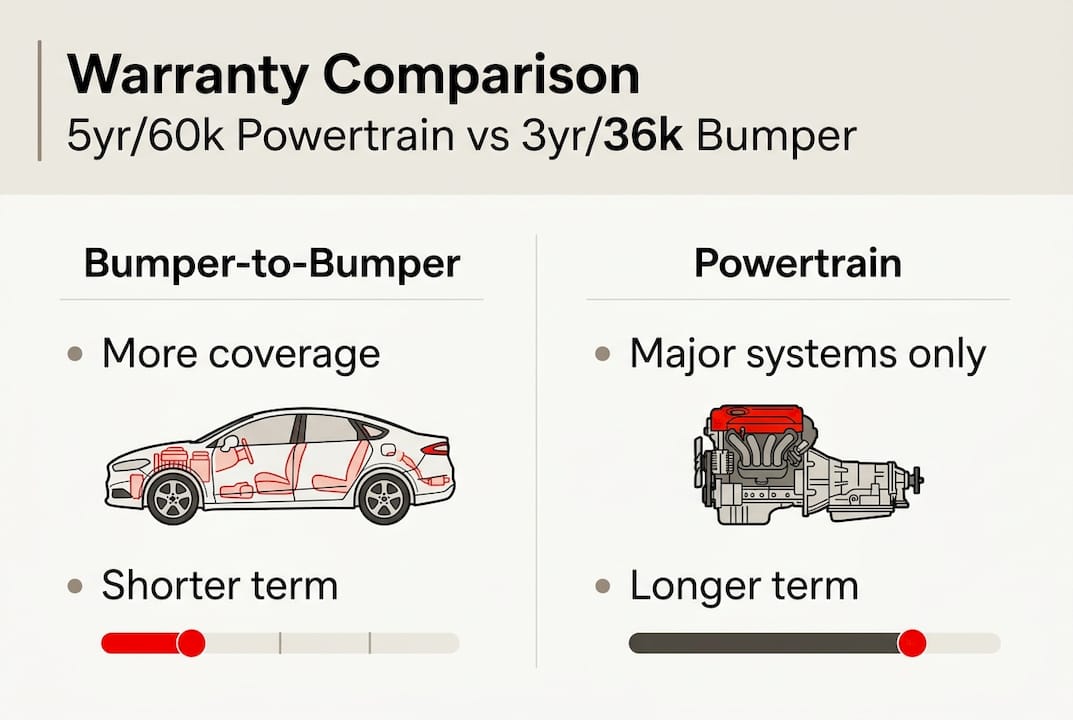
Typical warranty durations show bumper-to-bumper coverage at 3 years or 36,000 miles, while powertrain coverage stretches to 5 years or 60,000 miles, though this varies by manufacturer. Some brands like Hyundai and Kia offer powertrain coverage up to 10 years or 100,000 miles.
Side-by-side comparison
| Feature | Bumper-to-bumper | Powertrain |
|---|---|---|
| Duration (typical) | 3 years / 36,000 miles | 5 years / 60,000 miles |
| Engine coverage | Yes | Yes |
| Transmission coverage | Yes | Yes |
| Electrical systems | Yes | No |
| AC and cooling | Yes | No |
| Suspension and steering | Yes | No |
| Sensors and tech | Yes | No |
| Wear items | No | No |
Repair cost reality
The numbers make the coverage gap very clear. Engine repairs run $5,000 to $10,000, transmission repairs cost $3,000 to $7,000, and electrical failures account for roughly 25% of all warranty claims. That last stat matters because electrical failures are only covered under bumper-to-bumper, not powertrain.
Common exclusions to watch for in both warranty types:
- Pre-existing conditions at time of purchase
- Damage from accidents, floods, or misuse
- Modifications or aftermarket parts
- Missed or undocumented maintenance
- Cosmetic issues like paint, trim, and upholstery
If you drive a hybrid or electric vehicle, coverage gets more nuanced. Check out hybrid car warranty coverage for specifics on battery and motor protection. For a deeper look at what a mid-tier plan includes, the advanced warranty coverage breakdown is worth reading.
When each warranty matters: Real-world scenarios
Knowing the definitions is one thing. Knowing which warranty actually protects you is another. Your vehicle's age, mileage, and how you use it all factor in.
Choosing based on your situation
| Vehicle situation | Best warranty fit | Why |
|---|---|---|
| New car, under 36k miles | Bumper-to-bumper | Widest coverage during early ownership |
| 36k to 60k miles | Powertrain (if still active) | Engine and transmission still covered |
| Over 60k miles | Extended warranty | Factory coverage likely expired |
| Used car purchase | Extended warranty | No factory coverage remaining |
Here's a practical way to think through your decision:
- Check your current mileage against your factory warranty terms.
- Identify your biggest risk by looking at your vehicle's reliability history.
- Review what's excluded in your current warranty before assuming you're covered.
- Consider your repair budget and whether a surprise $5,000 bill would be manageable.
- Look at extended options before your factory coverage runs out, not after.
After bumper-to-bumper expires at around 36,000 miles, the powertrain warranty may still apply, but it leaves many costly systems completely exposed. Electrical failures, AC breakdowns, and suspension issues all become out-of-pocket expenses.

The risk compounds over time. Powertrain failure risk runs roughly 3 to 8% annually and climbs significantly after 100,000 miles. That's not a small number when you're talking about a $7,000 transmission replacement.
Pro Tip: Before buying a used car, ask for the full maintenance history. Many extended warranty claims get denied because the previous owner skipped oil changes or other scheduled services. A clean service record protects your coverage.
If you're unsure whether your vehicle has reached the point where extended coverage makes sense, the article on signs you need an extended warranty lays out clear indicators. You can also use choosing a warranty by year to match coverage to your vehicle's specific age.
Extended warranties: What to look for after factory coverage
Once your factory warranty expires, you're not out of options. Extended warranties are designed to pick up where the manufacturer leaves off, and the best ones closely mirror either bumper-to-bumper or powertrain coverage.
Here's what extended warranties typically offer:
- Powertrain-style plans: Cover engine, transmission, and drivetrain components at a lower monthly cost
- Bumper-to-bumper-style plans: Cover a broader range of systems including electrical, AC, and suspension
- Hybrid plans: Mix coverage tiers to match your vehicle's specific risk profile
- Roadside assistance: Often bundled in, covering towing, flat tires, and lockouts
But extended warranties come with real pitfalls. Extended warranties mimic factory coverage, but exclusions and claims denial triggers, especially around maintenance records, can catch owners off guard. A plan that looks great on paper can fall apart at the claims stage if you haven't kept up with scheduled maintenance.
Always request a complete list of covered parts and a full exclusions list before signing any extended warranty contract. If a provider won't give you that in writing, walk away.
Pro Tip: Compare the exclusions list, not just the coverage list. Two plans may both claim to cover "electrical systems," but one might exclude sensors, modules, and wiring harnesses while the other covers them fully.
Understanding why you need warranty after factory coverage helps frame the decision as a financial one, not just a convenience. And if your current plan is nearing its end, the process of renewing an auto warranty is simpler than most owners expect.
Explore your extended warranty options
You now know the difference between bumper-to-bumper and powertrain coverage, where each one falls short, and what to look for in an extended plan. The next step is finding coverage that actually fits your vehicle and your budget.
RPM Warranty offers nationwide vehicle warranty plans built around real coverage, not fine-print surprises. Whether you need powertrain-level protection or something closer to full bumper-to-bumper coverage, the Elite, Advanced, and Essential plans give you options that scale to your needs. You can get a free quote in minutes based on your vehicle's year, make, and model. Still have questions about what's covered? The warranty FAQ answers the most common concerns about claims, exclusions, and plan details so you can decide with confidence.
Frequently asked questions
Do bumper-to-bumper warranties cover all repairs?
No. Bumper-to-bumper warranties exclude maintenance items, wear parts like brake pads and tires, and most cosmetic damage. Electrical, AC, suspension, and steering are covered, but the plan still has a defined exclusions list.
How long does a powertrain warranty last compared to bumper-to-bumper?
Powertrain warranties typically outlast bumper-to-bumper coverage. Standard durations run 5 years or 60,000 miles for powertrain versus 3 years or 36,000 miles for bumper-to-bumper, though some manufacturers offer longer terms.
What happens when bumper-to-bumper warranty expires?
Once bumper-to-bumper coverage ends, electrical failures, AC issues, and suspension repairs become out-of-pocket costs. The powertrain warranty may still apply for engine and transmission problems, but many costly systems are no longer protected.
Are extended warranties worth it for older vehicles?
For vehicles past their factory warranty, extended coverage often pays for itself after a single major repair. Repair costs spike after 3 to 5 years of ownership, making extended warranties a practical financial buffer for older cars.