

Hybrid car owners often brace for the worst when they think about battery replacement costs. A new hybrid battery can run anywhere from $2,000 to $8,000 out of pocket, which makes warranty coverage feel like a lifeline. Here's the part that surprises most people: federal law already mandates strong protection on your hybrid's most expensive components. This guide breaks down exactly what your hybrid warranty covers, what it skips, and how to make sure you're fully protected from the moment you drive off the lot to the day you eventually sell.
Table of Contents
- What is hybrid car warranty coverage?
- What components does a hybrid warranty cover?
- How long do hybrid car warranties last?
- What is NOT covered under a hybrid car warranty?
- Special rules: Transferability and unique state protections
- Protect your hybrid investment with extended warranty coverage
- Frequently asked questions
Key Takeaways
| Point | Details |
|---|---|
| Federal law protects hybrid batteries | All hybrid batteries come with at least 8 years or 100,000 miles of coverage by law. |
| Coverage varies by brand and state | Terms can be longer or more comprehensive in states with stricter emissions rules or with certain manufacturers. |
| Know what’s not covered | Normal wear and improper use are usually excluded, so read the fine print. |
| Transfer and extend warranties easily | Most hybrid warranties transfer to new owners and can be extended after factory coverage ends. |
What is hybrid car warranty coverage?
Hybrid car warranty coverage is a contractual agreement that protects the high-voltage battery pack and hybrid-specific components against defects and premature failure. Unlike a standard powertrain warranty, it's built around the unique technology that makes your hybrid run. Think of it as a specialized safety net layered on top of your regular bumper-to-bumper coverage.
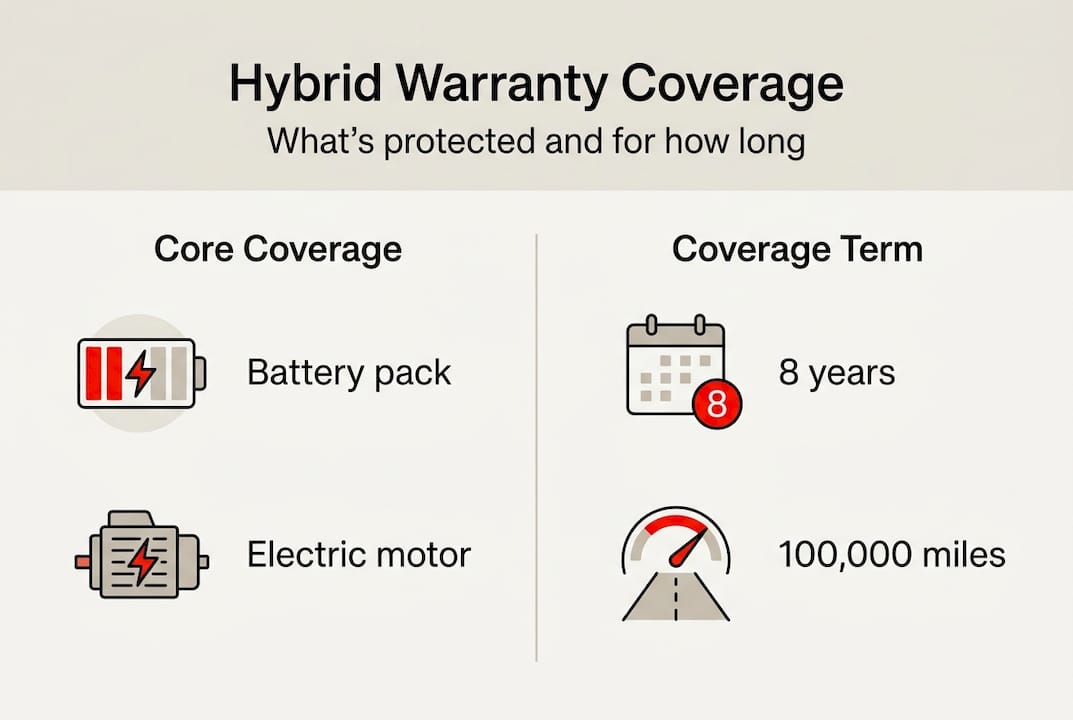
Understanding auto warranty basics helps you see why hybrid coverage stands apart. Federal emissions law requires that hybrid battery warranties last at least 8 years or 100,000 miles, whichever comes first. That minimum already exceeds what most standard powertrain warranties offer on conventional vehicles.
Here's what a typical hybrid warranty covers at a glance:
- High-voltage battery pack (the core energy storage system)
- Battery management system (the software and hardware that monitors charge)
- Hybrid-specific cooling systems (keeps the battery at safe operating temperatures)
- Inverters and power control units (convert and manage electrical flow)
- Electric drive motors (power the wheels in electric mode)
- Hybrid system controls and sensors
"Hybrid car warranties typically include a federal minimum of 8 years/100,000 miles for high-voltage battery and hybrid components, which goes beyond what most conventional powertrain warranties provide."
For a deeper look at what advanced warranty coverage includes beyond the factory plan, it's worth comparing your options before your factory coverage expires.
What components does a hybrid warranty cover?
The covered components vary slightly by automaker, but the core protections are consistent across the industry. Most manufacturers protect the same high-value systems, though the duration and specific terms differ. Knowing what each brand covers helps you set realistic expectations.

| Automaker | Battery warranty | Key covered components |
|---|---|---|
| Toyota | 10 years/150,000 miles (2020+ models) | Battery pack, inverter, motor, hybrid ECU |
| Ford | 8 years/100,000 miles | High-voltage battery, eDrive motor, inverter |
| Honda | 8 years/100,000 miles | Battery pack, motor, power control unit |
| Hyundai/Kia | 10 years/100,000 miles | Battery, motor, inverter, 70% capacity guarantee |
Beyond the battery itself, hybrid warranties typically protect:
- Electric drive motors (both primary and secondary in AWD systems)
- Inverter and converter assemblies (expensive to replace without coverage)
- Regenerative braking components (unique to hybrids and EVs)
- Hybrid-specific wiring harnesses and connectors
- Onboard charging systems (for plug-in hybrids)
What's not covered is just as important to understand. Normal wear items like brake pads, tires, and 12-volt batteries fall outside hybrid warranty protection. Cosmetic damage, fluid leaks from non-hybrid systems, and standard maintenance items are excluded too.
Pro Tip: Keep all your service records in one place. If you ever need to file a hybrid warranty claim, a clean maintenance history speeds up dealer verification and reduces the chance of a dispute.
For a full breakdown of essential warranty features that protect your investment, reviewing what's included before you need it saves a lot of stress later.
How long do hybrid car warranties last?
Warranty duration depends on two things: your automaker's policy and the state where your vehicle is registered. The federal floor is 8 years or 100,000 miles, but several states have pushed that higher.
Key duration benchmarks by brand and region:
| Brand/Region | Battery warranty term | Capacity guarantee |
|---|---|---|
| Federal minimum | 8 years/100,000 miles | No minimum specified |
| CARB states (CA, NY, etc.) | 10 years/150,000 miles | Varies |
| Toyota (2020+) | 10 years/150,000 miles | Not specified |
| Hyundai/Kia | 10 years/100,000 miles | 70% minimum capacity |
| Honda | 8 years/100,000 miles | Not specified |
| Ford | 8 years/100,000 miles | Not specified |
CARB states (California Air Resources Board states) include California, New York, Massachusetts, Oregon, and about a dozen others. If you live in one of these states, your warranty extends to 10 years or 150,000 miles automatically, regardless of what the manufacturer's national policy says.
Statistic worth knowing: Most hybrid batteries actually last between 150,000 and 200,000 miles in real-world use, which means many owners never need a warranty replacement at all. The warranty is there for the exceptions, not the rule.
Pro Tip: If you're buying a used hybrid, check whether the vehicle was originally sold in a CARB state. That longer coverage may still apply to the remaining warranty period, even if you now live elsewhere.
When it comes to choosing warranty length for extended coverage after the factory plan ends, matching the plan to your expected ownership period makes the most financial sense.
What is NOT covered under a hybrid car warranty?
This is where many hybrid owners get caught off guard. The warranty protects against defects and abnormal failures, not against the natural aging of battery chemistry. That distinction matters a lot.
Here's what falls outside standard hybrid warranty protection:
- Normal battery capacity loss from regular use and aging (gradual fade is expected)
- Accident damage to battery or hybrid components
- Misuse or abuse, including improper charging habits on plug-in hybrids
- Unauthorized modifications to the hybrid system or battery
- Improper storage in extreme temperatures for extended periods
- Environmental damage from floods, fires, or corrosive conditions
- Non-dealer repairs that affect hybrid system integrity
"Common exclusions include normal battery degradation, accidents, misuse, modifications, improper storage, and environmental damage. These apply across virtually all major automakers."
The gray area is gradual capacity loss. A battery that slowly loses range over time is considered normal wear and is typically not covered. However, if your battery drops below a specific threshold suddenly or well ahead of schedule, that may qualify as an abnormal failure. Ford's warranty documentation notes that edge cases like gradual capacity loss are usually excluded, but excessive loss may be covered with dealer verification.
The key takeaway: document everything. If your hybrid battery seems to be degrading faster than normal, get a dealer diagnostic early. Waiting too long can make it harder to prove the failure was abnormal rather than gradual.
For a comparison of how EV warranty differences affect coverage decisions, understanding the full-electric versus hybrid distinction helps you plan smarter.
Special rules: Transferability and unique state protections
One of the most overlooked benefits of hybrid warranties is that they follow the vehicle, not the original owner. If you buy a used hybrid, you inherit whatever coverage remains on the factory warranty. That's a significant financial advantage.
Here's how transferability and state protections work in practice:
- Coverage transfers automatically to subsequent owners for the remaining warranty period. The clock does not reset.
- Proof of regular maintenance strengthens your claim. Dealers look for evidence that the vehicle was properly serviced.
- Dealer inspection is required before any warranty repair is approved. You can't simply request a replacement without a formal diagnosis.
- CARB state protections apply based on where the vehicle was originally certified, which can extend coverage even for buyers in non-CARB states in some cases.
- Keep all service records from previous owners if you're buying used. Gaps in maintenance history can complicate claim approval.
As noted in hybrid warranty comparisons, warranties are transferable to subsequent owners for the remaining period, and dealer diagnosis is required for claims to move forward.
Pro Tip: Before buying a used hybrid, ask the seller for a full service history and verify the remaining warranty coverage directly with the manufacturer's customer service line. A five-minute call can confirm exactly how much protection you're inheriting.
If your factory coverage has already expired or is close to running out, it's worth exploring how to renew your warranty with an extended plan before a costly repair catches you off guard.
Protect your hybrid investment with extended warranty coverage
Factory hybrid warranties are genuinely strong, but they don't last forever. Once your battery and hybrid component coverage expires, you're on the hook for repair costs that can easily run into the thousands. That's when an extended warranty plan becomes one of the smartest financial decisions you can make as a hybrid owner.

At RPM Warranty, our protection plans are built to cover hybrid vehicles with the same level of care the factory warranty provides, and in some cases more. From high-tech electrical components to cooling systems and drive motors, we offer coverage options that fit your budget and your vehicle's specific needs. Nationwide support, easy claims processing, and clear terms mean no surprises when something goes wrong. Get a free warranty quote today and find out exactly what coverage is available for your hybrid.
Frequently asked questions
Does hybrid car warranty cover battery replacement?
Yes, hybrid warranties cover battery replacement for manufacturing defects and abnormal capacity loss, but normal degradation from regular use is typically excluded from coverage.
Can I transfer my hybrid warranty to a new owner?
Yes, most hybrid warranties transfer automatically to new owners for the remaining coverage period without requiring any formal registration or transfer fee.
What voids a hybrid car warranty?
Misuse, accidents, unauthorized modifications, and improper maintenance can all void coverage. Common exclusions also include non-dealer repairs that affect the hybrid system.
Do hybrid warranties differ between states?
Yes, states following CARB rules such as California and New York require battery warranty coverage of 10 years or 150,000 miles, which is longer than the federal minimum.