

TL;DR:
- OEM warranties cover defects in materials or workmanship but exclude routine wear and accident damage.
- Warranty claims often include costly repairs like engine or transmission failures, saving owners thousands.
- After OEM coverage ends, self-insuring or purchasing extended warranties depends on vehicle reliability and repair risk.
Most vehicle owners assume that buying a new car means all repairs are free for years. That belief is understandable, but it leads to some genuinely painful surprises at the dealership service counter. The Federal Trade Commission notes that authorized dealerships handle all manufacturer warranty repairs, and coverage only applies to specific defects under normal use. That means plenty of common repair needs fall completely outside what your OEM warranty will pay for. This article breaks down exactly what OEM warranty coverage includes, what it excludes, how much it actually saves you, and how it compares to extended warranty products so you can make informed decisions throughout your ownership experience.
Table of Contents
- What is an OEM warranty?
- What does an OEM warranty cover and exclude?
- How much do OEM warranty claims actually cost?
- OEM versus extended warranties: what's the real difference?
- A fresh perspective on OEM vs. extended warranties
- Explore your top options for extended warranty coverage
- Frequently asked questions
Key Takeaways
| Point | Details |
|---|---|
| Covers factory defects only | An OEM warranty pays for repairs on defects from the factory, not normal wear or routine maintenance. |
| Exclusions to know | Parts like brakes, tires, and batteries and any accidental damage are typically not covered. |
| Authorized repair requirements | Repairs must be completed at authorized dealerships to use your OEM warranty. |
| Major repair savings | OEM warranties can save you thousands on big-ticket repairs early in your car’s life. |
| Understand extension options | OEM warranties are usually stronger than extended plans but only last for a set time or mileage. |
What is an OEM warranty?
An OEM (Original Equipment Manufacturer) warranty is a legally binding promise made by the vehicle manufacturer to pay for repairs caused by defects in materials or workmanship during a set coverage period. It is not a blanket protection plan. It is a targeted commitment that the car you purchased was built correctly, and if it wasn't, the manufacturer will fix it at no cost to you.
The manufacturer issues the warranty directly, not a third party. Coverage typically applies to the original buyer and, in many cases, transfers to a subsequent owner if the vehicle is sold before the warranty expires. That transferability can actually add resale value to a well maintained vehicle. Most OEM warranties follow a tiered structure: a bumper-to-bumper (also called a basic or limited) warranty lasts around three years or 36,000 miles, while a powertrain warranty extends longer, often five years or 60,000 miles. Some brands like Hyundai and Kia offer powertrain coverage up to 10 years or 100,000 miles.
Understanding auto warranty basics before you sign any paperwork puts you ahead of most buyers. The FTC confirms that covered repairs require an authorized dealership and manufacturer-approved parts, meaning you cannot take your car to a neighborhood shop and expect reimbursement under an OEM warranty.
Key fact: An OEM warranty covers defects in how the vehicle was made, not every problem that develops over time. Normal wear, accidents, and improper maintenance are your responsibility.
At-a-glance benefits of OEM warranty coverage:
- Repair costs for qualifying defects are covered entirely, including both parts and labor
- Coverage is backed by the manufacturer, giving you strong legal standing
- Lemon law protections in most states apply during the OEM warranty period
- Authorized dealers use genuine factory parts, preserving vehicle integrity
- Transferability can make your vehicle more attractive to future buyers
- Roadside assistance is often bundled for the duration of the bumper-to-bumper term
Want to clarify warranty coverage terms before your next service visit? Reviewing your owner's manual and warranty booklet side by side is a smart first step.
What does an OEM warranty cover and exclude?
With the basics covered, it's vital to see exactly what's included under an OEM warranty and just as important, what's left out.
OEM warranties cover defects in materials and workmanship. That means if your engine mounts crack prematurely because of a factory error, or your infotainment screen goes dark due to a software flaw the manufacturer introduced, those repairs qualify. If your water pump fails at 28,000 miles with no history of abuse, that's a warranty claim. The standard is clear: if the failure traces back to how the car was manufactured, you have coverage.
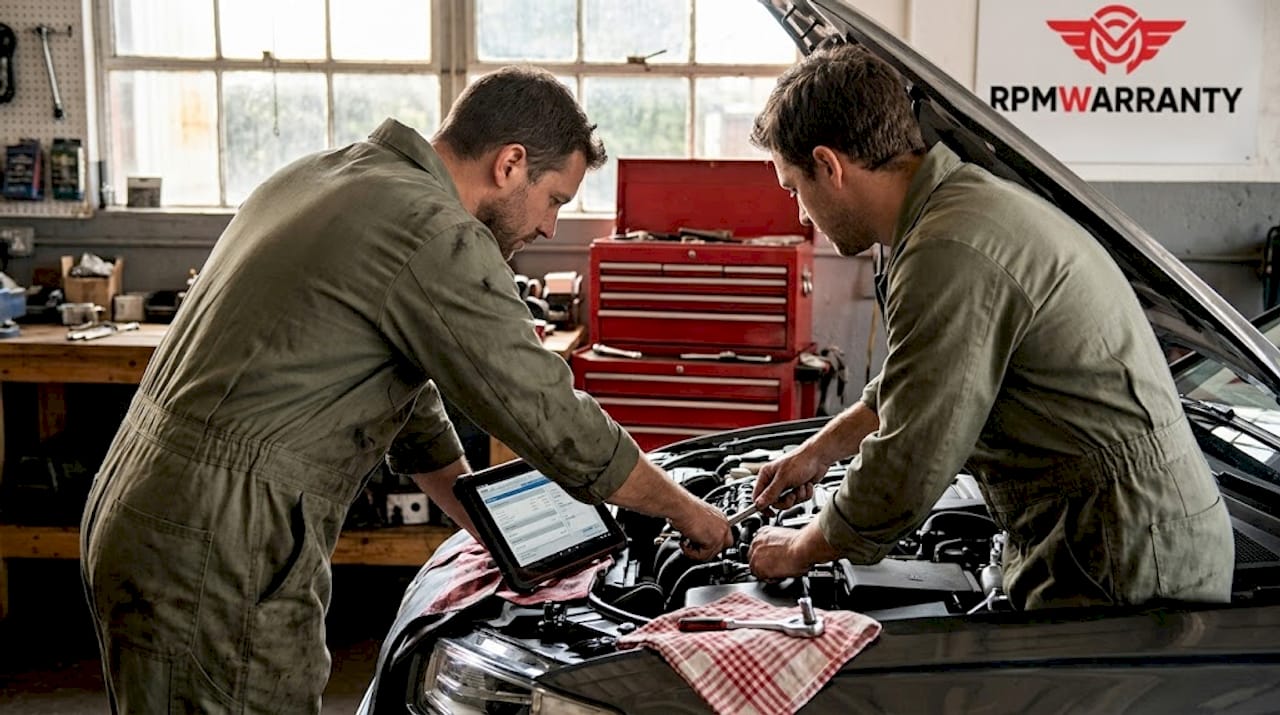
What OEM warranties do not cover is a longer list than most people expect. According to a comprehensive warranty breakdown, exclusions include normal wear and tear items such as brakes, tires, wipers, fluids, filters, and batteries, along with damage from accidents, misuse, modifications, improper maintenance, and environmental factors like hail or flooding.
| Item | Covered under OEM? | Notes |
|---|---|---|
| Engine defect from faulty casting | Yes | Manufacturing defect |
| Worn brake pads at 40,000 miles | No | Normal wear item |
| Transmission failure from factory error | Yes | Documented defect |
| Battery replacement after 4 years | No | Wear exclusion |
| Water pump failure at 25,000 miles | Yes | Below expected lifespan |
| Cracked windshield from road debris | No | Environmental damage |
| Faulty infotainment system | Yes | Electrical workmanship defect |
| Routine oil change | No | Scheduled maintenance |
Most commonly missed exclusions vehicle owners overlook:
- Tires, even new vehicle tires, are often covered under a separate tire manufacturer warranty, not the vehicle OEM
- Battery degradation in conventional vehicles is almost never covered once it's classified as age-related decline
- Aftermarket parts or modifications can void coverage for connected systems, not just the part itself
- Any repair performed outside an authorized dealer without prior written approval typically voids that specific claim
Learning how warranties are voided is just as important as knowing what they cover. A single oversight, like using a non-approved engine oil or skipping a scheduled service, can create an opening for a claim denial.
Pro Tip: Keep every oil change receipt, tire rotation record, and dealer inspection summary in one folder. If you face a warranty dispute, documented maintenance history is your strongest defense.
The section on transparency on exclusions is worth bookmarking before your next scheduled service appointment.
How much do OEM warranty claims actually cost?
Knowing what's covered brings up the bigger question: is OEM warranty coverage truly valuable in dollars and cents?
The short answer is yes, significantly. Real claims data puts the financial stakes into sharp focus. Common warranty claims include battery failures at 2.47% of all claims, ABS sensor failures at 2.43%, and water pump failures at 2.36%. The average repair under warranty runs around $800, but that number masks a wide range. Engine repairs average $3,500, and transmission replacements land between $4,000 and $6,000 out of pocket if you're not covered.
| Repair type | Claim frequency | Estimated cost without coverage |
|---|---|---|
| Battery failure | 2.47% | $200 to $500 |
| ABS sensor failure | 2.43% | $300 to $800 |
| Water pump failure | 2.36% | $400 to $900 |
| Engine repair | Less common | $2,500 to $5,000+ |
| Transmission replacement | Less common | $4,000 to $6,000+ |
> Stat spotlight: Ford paid $2.86 billion in warranty claims in the first half of 2024 alone, and GM paid $2.05 billion in the same period. Those numbers confirm that manufacturing defects are far more common than most buyers assume.
Understanding engine coverage details gives you a clearer picture of what your specific warranty pays for when it comes to the most expensive drivetrain failures. For vehicles approaching end-of-warranty age, warranty costs by year helps frame the financial risk of going unprotected.
Common scenarios where an active OEM warranty saves you significant money:
- Your ABS module fails at 28,000 miles on a three-year-old vehicle: $700+ covered at zero cost to you
- A factory weld on an exhaust manifold cracks at 18 months: full repair paid by the manufacturer
- Your engine misfires due to a defective fuel injector installed at the factory: diagnostic fees, parts, and labor all covered
- An electrical short in a body control module causes repeated warning lights: full diagnostic and repair covered under workmanship
- A transmission torque converter fails prematurely due to a manufacturing tolerance issue: $1,500 to $4,000 repair at no cost
These are not hypothetical edge cases. They represent the type of failures that prompt hundreds of thousands of warranty claims every year across all major brands.
OEM versus extended warranties: what's the real difference?
With a grasp of coverage and costs, let's see how OEM protection stacks up against extended warranty products and what you should factor into your next coverage decision.
The most important distinction is who backs the coverage and what legal protections apply. OEM warranties are governed by federal law under the Magnuson-Moss Warranty Act, and they connect directly to state lemon laws. If your vehicle has a recurring defect during the OEM period and the dealer cannot fix it after a reasonable number of attempts, you may be entitled to a replacement or refund. Extended warranties, also called vehicle service contracts, do not carry the same automatic legal weight.
Expert perspective: Consumer Reports research confirms that OEM warranties provide stronger legal protections and fewer coverage gaps than third-party extended plans, and that self-insuring through a dedicated savings fund often outperforms buying an extended warranty for post-OEM repairs because most failures after the warranty expires are wear-based, not defect-based.
| Feature | OEM warranty | Extended warranty |
|---|---|---|
| Backed by | Vehicle manufacturer | Third-party provider or dealer |
| Legal protections | Magnuson-Moss + lemon laws | Varies by contract |
| Repair location | Authorized dealers only | Often nationwide, any shop |
| Coverage type | Defects in materials/workmanship | Varies: defects and/or wear |
| Transferability | Usually yes | Depends on provider |
| Claim process | Through dealership | Through provider or shop |
| Cost to buyer | Included in vehicle purchase | Separate purchase |
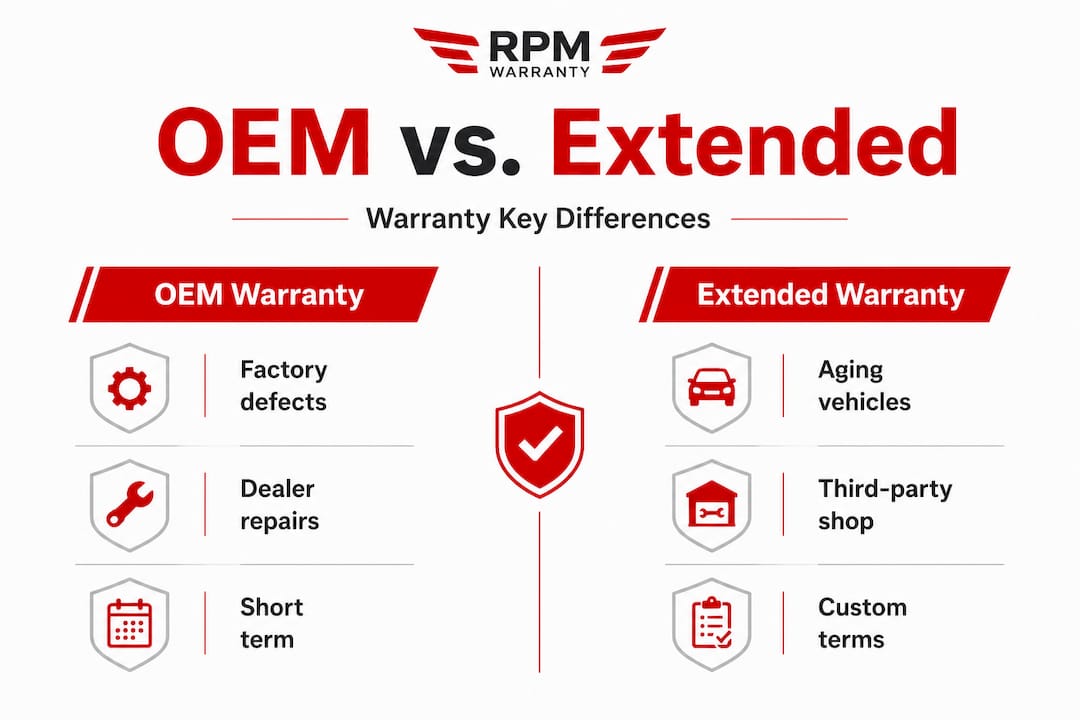
That said, extended coverage options fill a real gap once your OEM period ends. Defects do not stop happening at 36,001 miles, and not every driver has a fully funded repair emergency fund sitting ready.
Jalopnik research points out that OEM warranty coverage reduces repair costs during early ownership and motivates proper maintenance habits, which themselves extend vehicle life well beyond the warranty window.
Steps to evaluate whether you need extended coverage after your OEM expires:
- Research your specific vehicle's reliability ratings and average repair costs after 60,000 miles using sources like Consumer Reports or J.D. Power data
- Calculate the total cost of an extended plan, including the deductible structure and any exclusions that mirror OEM gaps
- Estimate your out-of-pocket risk by looking at average repair bills for your make and model in years five through ten
- Check whether the extended plan covers your most likely failure points such as electrical systems, cooling, or transmission depending on your vehicle's known weak spots
- If your vehicle has a strong reliability record and you can realistically save $100 to $150 per month, self-insuring may be the more financially sound path
Customizing your protection to match your actual risk profile, vehicle age, and budget is far smarter than buying the most expensive plan by default.
A fresh perspective on OEM vs. extended warranties
After weighing all the facts, here's a practical take that could change how you approach warranty coverage permanently.
Most of the conversation around warranties focuses on what gets covered. But experienced industry professionals focus on something different: claim frequency by vehicle brand, not by coverage tier. They tend to favor vehicles from manufacturers with lower per-unit defect rates, then apply rigorous maintenance schedules to keep those defect rates even lower. That combination, choosing reliable hardware and servicing it properly, reduces warranty claim likelihood more than any coverage upgrade.
The Consumer Reports finding that self-insuring often beats extended warranty purchases deserves to be taken seriously. The core reason is that most repairs after your OEM expires are classified as wear, not manufacturing defects. An extended warranty that excludes wear items leaves you paying a monthly premium for coverage that might never trigger. That's a poor financial trade for many owners.
The uncomfortable truth: A dedicated car repair fund that you build during your OEM warranty period, when your repair costs are near zero, will often outperform a $2,000 to $3,500 extended warranty purchase by the time you reach 100,000 miles.
That said, not everyone has the discipline or financial flexibility to self-insure effectively. And some vehicles, particularly those with complex electronics, turbocharged engines, or dual-clutch transmissions, carry genuinely elevated defect risk beyond 60,000 miles. In those cases, a well-structured extended plan with strong must-have protection features can absolutely justify the cost.
Pro Tip: Before purchasing any extended plan, pull your vehicle's historical repair data from a credible source, calculate what those repairs would cost you out of pocket over three years, and then compare that number directly to the total cost of the extended plan including deductibles. That math will tell you more than any sales pitch.
The best protection starts with being informed. Coverage is a tool, not a blanket security blanket.
Explore your top options for extended warranty coverage
Once your OEM warranty period ends, the financial exposure becomes real. A single transmission issue or electrical failure can cost more than an entire year of extended coverage payments. That's why having a clear next step matters.
RPM Warranty makes it straightforward to explore your options without pressure. You can explore protection plans across three coverage tiers, Elite, Advanced, and Essential, each designed for different budgets and vehicle needs. The process takes minutes: get a consultation, pick your plan, customize your deductible and terms, and confirm your agreement. If you're ready to see what coverage costs for your specific year, make, and model, get a free quote today. Still have questions? The extended warranty FAQs page covers the most common concerns about coverage, claims, and transferability in plain language.
Frequently asked questions
Does an OEM warranty cover every type of repair?
No, OEM warranties only cover defects in materials or workmanship and exclude wear items, routine maintenance, accidents, and misuse. The common exclusions list includes brakes, tires, filters, fluids, and batteries among the most frequently denied claims.
Are OEM warranties transferable if I sell my car?
Most OEM warranties are transferable to the next owner, but specific terms, transfer fees, and any remaining coverage depend entirely on the manufacturer's policy for your vehicle brand.
How do OEM warranties compare to third-party extended plans?
OEM warranties typically provide stronger legal protections, clearer terms, and require dealer repairs, while extended plans offer more shop flexibility but may cover fewer defect-based repairs. Consumer Reports data suggests OEM coverage remains superior in legal standing during its active period.
Does missing scheduled maintenance void my OEM warranty?
Yes, failure to perform manufacturer-recommended maintenance can void your OEM warranty for related repairs. The FTC confirms that coverage requires proper maintenance and normal use throughout the warranty period.
What repairs are most often claimed under OEM warranties?
The most common claims are for batteries, ABS sensors, and water pumps. Warranty claims data shows batteries lead at 2.47% of all claims, followed by ABS sensors at 2.43% and water pumps at 2.36%.