

TL;DR:
- Warranty support plays a crucial role in determining claim outcomes, from approval to dispute resolution.
- Proactive communication, thorough documentation, and understanding legal rights significantly improve the customer experience and loyalty.
Most car owners treat a warranty like a coupon. You tuck it away, forget about it, and only dig it out when something breaks. What they rarely think about is the person on the other end of the phone when that moment arrives. The role of customer support in warranties is not a background function. It is the mechanism that determines whether your claim gets approved quickly, gets stalled, or gets denied outright. Understanding how that support system works gives you a real advantage as a car owner, and the data behind it is more striking than most people expect.
Table of Contents
- Key takeaways
- The role of customer support in warranties
- How support quality shows up in the numbers
- Resolving disputes and handling difficult claims
- Legal frameworks that shape warranty support
- How follow-up recovery builds lasting loyalty
- My honest take on what actually matters here
- Protect your vehicle with Rpmwarranty
- FAQ
Key takeaways
| Point | Details |
|---|---|
| Support reps shape claim outcomes | Warranty representatives directly influence approval rates, cycle times, and your overall claims experience. |
| Proactive communication cuts friction | Proactive status updates reduce inbound customer inquiries by 40 to 60 percent, improving satisfaction scores. |
| Documentation wins disputes | Written denial reasons, technician notes, and photos are your best tools when a claim gets challenged. |
| Legal protections back you up | The Magnuson-Moss Warranty Act gives you the right to sue for warranty breaches, with attorney fees covered. |
| Recovery builds loyalty | Companies that demonstrate learning from service failures retain more customers than those who simply fix the immediate problem. |
The role of customer support in warranties
When you call a warranty provider about a broken transmission or a failing cooling system, you are not just reporting a problem. You are entering a process where the representative you reach has real influence over what happens next. A warranty customer service rep fields your inquiry, interprets the terms of your plan, coordinates with the repair facility, and often has direct input on whether a claim moves forward or gets flagged for review.
The scope of that role is wider than most people realize. Here is what a capable warranty support rep actually handles:
- Claim intake and initial review: Collecting vehicle details, repair documentation, and matching the complaint to covered components under your specific plan.
- Term interpretation: Translating warranty language into plain decisions. Is a turbocharger seal a covered "engine component" or an excluded wear item? That call often starts with a rep.
- Repair coordination: Contacting the service facility, confirming labor rates, and authorizing work so you are not stuck in a waiting room for days.
- Escalation routing: Identifying when a claim needs a supervisor, an adjuster, or a technical specialist and getting it there without losing momentum.
- Customer communication: Keeping you informed so you are not calling back every hour to ask what is happening.
Proactive reps do not just process paperwork. They catch mismatched part numbers before they cause a denial, flag incomplete documentation before it delays approval, and sometimes identify coverage you did not know you had. Warranty transformation has shifted from a back-office cost function to a front-line customer experience role, and the reps who understand that shift are the ones who move claims forward efficiently.
Pro Tip: When you first contact a warranty provider about a claim, ask the rep directly what documentation they need before the shop touches your vehicle. Getting that list upfront prevents the most common cause of claim delays.
How support quality shows up in the numbers
The difference between a well-supported warranty operation and a poorly run one is not subtle. It shows up in measurable ways that affect your time, your money, and your frustration level.
Top-performing warranty operations achieve sub-24-hour claim cycle times and significantly higher first-touch resolution rates than systems still running manual legacy processes. That means a customer calling a top-tier provider gets an answer and an approval in less than a day. A customer calling a slow operation might wait three to five days for the same outcome on the same type of claim.
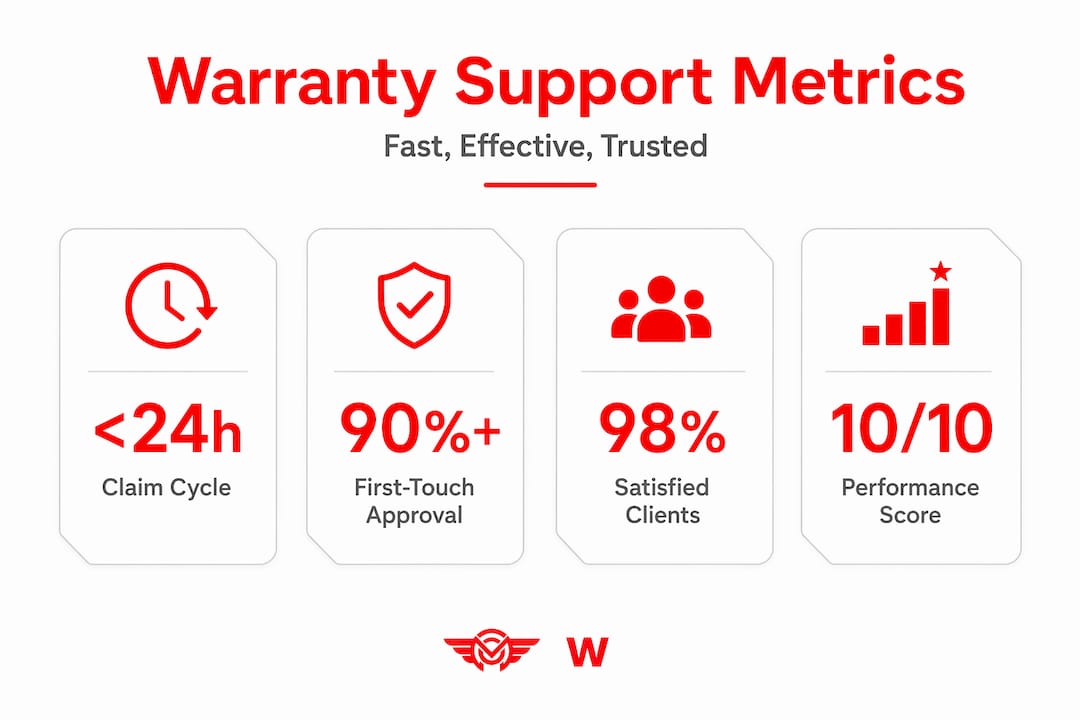
The table below shows how these performance gaps translate to real-world outcomes:
| Metric | High-performing operations | Legacy or underperforming operations |
|---|---|---|
| Claim cycle time | Under 24 hours | 3 to 5 days or longer |
| First-touch resolution rate | High, driven by trained reps | Low, requiring multiple callbacks |
| Inbound inquiry reduction | 40 to 60% lower with proactive updates | High, customers calling for status repeatedly |
| Customer satisfaction score | Significantly above benchmark | Below benchmark, often under 700 out of 1,000 |
Proactive communication is the biggest lever in that table. When customers receive status updates without having to ask, inbound inquiries drop 40 to 60 percent and satisfaction scores climb in parallel. You are not just receiving better service. You are receiving service that respects your time.
The JD Power U.S. Customer Service Index Study adds another layer to this. Meeting all 10 key performance indicators in dealership service produces near-perfect satisfaction scores of 979 out of 1,000. Drop below half of those KPIs and scores fall sharply. Wait times over two hours alone reduce satisfaction scores by 15 percent. Customer service in warranties is not a soft metric. It is a direct driver of whether you feel protected or abandoned by your coverage. Reading about must-have warranty features before you buy a plan can help you identify which providers are built for this standard.
Resolving disputes and handling difficult claims
Disputes happen in automotive warranty claims more often than providers advertise. Understanding why they happen and how to respond gives you leverage you would not otherwise have.

One of the most common friction points is the dealership itself. Dealers often prefer customer-pay repairs over warranty submissions because dealers may push customer-pay repairs to avoid the administrative burden of manufacturer pre-authorization paperwork. This is not always bad faith, but the result is the same. If you pay first, your leverage to get reimbursed later drops considerably.
Here is how to protect yourself and work effectively with customer support when a claim gets complicated:
- Refuse to authorize payment before pre-authorization. Tell the dealer you want the claim submitted to the warranty provider for manufacturer pre-authorization before any work begins. Your warranty customer support team can confirm this is standard practice.
- Request everything in writing. If a dealer tells you a repair is not covered, ask for that denial in writing. Verbal communications are insufficient in warranty disputes. A written denial with specific reasons is your starting point for escalation.
- Gather technician notes and photos. The diagnostic notes the technician writes and any photos of the failed component form the core of your dispute file. Without them, escalation to the manufacturer or a legal channel is far harder.
- Contact your warranty provider directly. If the dealership is the source of resistance, call your warranty provider's customer support line and describe exactly what the dealer said. A good rep will contact the dealer on your behalf and clarify coverage.
- Escalate formally if needed. Ask for a supervisor or claims review team. Document the date, time, and name of every rep you speak to. This record matters if you eventually need to involve a manufacturer or an attorney.
Pro Tip: Keep a dedicated folder, physical or digital, for every document related to your vehicle warranty. Add every receipt, authorization form, and repair order the moment you receive it. Gaps in documentation are the single most common reason valid claims get rejected at the escalation stage.
Legal frameworks that shape warranty support
The legal environment behind automotive warranties gives customer support teams a significant responsibility. When a rep helps you navigate a claim, they are operating within a defined legal structure that also gives you rights worth knowing.
The Magnuson-Moss Warranty Act is the federal law governing written warranties on consumer products, including vehicles. Under this law, customers can sue for warranty breaches and recover attorney fees through fee-shifting provisions, which means legal action is financially accessible even for smaller claims. Most cases are filed in state courts because federal jurisdiction thresholds are rarely met, but the right to pursue legal recourse exists and is exercised regularly.
The Federal Trade Commission reinforces this framework from a consumer protection angle. The FTC uses consumer complaints to identify deceptive warranty practices across the industry. That enforcement capacity is real. The agency reached a $10M settlement against CarShield for deceptive advertising, demonstrating that regulatory consequences for misleading warranty claims are not hypothetical.
Well-trained warranty support teams understand this legal context. They know that:
- Warranty terms must be available before purchase, not just at the point of claim.
- Exclusions must be clearly disclosed, not hidden in technical language.
- Denials must be grounded in the actual terms of the agreement, not convenience.
- Consumers have the right to escalate, dispute, and seek legal remedy.
"Consumers who document every interaction and understand their rights under the Magnuson-Moss Warranty Act are in a fundamentally stronger position than those who accept verbal denials at face value."
Learning about automotive warranty transparency before you sign a contract is one of the best ways to make sure your support team is working within a framework you understand and can hold them to.
How follow-up recovery builds lasting loyalty
Here is something most warranty providers do not talk about publicly. A customer who experiences a service failure and sees the company genuinely respond to it often ends up more loyal than a customer who never had a problem at all. This is the service recovery paradox, and it has direct implications for how warranty customer support should operate.
The research is specific. Follow-up recovery combined with demonstrated organizational learning strongly improves customer satisfaction by reducing anger and raising perceived trust. The key phrase is "organizational learning." Customers do not just want the immediate problem fixed. They want evidence that the company changed something so the problem does not happen to the next person.
What this looks like in practice for warranty support:
- Post-resolution follow-up calls. A rep calling three days after a claim closes to confirm the repair held signals that the company's interest in you did not end with payment.
- Transparent process updates. When a systemic issue causes delays, telling customers directly that the company identified the gap and is fixing it converts frustration into trust.
- Escalation feedback loops. When a customer dispute reveals a flaw in how claims are processed, a well-run support team feeds that back into training and policy.
- Personalized acknowledgment. A form email does not build loyalty. A rep who references your specific situation and explains what changed does.
Consumer loyalty after service failures depends more on demonstrated improvement than on the speed of the initial fix. Speed matters, but it is not the whole story. Car owners who see a warranty provider respond to a poor experience with genuine process change are far more likely to renew coverage and recommend the provider to others. This is why the benefits of support in warranties extend well beyond the individual claim. It is the foundation of the entire customer relationship.
My honest take on what actually matters here
I have spent a lot of time watching how car owners interact with warranty providers, and the pattern that frustrates me most is the assumption that a warranty is a passive document. People buy coverage, file it away, and expect it to work like a vending machine when something goes wrong. It rarely does, and when it does not, they assume the warranty was bad.
What I have seen more often is that the warranty was fine. The interaction was the problem. Customers who do not push back on verbal denials, who authorize payment before pre-authorization, who throw away technician notes because they look like unimportant paperwork. These are the people who end up feeling like their warranty failed them, when the real gap was in how they engaged with the support process.
The flip side is also true. I have seen customers with modest coverage plans get full repairs approved because they knew to ask the right questions, document everything, and escalate at the right moment. The importance of support in warranties is not just about what the provider does. It is about what you do with the access you have. Engage the rep, use the escalation process, and treat every claim like it matters. Because it does.
— Kenneth
Protect your vehicle with Rpmwarranty
When coverage matters, the quality of support behind it matters just as much as the plan itself. Rpmwarranty is trusted by dealers nationwide and built around the principle that customers should never have to fight for what they are owed.
Rpmwarranty's plans cover engines, transmissions, electrical systems, cooling systems, and high-tech components, with roadside assistance included. The claims process is direct, the coverage is clear, and the support team is trained to move claims forward without unnecessary friction. Whether you drive a BMW, a Range Rover, a Mercedes, or a Honda, there is a plan designed for your vehicle and your budget. Get your free warranty quote today and see exactly what protection is available for your vehicle. Explore the full range of extended warranty plans and choose coverage with confidence.
FAQ
What does warranty customer support actually do?
Warranty customer support representatives handle claim intake, interpret coverage terms, coordinate with repair facilities, and escalate complex cases. Their decisions directly affect how quickly and successfully your claim gets resolved.
How does customer support affect claim approval rates?
Top-performing support operations achieve sub-24-hour claim cycle times and significantly higher first-touch resolution rates than manual systems, meaning faster approvals and fewer repeat contacts for customers.
What should I do if a dealer refuses a warranty repair?
Refuse to authorize payment before the dealer submits the claim for manufacturer pre-authorization. Request any denial in writing and contact your warranty provider's customer support team directly to escalate the situation.
Can I take legal action if my warranty claim is wrongfully denied?
Yes. Under the Magnuson-Moss Warranty Act, you can sue for breach of warranty and recover attorney fees through fee-shifting provisions, making legal recourse financially accessible even for smaller claims.
Why do proactive updates from warranty support matter so much?
Proactive status communications reduce inbound customer inquiries by 40 to 60 percent and are directly correlated with higher satisfaction scores, according to claims processing benchmarks in the warranty industry.