

TL;DR:
- Warranty start dates are based on original in-service date, not purchase date, reducing coverage time.
- Proper maintenance and documentation are crucial to avoid claim denial and ensure warranty validity.
- Understanding exclusions and claim procedures helps vehicle owners maximize warranty benefits and avoid surprises.
Most vehicle owners assume that having a warranty means repairs are covered. That assumption is exactly what warranty providers count on. The reality is that coverage limits are often tied to time and mileage from the original in-service date, not your purchase date, which means the clock may already be running out before you even drive off the lot. Missed deadlines, overlooked exclusions, and skipped maintenance records are the three most common reasons claims get denied. This article walks you through every layer of your contract so you never face a surprise repair bill.
Table of Contents
- The hidden fine print: What most owners overlook
- Essential maintenance and documentation: Your role in staying covered
- What's really covered (and not): Exclusions, parts, and complexity
- Claims, pre-authorization, and repair shop rules: Navigating the process
- "Fit for purpose": How contract choice and review ensure real value
- What most drivers get wrong about warranty contracts
- Get confidence from the right warranty contract
- Frequently asked questions
Key Takeaways
| Point | Details |
|---|---|
| Coverage isn’t automatic | Warranty limits and exclusions mean coverage may not last as long as you think. |
| Maintenance is mandatory | Keep up with required service and accurate documentation to avoid denied claims. |
| Read the fine print | Know what’s really included and excluded before relying on your contract. |
| Filing claims is nuanced | Pre-authorization steps and repair shop rules can impact whether repairs are approved or reimbursed. |
| Match contract to your needs | The best value comes from contracts that fit your vehicle’s age, risk, and technology. |
The hidden fine print: What most owners overlook
Now that we've previewed the risks of ignoring your warranty's details, let's dig into the fine print that often catches owners off guard.
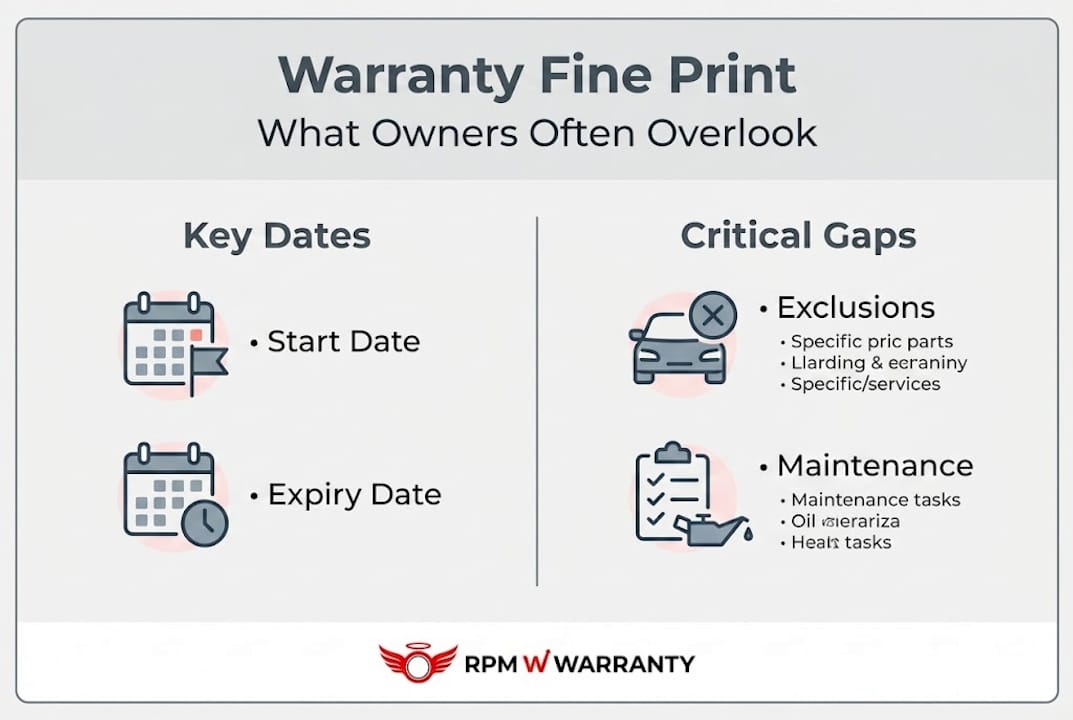
The single most misunderstood element of any warranty contract is the start date. Warranty coverage limits are measured from the original in-service date, not your purchase date. That distinction can cost you years of protection you thought you had.
Here's a real-world example that illustrates the problem clearly. Imagine buying a used vehicle advertised as having "5 years remaining" on a 7-year powertrain warranty. You check the paperwork and the car was first registered three years ago. You actually have four years left, not five. If the seller rounded up or made an honest mistake, you could be budgeting for coverage that expires sooner than planned. Worse, if the mileage is already at 55,000 on a 60,000-mile limit, you may have weeks of coverage left, not years.
Common contract details owners miss at signing:
- The exact in-service date and corresponding mileage cap
- Whether the warranty is transferable to a new owner (and at what cost)
- Which components fall under exclusionary warranty coverage versus what is specifically listed as included
- Clauses that void coverage if modifications are made to the vehicle
- Geographic restrictions that affect roadside assistance or towing benefits
"Many buyers focus on the brand name of the warranty rather than the actual terms inside the contract. By the time they need it, they discover the coverage they assumed was there simply isn't."
The table below shows how dramatically the effective coverage window can shrink depending on when you buy a used vehicle:
| Vehicle age at purchase | Warranty term | Effective coverage remaining |
|---|---|---|
| 1 year old | 5 years / 60,000 miles | Up to 4 years |
| 3 years old | 5 years / 60,000 miles | Up to 2 years |
| 4 years old | 5 years / 60,000 miles | Possibly expired |
| 2 years old | 7 years / 100,000 miles | Up to 5 years |
Reading the Consumer Reports guidance on warranty start dates before you finalize any used vehicle purchase is a straightforward step that can save you thousands.
Essential maintenance and documentation: Your role in staying covered
Beyond just reading the terms, you also need to understand your active responsibilities under the contract.

A warranty is not a passive safety net. It is a contract with conditions, and you are responsible for meeting those conditions every single time. Many contracts require scheduled maintenance and documentation, and missing even one requirement can jeopardize your ability to file a successful claim.
Step-by-step: What you must do to stay covered
- Read the maintenance schedule in your contract, not just the manufacturer's guide. Some extended warranties have stricter intervals than the factory recommendation.
- Use a qualified service facility for every oil change, tire rotation, and fluid check. Some contracts require work to be performed at a licensed shop, not a DIY job in your driveway.
- Save every receipt and service record, including the date, mileage, type of service, and the name of the facility. A handwritten note is not enough.
- Log mileage at each service visit so there are no gaps in your timeline. A claim reviewer will look for continuity.
- Check your contract before any major repair to confirm whether pre-authorization is required before work begins.
Missing a single oil change at the required interval can give a warranty provider grounds to deny a claim if the resulting engine failure is linked to that lapse. It sounds harsh, but it is written into most contracts. The extended warranty maintenance laws vary by state, but the documentation burden almost always falls on the vehicle owner.
Pro Tip: Create a dedicated folder, physical or digital, for every service receipt. Label it by vehicle and year. When a claim comes up, you want to hand over a clean paper trail in minutes, not spend hours hunting for records.
Understanding which vehicle protection features your contract actually includes makes it easier to know which maintenance tasks are non-negotiable. Some plans also reward consistent maintenance with smoother claims processing, which is a direct benefit of staying organized. Reviewing the car warranty features that matter most before you sign helps you set the right habits from day one.
What's really covered (and not): Exclusions, parts, and complexity
Understanding your maintenance obligations is only part of the puzzle. You still need to know what your contract actually covers and where it falls short.
The most common source of claim disputes is the gap between what owners think is covered and what the contract actually lists. Warranties often do not cover maintenance items like tires and brake pads, or failures that result from improper maintenance. These are standard exclusions, but they surprise people every year.
Commonly excluded items across most warranty plans:
- Brake pads, rotors, and shoes (considered wear items)
- Tires and wheels
- Wiper blades, filters, and belts
- Cosmetic damage including paint, upholstery, and trim
- Damage caused by accidents, floods, or environmental events
- Failures traced to modifications or aftermarket parts
Modern vehicles add another layer of complexity. Advanced driver assistance systems (ADAS), which include features like lane-keeping assist, automatic emergency braking, and adaptive cruise control, are expensive to repair and not always clearly addressed in older contract language. If your vehicle has these systems, you need to confirm explicitly whether sensors, cameras, and control modules are included.
| System | Typically covered | Typically excluded |
|---|---|---|
| Engine internals | Yes (most plans) | Damage from oil neglect |
| Transmission | Yes (most plans) | Fluid service items |
| Electrical systems | Varies by plan | Fuses, bulbs, wiring wear |
| ADAS sensors | Advanced plans only | Calibration after collision |
| Brake components | Hydraulics only | Pads, rotors, shoes |
| Cooling system | Yes (most plans) | Hoses and belts |
Pro Tip: Read the exclusions section of your contract before you read anything else. Most people read the coverage highlights and stop there. The exclusions section is where the real terms live.
For a detailed breakdown of what falls outside typical contracts, the KBB warranty exclusions guide is a reliable starting point. You can also review what's excluded from warranty in more detail, or explore engine coverage explained to understand exactly how powertrain protection is structured. If you drive a newer model, checking advanced warranty coverage options is especially worthwhile.
Claims, pre-authorization, and repair shop rules: Navigating the process
Once you know what's covered and what isn't, the next issue is how those benefits play out when you actually need to file a claim.
Filing a warranty claim is not as simple as dropping your car off and waiting for a call. Authorization workflow, approved facilities, and deductible structure can all affect whether you actually benefit from a contract when something goes wrong.
How the claims process typically works:
- Contact your warranty provider before authorizing any repairs. Most contracts require pre-authorization. If the shop starts work before you call, the claim may be denied entirely.
- Confirm the repair facility is in the approved network. Some contracts restrict you to specific shops or dealer service centers.
- Get a written diagnosis from a licensed technician. The warranty company will often require a formal repair order before approving coverage.
- Understand your deductible structure. Some contracts charge a deductible per visit, while others charge per repair item. If you have three separate issues fixed in one visit, you could owe three deductibles.
- Follow up in writing. Keep records of every conversation with your warranty provider, including dates, names, and what was discussed.
"The biggest mistake owners make is assuming the shop handles the warranty process for them. You are the policyholder. The responsibility to initiate and follow up on a claim is yours."
Deductible structures deserve more attention than they usually get. A "per visit" deductible means you pay once regardless of how many repairs happen during that appointment. A "per repair item" deductible means each individual fix carries its own cost. On a complex repair involving multiple systems, the difference can be hundreds of dollars out of pocket.
Knowing when a warranty really matters helps you decide whether your current contract is worth renewing or whether a different structure would serve you better. Understanding post-factory warranty choices is especially useful once your manufacturer coverage expires.
"Fit for purpose": How contract choice and review ensure real value
Beyond just understanding coverage, there's an opportunity: choosing the right contract can actively protect your finances.
Not every warranty is a good deal for every vehicle. Some consumers benefit greatly from extended coverage when the contract matches the vehicle's actual risk areas and the pricing reflects realistic repair costs. Others overpay for coverage on reliable vehicles that rarely need major work.
When extended coverage tends to be a strong value:
- Vehicles with complex electronics, turbocharged engines, or dual-clutch transmissions
- High-mileage vehicles approaching the end of factory coverage
- Owners who plan to keep the vehicle for five or more years
- Anyone who cannot absorb a $3,000 to $6,000 repair bill without financial stress
When extended coverage may not be worth the cost:
- Vehicles with strong reliability track records and low repair histories
- Owners who are about to sell or trade in within the next 12 months
- Contracts with so many exclusions that few real-world repairs would qualify
The 2025 J.D. Power vehicle dependability research reinforces that satisfaction depends not just on coverage but on how repairs are handled and approved during service. A plan that looks affordable on paper can become frustrating if the claims process is slow or the approved shop network is limited.
Pro Tip: Before signing any extended warranty, list the top three systems most likely to fail on your specific make and model. Then check whether those systems are explicitly covered in the contract you're considering. If they aren't, keep shopping.
Comparing bumper-to-bumper vs powertrain coverage side by side is one of the most practical steps you can take to find the right fit for your vehicle and budget.
What most drivers get wrong about warranty contracts
With all the practical details in mind, let's step back and consider the real-world lessons veteran owners and industry experts wish more people knew.
Most drivers treat a warranty like a smoke alarm. They install it, forget about it, and only think about it when something goes wrong. That mindset is exactly why so many claims get denied. The contract was there. The coverage was real. But the owner never read it closely enough to use it correctly.
The drivers who get the most value from their warranty contracts are the ones who treat the review process like routine maintenance. They read the terms when they sign. They check the exclusions before any major repair. They keep their service records organized and current. They ask questions before assuming coverage exists.
There's also a deeper issue worth naming. Many owners feel intimidated by contract language and avoid reading it as a result. That avoidance is understandable, but it is expensive. You don't need a law degree to understand a warranty contract. You need patience and a highlighter. Mark the exclusions. Mark the maintenance requirements. Mark the claims process steps. Those three sections contain everything that determines whether your contract works for you or against you.
Reviewing rules that void a warranty is one of the most overlooked steps in the entire process. Modifications, missed service intervals, and unauthorized repairs are the most common reasons coverage disappears. Knowing them in advance costs nothing. Discovering them after a denied claim costs plenty.
The mindset shift is simple: don't just check a box when you sign. Actively compare, clarify, and ask questions. A warranty is only as good as your understanding of it.
Get confidence from the right warranty contract
Ready to take control of your coverage and avoid the most common warranty mistakes? Reviewing your options doesn't have to be overwhelming, especially when you have the right tools and support behind you.
At RPM Warranty, we make it straightforward to find, review, and customize a plan that actually fits your vehicle and your budget. Whether you drive a high-tech SUV or a high-mileage sedan, our Elite, Advanced, and Essential plans are built to match real-world coverage needs, not just headline promises. You can get free warranty quotes in minutes, compare coverage side by side, and get clear answers on exclusions before you commit. Our team is here to help you understand every term so there are no surprises when you need us most.
Frequently asked questions
Why does the start date of my warranty matter?
Warranties often begin on the vehicle's original in-service date, not your purchase date, so coverage time may already be partially used before you sign anything.
What documentation do I need to keep my warranty valid?
You need to keep records of all scheduled maintenance and repairs. Contracts require that you follow scheduled maintenance and retain proof of every service visit.
Are all types of repairs covered by standard auto warranties?
Most warranties exclude maintenance items like brake pads and tires. Warranties do not cover failures caused by improper maintenance or normal wear and tear.
What happens if I use a repair shop that is not approved by my warranty?
Using an unauthorized facility can result in a denied claim. Contracts may restrict repair shop choice and require prior authorization before any work begins.
Is it worth getting an extended warranty for a vehicle with advanced features?
Extended warranties can offer strong value for vehicles with complex electronics and ADAS. Modern electronics can complicate claims, making tailored coverage especially important for recent-model vehicles.