

TL;DR:
- A vehicle eligibility check verifies if a specific vehicle qualifies for programs like warranties, tax credits, or emissions standards. The process depends on criteria such as VIN accuracy, model year, price caps, mileage, and documentation, which vary by program and require careful, official confirmation. Failing to properly perform or update these checks can lead to costly surprises, missed benefits, or registration and warranty issues.
A vehicle eligibility check is the process used to verify whether a specific vehicle qualifies for a defined program, benefit, or requirement, such as an extended warranty, financing approval, government tax credit, or emissions compliance. This verification process matters whether you are buying a BMW 5 Series, a Mercedes-Benz GLE, or a used Honda Accord, because the outcome directly affects your costs, coverage, and legal standing. Understanding what a vehicle eligibility check involves, and how to run one correctly, protects your investment before you sign anything.
What is a vehicle eligibility check and why does it matter?
A vehicle eligibility check is a structured verification process that confirms whether a car meets the specific criteria required by a program, lender, insurer, or regulator. The check is not a single universal test. It is a program-specific gate that uses defined data points to approve or reject a vehicle's participation.

The criteria assessed during a vehicle eligibility check vary by program but typically include the Vehicle Identification Number (VIN), model year, make and trim level, mileage, sale price, warranty status, and emissions compliance. A vehicle qualification check in California's CARB purchase incentive programs, for example, requires the vehicle to appear on an official eligible vehicles list and meet price caps based on vehicle category. That means a Porsche Taycan and a Ford Mustang Mach-E may both be electric vehicles, but only one might qualify for a specific incentive depending on its MSRP and configuration.
The practical stakes are high. Eligibility checks determine whether you receive a tax credit, whether your warranty claim gets honored, whether a lender approves your financing, and whether your vehicle passes registration. Getting the check right before you commit to a purchase or a plan saves you from expensive surprises later. Finance platforms rely on structured vehicle identifiers and eligibility factors rather than buyer intent alone to approve transactions, which means the vehicle itself must qualify, not just the buyer.
What criteria are used in vehicle eligibility checks?
Vehicle eligibility criteria fall into several categories, and each program weighs them differently. Knowing which factors apply to your situation helps you prepare the right documentation and avoid delays.
VIN and model verification is the starting point for almost every check. The VIN encodes the manufacturer, model, engine type, and production year. Programs use it to confirm the vehicle is what the seller claims it is. However, eligibility often depends on vehicle variant and configuration rather than just the VIN. Two BMW X5 units built in the same year can differ in trim, battery configuration, or emissions rating, and only one may qualify for a specific program.
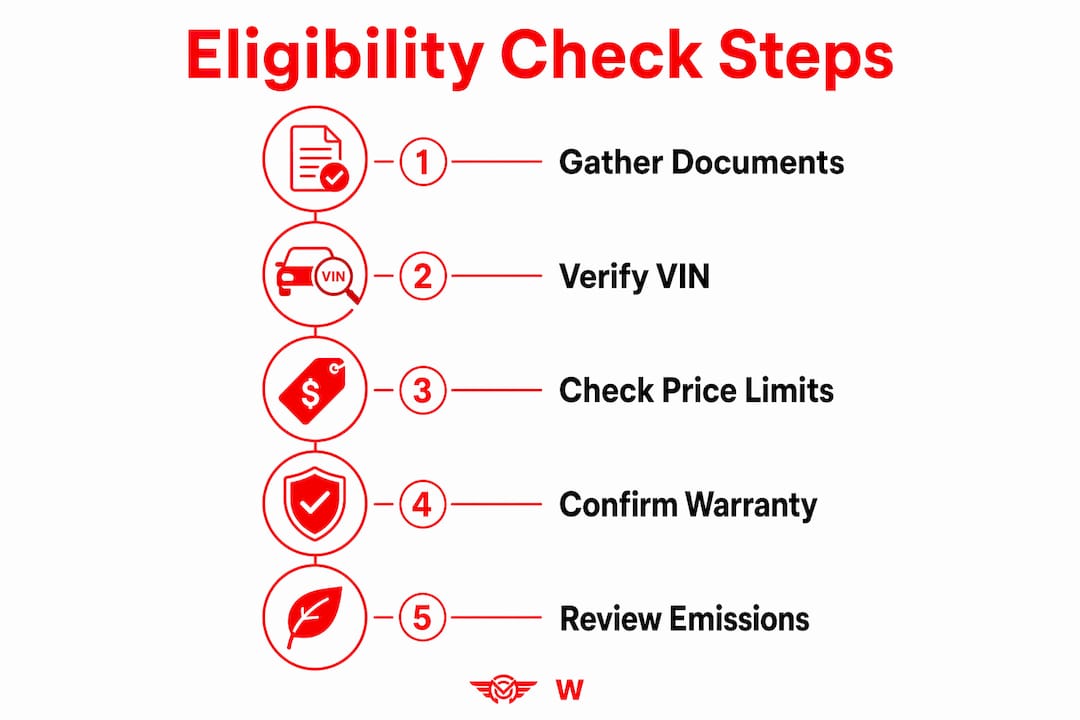
Price and MSRP caps are common in government incentive programs. The IRS used clean vehicle credit sets a sale price limit of $25,000, and the model year must be at least two years before the purchase year. This means a 2023 vehicle becomes eligible for the used credit in 2025 at the earliest. Buyers who overlook this detail lose the credit entirely.
Warranty status and transferability matter significantly for extended warranty eligibility. Factors like mileage, age, and transfer rules all affect whether a vehicle qualifies for a new plan or retains its existing coverage. A Range Rover Sport with 85,000 miles may face different eligibility thresholds than the same model at 40,000 miles. You can learn more about how vehicle age affects warranty options before starting the process.
Emissions and environmental standards apply to registration and regulatory compliance. California's Bureau of Automotive Repair requires a smog check for most gasoline vehicles older than eight model years, required biennially for registration renewal and on ownership change. Newer vehicles are exempt, but the rule catches many buyers off guard when they transfer a used Mercedes-Benz C-Class or a Ford F-150 that falls outside the exemption window.
Documentation and reporting requirements are often the most overlooked criteria. The IRS requires dealers to report the transaction to the IRS at the point of vehicle possession for the used clean vehicle credit. Missing this step makes an otherwise eligible vehicle ineligible in practice.
Here is a summary of the key criteria categories:
- VIN and vehicle configuration verification
- Model year and age requirements
- MSRP or sale price caps
- Mileage thresholds
- Warranty status, transferability, and remaining coverage
- Emissions compliance and smog test results
- Dealer or manufacturer reporting and documentation timing
Pro Tip: Gather your VIN, purchase invoice, warranty documentation, and emissions records before starting any eligibility check. Programs that require dealer reporting, like the IRS used clean vehicle credit, can disqualify you if the paperwork is not submitted at the right moment.
How do vehicle eligibility checks differ by program and purpose?
The vehicle eligibility process changes significantly depending on what you are trying to qualify for. A check for an extended warranty looks nothing like a check for a government tax credit, and both differ from a smog compliance check. Understanding these differences prevents you from applying the wrong process to the wrong situation.
The table below compares four common program types:
| Program type | Primary criteria | Key documentation | Timing requirement |
|---|---|---|---|
| Purchase incentive (CARB) | MSRP cap, eligible vehicles list, VIN | Dealer invoice, vehicle spec sheet | At point of purchase |
| IRS used clean vehicle credit | Sale price under $25,000, model year, battery capacity | Dealer IRS report, purchase agreement | At vehicle possession |
| Extended warranty eligibility | Mileage, age, VIN, warranty transferability | Warranty statement, service history | Before plan activation |
| Emissions/smog compliance | Vehicle age, fuel type, model year | Smog certificate, registration records | At registration renewal or ownership transfer |
Purchase incentive programs like CARB's ZEV list use a pre-approved eligible vehicles list where vehicles must appear by name and configuration. A vehicle not on the list is ineligible regardless of its actual emissions performance. This is a critical distinction. The list is updated regularly, so a Porsche Taycan trim that qualified last quarter may not qualify this quarter if CARB revises its price cap thresholds.
The UK's Electric Car Grant program takes a two-stage approach. The Vehicle Certification Agency (VCA) and the Office for Zero Emission Vehicles (OZEV) conduct both technical and environmental assessments. The outcome determines grant tier or full ineligibility, and the criteria include warranty terms and zero-emission range. This illustrates why gathering correct evidence is not optional. It is the difference between receiving a grant and receiving nothing.
Extended warranty eligibility checks work differently from government programs. A VIN-based warranty lookup identifies possible basic, powertrain, and extended coverage, but final confirmation depends on mileage, age, exclusions, and transfer rules. Owners of a Mercedes-Benz E-Class or a BMW 7 Series should always confirm coverage directly with the warranty provider rather than relying solely on a VIN report. The VIN lookup is a triage tool, not a binding confirmation.
Pro Tip: When checking warranty eligibility for a used vehicle, request a written coverage confirmation from the warranty provider. A VIN report tells you what coverage may exist. A written statement tells you what coverage actually applies to your specific vehicle and situation.
What are common misconceptions about vehicle eligibility checks?
Several persistent misunderstandings cause buyers and owners to lose benefits, face registration delays, or discover their warranty claim is denied. These are the most common ones worth addressing directly.
Assuming the VIN lookup is the final answer is the most frequent mistake. A VIN search through a third-party tool or manufacturer portal shows what coverage was originally issued. It does not confirm that coverage transfers to a new owner, that mileage thresholds have not been exceeded, or that the policy has not lapsed. VIN-based warranty checks are starting points, not conclusions.
Overlooking dealer reporting obligations costs buyers real money. For the IRS used clean vehicle credit, the dealer must report the transaction to the IRS at the moment of vehicle possession. If the dealer fails to do this, or if the buyer takes possession before the report is filed, the credit is lost. Dealer reporting at possession is mandatory, and no amount of vehicle eligibility after the fact can recover a missed filing.
Treating eligibility as a one-time check creates problems when programs update their criteria. CARB revises its eligible vehicles list. The IRS adjusts credit rules. Warranty providers update their mileage and age thresholds. A vehicle that qualified six months ago may not qualify today under the same program.
Here are additional pitfalls to watch for:
- Assuming a vehicle qualifies for all programs because it qualified for one. Eligibility is program-specific, and a Honda CR-V Hybrid may qualify for a state rebate but not a federal credit due to different price or configuration rules.
- Ignoring state-level variation. Smog check requirements differ between California, Texas, and states with no emissions testing at all. Buying a used Range Rover Defender in a non-testing state and then moving to California triggers a compliance check you may not have planned for.
- Misreading warranty lookup results as confirmed coverage. Warranty status shown online reflects original issuance. Transferability, exclusions, and remaining term require direct confirmation with the provider.
- Skipping documentation review before purchase. Sellers sometimes present incomplete service records or warranty paperwork that does not support the eligibility claim being made.
How to perform a vehicle eligibility check step by step
Running a vehicle eligibility check correctly requires a methodical approach. The steps below apply whether you are checking for warranty coverage, a tax credit, or emissions compliance.
-
Identify the specific program or requirement. Determine exactly what you are checking eligibility for. A warranty check, a CARB incentive check, and an IRS tax credit check each use different tools and criteria. Starting with the wrong process wastes time and produces misleading results.
-
Locate the official program website or eligibility tool. Use the program's own verification resource. For CARB incentives, use the official CARB eligible vehicles list. For IRS credits, use the IRS website directly. For warranty status, use the manufacturer's VIN lookup portal or contact the warranty provider. Third-party aggregators can be useful for initial research, but official sources are the only reliable confirmation.
-
Gather your vehicle's core information. You need the full 17-character VIN, the model year, make, trim level, current mileage, and purchase price. For warranty checks, also collect any existing warranty documentation, service records, and the original purchase invoice.
-
Submit the information accurately and completely. Errors in VIN entry or model year produce incorrect results. Double-check every field before submitting. For programs with documentation uploads, use clear, legible copies of all required files.
-
Confirm dealer or manufacturer reporting obligations. For programs like the IRS used clean vehicle credit, verify that the dealer has completed their reporting requirement before you take possession. Do not assume this step has been handled. Ask for written confirmation.
-
Request written confirmation of eligibility. A screen showing "eligible" is not a binding document. Request a written eligibility confirmation, coverage statement, or program approval letter. This protects you if a dispute arises later.
-
Monitor for program updates. Eligibility criteria change. Set a reminder to recheck eligibility if your purchase or plan activation is more than 30 days away from when you first ran the check. This applies especially to CARB lists, IRS rules, and warranty provider thresholds.
For ongoing warranty eligibility, reviewing essential vehicle protection features helps you understand what coverage criteria matter most for your specific vehicle type and usage pattern.
Key takeaways
A vehicle eligibility check is a program-specific verification process, and the outcome depends on VIN, mileage, model year, price, documentation timing, and the specific rules of each program.
| Point | Details |
|---|---|
| Eligibility is program-specific | A vehicle may qualify for one benefit and be rejected by another due to different criteria. |
| VIN lookup is a starting point | Final warranty coverage requires written confirmation from the provider, not just a VIN report. |
| Documentation timing is critical | IRS tax credit eligibility requires dealer reporting at possession; missing this step voids the benefit. |
| Criteria include more than specs | Price caps, emissions compliance, and warranty transferability all affect whether a vehicle qualifies. |
| Recheck before activating any plan | Program criteria change; an eligibility check from months ago may no longer reflect current rules. |
Why I think most buyers underestimate the eligibility check
Most car buyers treat the eligibility check as a formality. They run a quick VIN lookup, see a green checkmark, and assume the work is done. In my experience, that assumption is where the expensive surprises begin.
The part that catches people off guard is not the vehicle itself. It is the process around the vehicle. A BMW X3 or a Mercedes-Benz GLC can be perfectly eligible on paper and still fail to qualify for a tax credit because the dealer did not file the IRS report at the right moment. The vehicle did not change. The paperwork did. That distinction costs buyers thousands of dollars, and it is entirely preventable with one phone call before taking possession.
What I have also seen is buyers treating eligibility as binary. Either the car qualifies or it does not. The reality is more layered. A vehicle may qualify for a state rebate but not a federal credit. It may qualify for an extended warranty at 60,000 miles but not at 62,000. These thresholds are not arbitrary. They reflect real risk calculations by the programs and providers involved. Respecting those thresholds, rather than assuming they do not apply to you, is the mark of a buyer who protects their investment.
The complexity of eligibility checks is only growing. Emissions standards, EV incentive rules, and warranty criteria are all evolving faster than most buyers track. The practical answer is to verify early, verify officially, and get everything in writing. That approach works for a Ford Explorer, a Porsche Cayenne, or any vehicle in between.
— Kenneth
How Rpmwarranty helps you navigate warranty eligibility
Knowing whether your vehicle qualifies for extended coverage should not require hours of research across multiple websites. Rpmwarranty simplifies the process by matching your vehicle's year, make, and model against coverage criteria across its Elite, Advanced, and Essential warranty plans.
Whether you drive a Range Rover Sport, a Honda Pilot, or a BMW 3 Series, Rpmwarranty's team walks you through the eligibility process and identifies the right plan for your vehicle's age and mileage. Coverage includes engines, transmissions, cooling systems, electrical systems, and high-tech components, backed by a nationwide dealer network. Get a free quote through Rpmwarranty's extended warranty plans and confirm your vehicle's eligibility today before your manufacturer coverage expires.
FAQ
What does a vehicle eligibility check verify?
A vehicle eligibility check verifies whether a specific vehicle meets the criteria required by a program, such as a warranty plan, government tax credit, purchase incentive, or emissions regulation. The check typically uses the VIN, model year, mileage, sale price, and documentation status to confirm qualification.
How do I check vehicle eligibility for a warranty?
Start with the manufacturer's VIN lookup tool to identify existing coverage, then contact the warranty provider directly for written confirmation of transferability, remaining term, and mileage limits. A VIN-based warranty check is a useful first step but does not replace official written confirmation.
Can a vehicle qualify for one program but not another?
Yes. Eligibility is program-specific, meaning a vehicle may meet the criteria for a state purchase incentive but fail to qualify for a federal tax credit due to different price caps, model year rules, or configuration requirements. Always check each program separately using its official eligibility tool.
What happens if dealer reporting is missed for a tax credit?
If the dealer does not report the transaction to the IRS at the point of vehicle possession, the buyer loses the used clean vehicle credit regardless of whether the vehicle itself meets all other eligibility criteria. Confirming dealer reporting before taking possession is a mandatory step, not optional.
Does vehicle age affect extended warranty eligibility?
Vehicle age directly affects extended warranty eligibility. Most providers set thresholds based on model year and mileage, and a vehicle that exceeds those limits may be ineligible for certain plans or face higher premiums. Reviewing how age impacts warranty eligibility before shopping for coverage helps you identify the right plan before your options narrow.