

TL;DR:
- Updating vehicle warranty information requires owners to proactively notify administrators, especially for extended and CPO plans, to avoid claim denials. Proper preparation involves gathering essential documents like VIN, proof of ownership, and maintenance records before submitting transfer forms within specific deadlines. Failing to follow these steps or confusing registration updates with warranty transfers can result in costly coverage issues and claim rejections.
Updating vehicle information for warranty purposes is the process of formally notifying your warranty provider that ownership, address, or vehicle details have changed so your coverage remains valid and enforceable. Many vehicle owners assume this happens automatically, but factory warranties link by VIN while extended and Certified Pre-Owned warranties almost always require manual action from you. Miss the deadline or skip the paperwork, and a claim denial is the likely result. Whether you drive a BMW 5 Series, a Mercedes-Benz GLE, a Range Rover Sport, or a Honda Accord, the steps to update your warranty records follow the same core logic. This guide walks you through every stage of the vehicle warranty registration process so your coverage never has a gap.
How to update vehicle information for warranty: what you need to know first
Not every warranty works the same way, and the update requirements depend entirely on the type of coverage you hold. Getting this distinction right is the first step in the warranty information update process.

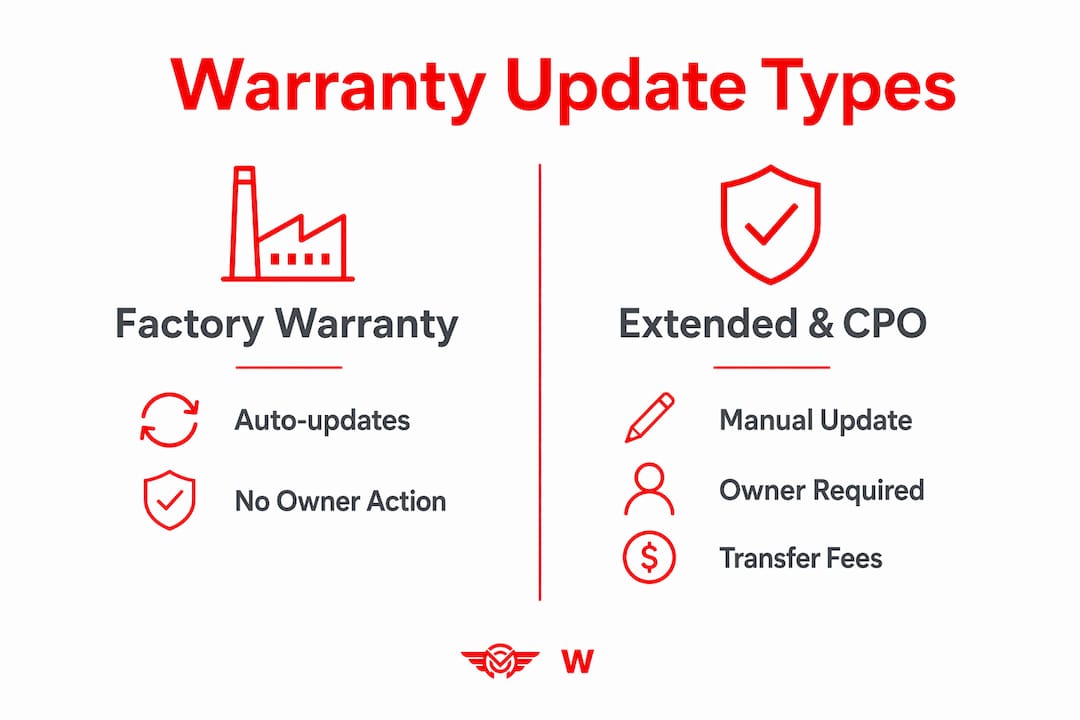
Factory warranties are tied directly to the vehicle identification number. When BMW, Mercedes-Benz, Ford, or Honda sells a new vehicle, the manufacturer's warranty attaches to the VIN automatically. A new owner who checks coverage through the manufacturer's portal will typically see the remaining factory warranty without any manual registration. Factory warranties need no manual update because the VIN carries the coverage record.
Extended warranties and third-party service contracts operate differently. These are sold by dealers, independent warranty administrators, or companies like Rpmwarranty, and they are tied to a contract number linked to a named owner. When ownership changes or your contact details shift, the contract does not update itself. You must contact the warranty administrator directly and submit updated information.
Certified Pre-Owned warranties sit between the two. A CPO warranty from a manufacturer such as Porsche or Mercedes-Benz is more formal than a third-party contract but still requires the new owner to complete a transfer process. CPO warranty transfers often cost between $25 and $75, with processing times running two to four weeks. That fee is a small price compared to a denied claim on a Porsche Cayenne transmission repair.
The most common scenarios that require a warranty update include a private-party vehicle sale, a dealership trade-in where the extended contract is transferable, a change of address that affects service location eligibility, and a correction of mileage or in-service date errors. Each scenario requires a slightly different set of documents, but the underlying process is consistent.
| Warranty type | Auto-updates by VIN? | Owner action required |
|---|---|---|
| Factory warranty | Yes | None in most cases |
| CPO warranty | Partial | Transfer form and fee |
| Extended/third-party warranty | No | Full manual update required |
| Dealer service contract | No | Contact dealer and administrator |
Pro Tip: Before you assume your warranty transferred at the point of sale, call the warranty administrator directly and ask them to confirm the registered owner's name. Dealers frequently do not complete extended warranty transfers without explicit follow-up from the new owner.
What documents you need before updating warranty details
Preparation is the single biggest factor in whether your warranty update goes through on the first attempt or gets stuck in back-and-forth requests. Gather everything before you contact the warranty provider.
The documents you need fall into four categories:
- Vehicle identification: Your 17-digit VIN, found on the driver's side dashboard, the door jamb sticker, or your registration card. Accurate mileage and in-service date details are critical for verifying coverage, so note the current odometer reading as well.
- Proof of ownership: A copy of the title, bill of sale, or dealer purchase agreement showing your name as the new owner. For a Range Rover or BMW purchased privately, a notarized bill of sale adds credibility to your submission.
- Warranty contract documentation: The original warranty contract number, the name of the warranty administrator, and any correspondence from the previous owner. Keeping copies of all transfer paperwork protects your rights if a coverage dispute arises later.
- Maintenance records: Service history showing the vehicle was maintained according to the manufacturer's schedule. This matters most for high-mileage vehicles and luxury brands like Mercedes-Benz and Porsche, where warranty administrators may scrutinize maintenance compliance before approving a transfer.
Beyond the documents themselves, you need the contact details for the warranty administrator. This is not always the dealership. For third-party contracts, the administrator is a separate company whose name and contact information appear on the warranty contract itself. For manufacturer warranty transfers, the contact is typically the brand's owner services department.
Most major manufacturers now offer digital portals for document submission. Ford owners can use Ford's Owner Account portal. Honda owners use MyGarage on Honda's website. BMW and Mercedes-Benz both maintain owner portals where you can upload documents and track submission status. Third-party warranty administrators increasingly offer similar online tools, which speeds up processing considerably.
Pro Tip: Scan every document before you submit it and store copies in a dedicated folder, either in cloud storage like Google Drive or a physical binder. If a claim is denied six months later due to a records discrepancy, having timestamped copies of your submission is your strongest defense.
Step-by-step process to update car warranty information
Follow these steps in order. Skipping ahead or assuming a step was handled by someone else is the most common reason warranty updates fail.
-
Check your current warranty status. Use the manufacturer's VIN lookup tool or a third-party VIN checker to confirm what coverage is currently on record. This tells you whether the factory warranty is still active and whether any extended coverage appears in the system. VIN-based warranty checks provide reliable data on factory and CPO coverage but may not reflect third-party contracts, so check both sources.
-
Identify the correct warranty administrator. Read your warranty contract carefully. The administrator's name, phone number, and mailing address appear in the contract header or the claims section. For CPO warranties on vehicles like a Porsche Macan or Mercedes-Benz C-Class, the administrator is the manufacturer's certified program office.
-
Request the transfer or update form. Most administrators have a specific form for ownership transfers or information updates. Request it by phone, download it from their portal, or ask the dealership's finance office to provide it. Do not use a generic form or write a letter without the required fields completed.
-
Complete and submit the form with supporting documents. Fill out every field. Incomplete submissions are the leading cause of processing delays. Attach your proof of ownership, VIN documentation, and any required fee payment. Warranty transfer fees typically run $25 to $75 for CPO and extended contracts.
-
Submit before the deadline. Most warranty administrators enforce a 30-day deadline after the sale date for transferring coverage. Some allow up to 60 days, but you should treat 30 days as the hard cutoff. Missing this window can void the coverage entirely, leaving you unprotected on a vehicle that may still have years of potential claims.
-
Confirm the update in writing. After submission, follow up within five business days to confirm receipt. Ask for written confirmation showing your name as the registered owner and the updated coverage dates. Store this confirmation with your other warranty documents.
-
Verify through the manufacturer or administrator portal. Log in to the relevant portal and check that your name and vehicle details appear correctly. For luxury vehicles like a BMW 7 Series or Range Rover Autobiography, this verification step is especially worth doing because repair costs on these platforms are high and any coverage dispute is costly.
| Step | Action | Deadline |
|---|---|---|
| Check warranty status | VIN lookup via manufacturer or portal | Before purchase or immediately after |
| Identify administrator | Read warranty contract | Day 1 post-purchase |
| Submit transfer form | Online, mail, or email with documents | Within 30 days of sale |
| Confirm update | Written confirmation from administrator | Within 5 business days of submission |
| Verify portal record | Log in and check registered owner details | After confirmation received |
Pro Tip: If you purchased a used Honda, Ford, or BMW from a private seller and the extended warranty is transferable, call the administrator the same day you take possession. The 30-day clock starts at the sale date, not the date you get around to it.
Common mistakes when changing vehicle warranty registration
The most expensive warranty mistake is also the most avoidable. Owners commonly assume the dealer handled the warranty transfer during the sale, but third-party warranty systems do not sync automatically with title or registration records. The dealer's job ends at the sale. The warranty update is your responsibility.
Here are the errors that cause the most coverage problems:
- Confusing DMV registration with warranty registration. These are entirely separate processes. Updating vehicle registration after a move or sale does not update your warranty records. The DMV and your warranty administrator have no shared database. You must contact each organization independently.
- Missing the transfer deadline. Deadline enforcement is strict, and most administrators will not make exceptions. A 31-day submission on a 30-day deadline is a denied transfer. Set a calendar reminder the day you buy the vehicle.
- Submitting incomplete forms. A missing odometer reading, an unsigned field, or a blurry document scan will send your submission back for correction. Every day spent resubmitting is a day closer to the deadline.
- Not following up after submission. Submissions get lost. Portals have technical issues. Mailed forms go missing. Following up within five business days of submission is not optional if you want confirmed coverage.
"Failure to update warranty records may lead to claim denials even if vehicle registration is current." This distinction matters most for owners of extended and third-party contracts, where the administrator has no automatic access to title transfer data.
If your claim is denied due to an information discrepancy, act immediately. Request a written explanation of the denial and gather all documentation showing your ownership and submission history. A formal appeal supported by your transfer confirmation, bill of sale, and correspondence with the administrator gives you a strong case. For high-value repairs on vehicles like a Mercedes-Benz S-Class or Range Rover, consider getting an independent mechanic's assessment to support the claim's validity.
Pro Tip: If you are buying a used vehicle with an existing extended warranty, ask the seller to initiate the transfer process before the sale closes. Some administrators require the original owner's signature on the transfer form, and getting that signature after the fact can be difficult.
Key takeaways
Updating your vehicle warranty information requires proactive owner action for extended and CPO contracts, with strict deadlines that can void coverage if missed.
| Point | Details |
|---|---|
| Know your warranty type | Factory warranties auto-link by VIN; extended and CPO contracts require manual updates. |
| Prepare documents in advance | Gather your VIN, title, warranty contract, and maintenance records before contacting the administrator. |
| Submit within 30 days | Most administrators void transfers submitted after 30 days from the sale date. |
| Confirm in writing | Always get written confirmation showing your name as registered owner after submitting. |
| Separate DMV from warranty updates | Updating vehicle registration does not update warranty records. Contact each organization independently. |
Why I think most owners get this wrong until it costs them
I have seen the same pattern repeat across hundreds of vehicle owners. They buy a used BMW X5 or a Honda Pilot with a transferable extended warranty, assume the paperwork was handled, and find out the hard way when a transmission issue surfaces 18 months later. The claim gets denied because the warranty still shows the previous owner's name. At that point, the 30-day transfer window is long gone.
The root problem is that warranty administration is invisible until something breaks. Nobody thinks about it during the excitement of a new purchase. But the warranty information update process is one of the few administrative tasks in vehicle ownership where a missed step has a direct and immediate financial consequence. A denied claim on a Range Rover Sport transfer case or a Porsche Panamera cooling system can run well into five figures.
My strongest recommendation is to treat the warranty update as part of the purchase transaction itself, not as an afterthought. Before you drive off the lot or out of a private seller's driveway, ask for the warranty contract number and the administrator's contact information. Make the call that day. Use the annual warranty review process to verify your records are current every year, not just at the point of purchase.
For owners of luxury vehicles, the stakes are higher and the process deserves more attention. A Mercedes-Benz GLS or a BMW 8 Series carries repair costs that make warranty coverage genuinely valuable. Spending 30 minutes on paperwork to protect a $3,000 repair claim is one of the best returns on time you will find in vehicle ownership.
One more thing: do not rely on verbal assurances from a dealer or seller that the warranty is transferable. Get the contract, read the transfer terms yourself, and verify the administrator's contact details before money changes hands. Common warranty myths around automatic transfers cost owners real money every year.
— Kenneth
Protect your coverage with Rpmwarranty
If your factory warranty has expired or you want coverage that goes beyond what the original manufacturer provides, Rpmwarranty offers extended warranty plans built for exactly this situation. Their Elite, Advanced, and Essential plans cover engines, transmissions, cooling systems, electrical systems, and high-tech components across a wide range of vehicles, from Ford and Honda to BMW, Mercedes-Benz, and Range Rover. The process starts with a free consultation, moves through plan selection and customization, and ends with a clear agreement. You can get a free quote in minutes and compare coverage options based on your vehicle's year, make, and model. For drivers who want reliable protection without the guesswork, explore Rpmwarranty's protection plans and find the coverage that fits your vehicle and budget.
FAQ
What is the deadline for transferring a vehicle warranty?
Most warranty administrators require transfer within 30 days of the sale date. Missing this window typically voids the coverage, so submit your paperwork as soon as possible after purchase.
Does updating my vehicle registration also update my warranty?
No. DMV registration and warranty records are completely separate systems. You must contact your warranty administrator independently to update ownership or address information.
How much does it cost to transfer an extended warranty?
CPO and extended warranty transfers typically cost between $25 and $75, with processing times of two to four weeks. Keep your payment receipt and submission confirmation as proof.
What should I do if my warranty claim is denied due to wrong information?
Request a written denial explanation immediately and gather all documentation showing your ownership and submission history. File a formal appeal with your transfer confirmation and bill of sale attached.
Do factory warranties on BMW or Mercedes-Benz require manual updates?
Factory warranties are tied to the VIN and do not require manual registration updates. Extended or CPO warranties from these brands, however, require a formal transfer process with the manufacturer's warranty program office.