

TL;DR:
- Most vehicle owners overlook warranty details until they need them or at purchase time, risking coverage gaps.
- An annual review helps verify remaining coverage, ensure maintenance compliance, and spot potential claim issues before problems arise.
Most vehicle owners think about their warranty exactly twice: when they buy the car and when something breaks. That gap in attention is exactly where coverage problems live. A proper guide to annual warranty reviews gives you the tools to catch those problems before they cost you thousands. Whether you drive a BMW 5 Series, a Ford F-150, or a Range Rover Sport, your warranty has time limits, mileage caps, and maintenance conditions that quietly erode your protection every month. This article walks you through every step, from understanding what you own to verifying compliance and planning your next move.
Table of Contents
- Key takeaways
- Your guide to annual warranty reviews: why this matters
- Understanding your vehicle warranty: types, coverage, and limits
- Gathering documents before your review
- Conducting the review: verify coverage and spot risks
- Troubleshooting common warranty review challenges
- What to do after your annual review
- My take on what most owners get wrong
- Protect your coverage with Rpmwarranty
- FAQ
Key takeaways
| Point | Details |
|---|---|
| Reviews go beyond expiration dates | Check remaining time and mileage for every coverage type, not just whether the warranty is still active. |
| Documentation is your first defense | Organized maintenance records and repair orders are what protect your claim when a dispute arises. |
| Maintenance compliance is mandatory | Missing a scheduled service interval or using an unqualified shop can void coverage entirely. |
| Catch exclusions before you need them | Read contract exclusions annually so you know exactly what your warranty will not cover. |
| Extended coverage needs careful evaluation | Extended warranties vary widely in value. Research before you buy and watch for common scams. |
Your guide to annual warranty reviews: why this matters
Most people treat a warranty like a smoke alarm: they assume it works until the day they need it and find out otherwise. The reality is that auto warranties function as strict time-or-mileage contracts loaded with conditions. Miss one oil change at the wrong interval, take your Mercedes E-Class to a shop that does not qualify under your coverage terms, or let a minor issue sit unresolved, and you may find your next claim denied.
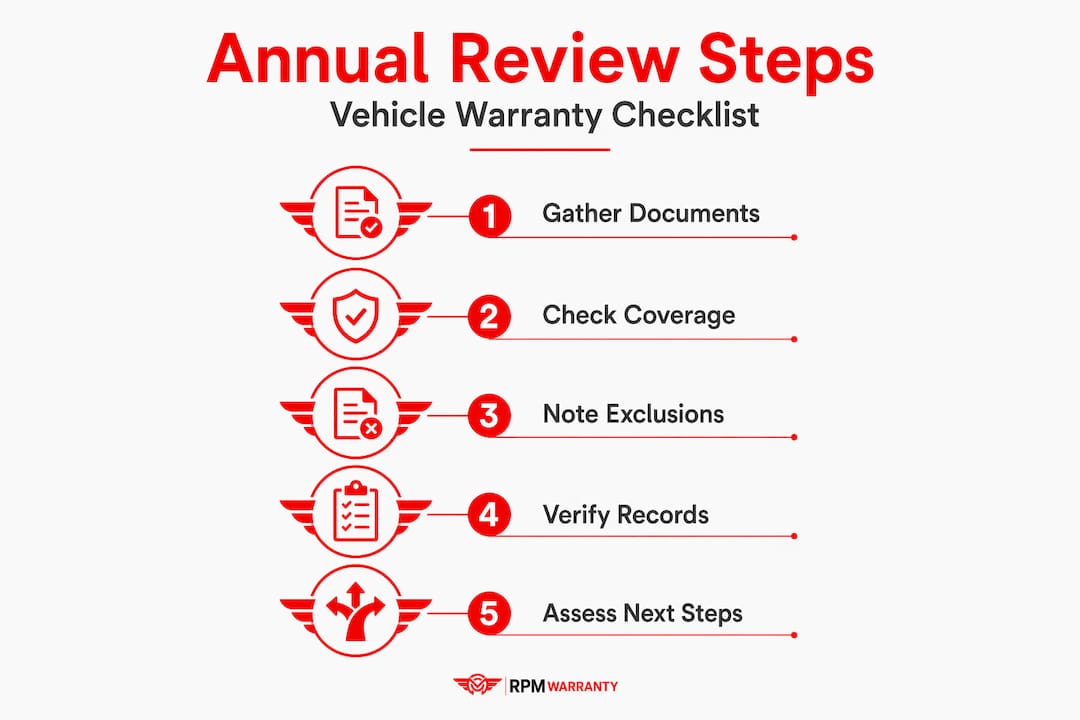
The annual warranty evaluation is the practice of sitting down once a year to verify that your coverage is still valid, that your maintenance history aligns with what the manufacturer requires, and that no upcoming expiration or mileage threshold is sneaking up on you. It is not a complicated process, but it does require attention to detail. Vehicle owners who skip this step often discover coverage gaps only when they are already standing at the service counter facing a four-figure repair bill.
There is also a legal dimension worth knowing. Federal protections under the Magnuson-Moss Warranty Act and various state lemon laws offer real remedies for covered defects. But those protections only work if you have met the warranty's conditions and can prove it. An annual review is what keeps you in that position.
Understanding your vehicle warranty: types, coverage, and limits
Before you can review a warranty, you need to know exactly what type of coverage you have. Not all warranties are the same, and confusing them is one of the most common mistakes vehicle owners make.
The main warranty types
Bumper-to-bumper warranty. This is the broadest coverage a manufacturer offers. It covers most components of the vehicle, from front to back, with a short list of exclusions (typically wear items like brake pads, tires, and wiper blades). A standard bumper-to-bumper term is 3 years or 36,000 miles, though some brands push it further. BMW offers 4 years/50,000 miles. Porsche matches that on most models.
Powertrain warranty. This covers the engine, transmission, and drivetrain. It outlasts the bumper-to-bumper coverage because these components are expensive and their failures tend to be defect-related rather than wear-related. A typical powertrain warranty runs 5 years or 60,000 miles, though Ford and Honda have extended theirs on certain models. You can learn more about the differences in coverage terms between these two major types.
Extended warranty or service contract. Once your manufacturer warranty expires, an extended warranty picks up where it left off. These are not issued by the manufacturer in most cases. They come from third-party providers or dealerships and vary considerably in what they cover, how claims are processed, and what deductibles apply.
What warranties typically exclude
| Coverage Type | Typical Duration | Common Exclusions |
|---|---|---|
| Bumper-to-bumper | 3 yr / 36,000 mi | Wear items, maintenance, cosmetic damage |
| Powertrain | 5 yr / 60,000 mi | Modifications, neglect, non-covered components |
| Extended warranty | Varies by plan | Pre-existing conditions, specific part exclusions |
| Corrosion/rust | 5 to 7 yr | Aftermarket modifications, environmental damage |
Knowing what exclusionary warranties cover versus what they leave out is not optional reading. It is the foundation of any honest warranty review. Ownership transfer also matters here. Bumper-to-bumper coverage is often transferable to a second owner, but the terms may change, and some extended warranties are not transferable at all.
Gathering documents before your review
The most thorough annual warranty inspection falls apart without the right paperwork. Collecting your documents before you sit down for the review saves time and prevents you from making decisions based on incomplete information.
Here is the order to approach this:
-
Locate your warranty booklet and coverage statement. This is the physical or digital document that came with your vehicle. It outlines exactly what is covered, for how long, and under what conditions. If you cannot find it, contact your dealership or check your manufacturer's website.
-
Pull together all maintenance records. This means oil change receipts, tire rotation records, fluid flush documentation, filter replacements, and any scheduled service visits. Certified maintenance records are what prevent disputes from going sideways when a manufacturer tries to argue that a failure was caused by neglect rather than a defect.
-
Collect every repair order. A repair order is more than a receipt. It should show the date, mileage, the symptoms you described, the technician's diagnosis, the parts replaced, and any diagnostic trouble codes. These documents are critical evidence in any warranty or lemon law scenario, and repair order completeness can make or break a coverage claim.
-
Verify your odometer reading. Your current mileage determines whether you are still within powertrain or bumper-to-bumper coverage. Write this number down with today's date when you start your review.
-
Build a simple timeline. List your vehicle's service history in chronological order. This makes it easy to spot gaps, verify that you have not missed a required service interval, and present a clear picture if you ever need to support a claim.
Pro Tip: Photograph or scan every paper receipt and upload it to a dedicated folder in cloud storage. If a dealership closes or a shop changes ownership, those paper records can disappear. A digital backup costs you nothing and can save your claim.
Conducting the review: verify coverage and spot risks
With your documents in hand, this is where the annual warranty assessment actually happens. Work through these checks one at a time.
-
Check remaining time and mileage. Look at your warranty booklet and confirm how much coverage remains on each type. A Range Rover owner with 58,000 miles on a 5 year/60,000 mile powertrain warranty has roughly 2,000 miles of that coverage left. Knowing this now lets you plan ahead, not scramble after the fact.
-
Match your maintenance history against manufacturer requirements. Auto warranties require scheduled maintenance compliance to stay valid. Pull out your manufacturer's maintenance schedule (usually in the owner's manual) and verify that every required service has been completed at the correct intervals.
-
Verify where service was performed. The 2026 GM warranty manual is explicit: maintenance at qualified centers protects your coverage. Using an unqualified shop does not automatically void your warranty under federal law, but it makes the manufacturer's job of denying your claim much easier if the work cannot be verified.
-
Identify modifications. Aftermarket parts and performance modifications are one of the most common reasons coverage gets denied. Added a cold air intake to your Honda Civic or a suspension lift to your Ford Ranger? Know exactly which components those modifications affect, because related failures may no longer be covered.
-
Read the exclusions section again. Most owners read the exclusions once when they buy the vehicle and never look at them again. Take 15 minutes to re-read them now. Your warranty contract may have terms you have forgotten.
-
Review any open diagnostic trouble codes. If your vehicle has thrown a check engine light or stored a DTC that you have not addressed, document it. Repair orders that include diagnostic trouble codes are the strongest evidence you have in a warranty dispute.
Pro Tip: If you drive a Mercedes-Benz or BMW with an onboard service indicator, do not rely solely on that light to tell you when maintenance is due. Cross-reference it with your warranty booklet's scheduled maintenance table. The indicator and the warranty requirement do not always align perfectly.
Coverage risk summary
| Risk Factor | Likely Impact | Action Needed |
|---|---|---|
| Missed oil change | Claim denial for engine damage | Document immediately, complete service |
| Aftermarket modification | Partial coverage void on related systems | Review modification scope with dealer |
| Incomplete repair order | Weak evidence for claim | Request amended or supplemental documentation |
| Service at unqualified shop | Increased scrutiny on claim | Keep all receipts and certifications |
| Approaching mileage limit | Loss of powertrain coverage | Plan service schedule accordingly |
Troubleshooting common warranty review challenges
Even a careful owner can run into problems during the review process. Here is how to handle the most common ones.
Missing or incomplete maintenance records. If you cannot find receipts for past service, start by calling the shops you used. Most automotive service providers keep digital records for several years. Your dealership's service department can also print your service history if the work was done there. For scheduled maintenance gaps at key mileage intervals, completing the missed service now and documenting it properly is better than leaving the record blank.

Coverage denial due to maintenance discrepancies. If a claim gets denied because the manufacturer argues inadequate maintenance, do not accept it without reviewing the denial reason in writing. You have the right to dispute claims. Lemon law protections and the Magnuson-Moss Warranty Act give vehicle owners recourse when manufacturers deny coverage unfairly.
Evaluating extended warranty offers with skepticism. Extended warranties can cost hundreds to thousands of dollars per year, and scams are genuinely common in this market. Before signing anything, confirm exactly which components are covered, what the deductible is, how claims are processed, and whether the provider has a history of honoring claims. Read the fine print on cancellation terms.
Documenting symptoms for potential disputes. If your vehicle has a recurring issue that has not been resolved, treat every shop visit as a legal document. Describe the symptom in writing to the service advisor and verify that your exact words appear on the repair order. If a problem persists across multiple visits, that repair history becomes critical evidence in a lemon law scenario.
Staying consistent after the review. The most common mistake is treating the review as a one-time fix rather than the start of better habits. Set a calendar reminder for the same date next year. Create a folder for warranty documents and add to it every time you visit a shop.
What to do after your annual review
Completing the review is step one. Acting on what you find is what actually protects you.
-
Schedule any missing or overdue maintenance immediately. Do not let gaps sit. A single missed service at 30,000 miles is manageable if addressed promptly. Left unresolved, it becomes a liability.
-
Upgrade your record-keeping system. If you have been stuffing receipts in a glove box, this is the moment to digitize everything. A simple folder in Google Drive or iCloud, organized by year and service type, is all you need.
-
Assess whether your current coverage still fits your needs. If you are approaching the end of your manufacturer warranty, research extended warranty options now while you have time to compare them. Waiting until your bumper-to-bumper expires puts you in a rush, which leads to bad decisions.
-
Consult a professional if disputes are involved. If your review uncovers a denied claim or a situation involving repeated unresolved repairs, speak with a consumer attorney who handles warranty or lemon law cases before agreeing to any repair settlement.
-
Mark your next review date today. Annual warranty reviews only work if they happen annually. Set the reminder before you close this tab.
My take on what most owners get wrong
I have worked with enough vehicle owners to know that the documentation problem is almost universal. People assume that because they got their oil changed, they are covered. They do not realize that warranty validity depends on maintenance records being organized and accessible, not just on the maintenance having happened.
The version of this I see most often involves Porsche and BMW owners. These are people who spent real money on their vehicles and genuinely care about them. But they use independent shops for convenience, skip the receipts, and assume the dealer can pull their history if needed. When a claim gets disputed, they are caught without documentation and have no way to prove compliance.
What I tell people is this: your warranty is only as strong as your paperwork. The car's condition does not matter in a dispute. What matters is what you can prove on paper. A clean repair order with a diagnostic trouble code and a precise symptom description carries more weight than a vehicle that looks perfect.
The other thing I push back on is the idea that reviews are only worth doing when something seems wrong. The best warranty outcomes I have seen come from owners who did the review when nothing was broken, caught an upcoming mileage threshold, scheduled the right maintenance, and walked into a repair situation with complete documentation already in hand. That is proactive warranty management, and it genuinely changes outcomes.
If you treat this process the way you treat renewing your car insurance, once a year, methodically, with attention to what the terms actually say, you will almost never be caught off guard.
— Kenneth
Protect your coverage with Rpmwarranty
Once your annual review is complete, you may realize your manufacturer coverage is running thin or that you need more protection than your current plan provides. That is exactly what Rpmwarranty was built for. Rpmwarranty offers extended vehicle warranty plans trusted by dealers nationwide, with coverage designed to protect engines, transmissions, electrical systems, cooling systems, and high-tech components on vehicles including BMW, Mercedes, Ford, Range Rover, Honda, and Porsche. The process is straightforward: consultation, plan selection, customization, and final agreement. No surprises. Rpmwarranty's protection plan options span three coverage tiers, Elite, Advanced, and Essential, so you can match coverage to your budget and your vehicle's specific needs. Get a free quote and see exactly what your next layer of protection looks like.
FAQ
What is an annual warranty review?
An annual warranty review is a structured process where vehicle owners verify their remaining coverage, confirm maintenance compliance, and identify any risks that could lead to a denied claim. It should be done once a year regardless of whether the vehicle is experiencing problems.
How do I know if my warranty is still valid?
Check your warranty booklet for the time and mileage limits on each coverage type, then compare them against your current odometer reading and purchase date. Scheduled maintenance compliance is also required, so verify your service history aligns with manufacturer requirements.
Can missing an oil change void my warranty?
It can. If a manufacturer can demonstrate that engine damage resulted from missed or improper maintenance, the related claim may be denied. Keeping organized maintenance records is the best way to protect yourself against that outcome.
What documents do I need for a warranty review?
You need your warranty booklet, all maintenance records and receipts, repair orders for every shop visit, and your current odometer reading. Detailed repair orders that include diagnostic trouble codes and symptom descriptions are especially valuable.
When should I consider an extended warranty?
Start researching extended warranty options at least six months before your manufacturer coverage expires. That gives you time to compare plans without pressure. Look for coverage that matches your vehicle's known risk areas and read the exclusions carefully before committing.