

TL;DR:
- Most vehicle repairs become significantly more expensive after 5 to 7 years, making timely warranty purchases crucial. Coverage options decrease with vehicle age, with new cars typically covered by factory warranties and older cars limited to powertrain or specific systems. Planning ahead based on your car’s age, mileage, and ownership plans can help maximize protection and save money.
Most car owners assume extended warranties are only for new vehicles rolling off the lot. That assumption can cost you thousands. Repair costs rise sharply for vehicles between 6 and 10 years old, often hitting $1,200 to $2,000 or more annually. As your car ages, your warranty options shift dramatically, and so does the financial risk you carry. This guide breaks down exactly how vehicle age affects your eligibility for coverage, what types of plans are available at each stage, and how to make a smart, well-timed decision that protects your budget without overpaying.
Table of Contents
- The connection between vehicle age, warranty eligibility, and repair costs
- What types of warranties are available by vehicle age?
- How do repair costs change as vehicles age—and what does warranty cover?
- When is the best time to get (or skip) warranty coverage?
- The overlooked reality: Why age isn't the only factor that matters
- Get expert help with your warranty options
- Frequently asked questions
Key Takeaways
| Point | Details |
|---|---|
| Repair costs rise with age | Older vehicles can cost two to three times more to repair after warranties expire. |
| Eligibility decreases over time | Fewer warranty options are available for vehicles older than 10 years or with high mileage. |
| Timing matters for value | Buying an extended warranty before existing coverage expires helps avoid gaps and higher costs. |
| Not all repairs are covered | Warranties generally exclude regular maintenance, wear-and-tear, and accidental damage. |
| Evaluate before buying | Consider your car’s age, mileage, plans to sell, and repair history before choosing any coverage. |
The connection between vehicle age, warranty eligibility, and repair costs
Let's start by seeing how vehicle age directly affects your eligibility for warranties and why this matters to your wallet.
Factory warranties are the coverage that comes standard with a new vehicle purchase. Most run for 3 to 5 years or 36,000 to 60,000 miles, whichever comes first. Once that window closes, you are entirely responsible for repair bills. And those bills can climb fast.
According to repair cost data, costs can double or triple after 5 to 7 years, which is exactly why timing your extended warranty purchase before the factory plan expires is so important. Waiting until something breaks is never the right move. By then, many providers will either decline coverage or charge significantly more.
| Vehicle age | Typical annual repair cost | Warranty availability |
|---|---|---|
| 0 to 3 years | $200 to $500 | Factory warranty active |
| 3 to 5 years | $500 to $900 | Factory ending; extended options open |
| 5 to 10 years | $1,200 to $2,000+ | Third-party extended plans |
| 10+ years | $2,000+ | Limited powertrain or service contracts |
The numbers above reflect average vehicles. Luxury brands hit harder. Annual repair costs for 6 to 10 year old vehicles regularly exceed $2,000, and luxury models can push well past that. A BMW or Mercedes owner dealing with an aging transmission or electrical failure can face a single repair bill that wipes out months of savings.
"The best time to buy an extended warranty is before your factory coverage runs out. Once it expires, your options narrow and your costs go up."
Understanding car warranty by year helps you plan ahead rather than react. And if you have already passed that factory expiration date, there is still a path forward. Learning about getting warranty after factory coverage ends can open options you did not know existed.
What types of warranties are available by vehicle age?
Now that you see why age matters, let's compare what coverage options you actually have at each vehicle stage.
Not all warranties are created equal, and not all vehicles qualify for the same plans. The type of coverage available to you depends heavily on how old your car is and how many miles are on it.
Vehicles under 3 to 5 years old are in the best position. They typically still carry an active factory warranty, and many manufacturers offer extended factory plans that push coverage further. Third-party providers are also eager to cover newer vehicles because the risk is lower.
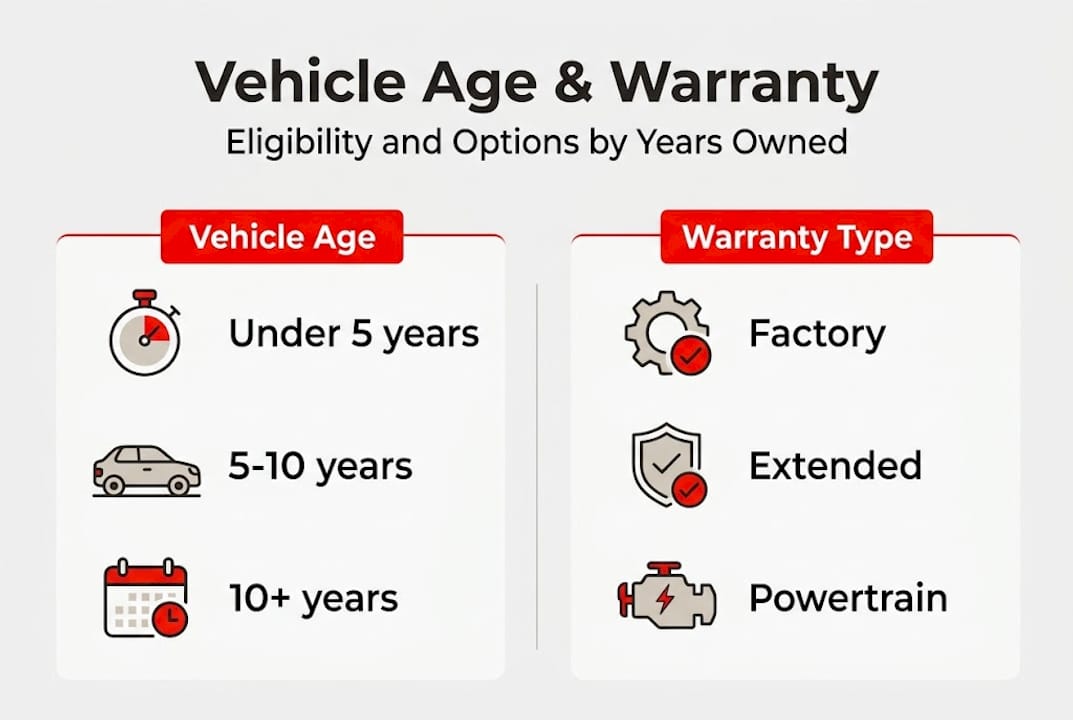
Vehicles between 5 and 10 years old fall into a middle zone. Factory coverage is usually gone, so third-party extended warranties become the primary option. These plans often come with more exclusions and require a vehicle inspection before approval. Coverage may be limited to specific systems rather than bumper-to-bumper protection.
Vehicles over 10 years old or with very high mileage face the most restrictions. Many providers will only offer basic powertrain coverage, which protects the engine and transmission but little else. Specialized service contracts may be available, but they tend to cost more and cover less.
| Coverage type | Best for | What it covers |
|---|---|---|
| Factory warranty | New vehicles | Nearly everything |
| Extended factory plan | Under 5 years | Broad coverage, manufacturer-backed |
| Third-party extended warranty | 5 to 10 years | Varies; engine, transmission, electrical |
| Powertrain-only plan | 10+ years | Engine, transmission, drivetrain |
| Service contract | Any age | Negotiated repairs, often more flexible |
One thing many owners miss: extended warranty costs and coverage terms depend on vehicle age, make, and model, and some plans overlap with existing factory coverage. Buying a plan you do not need yet is wasted money.
Also, not all warranties transfer to a new owner. If you plan to sell, check the transferability clause first.
- Check if your factory warranty is still active before purchasing anything extra
- Ask whether the plan covers parts and labor or just parts
- Confirm the deductible amount per visit
- Verify the plan is accepted at your preferred repair shop
Pro Tip: If you notice any of the signs you need extended warranty coverage, like frequent small repairs or a car approaching 60,000 miles, do not wait. Use the auto warranties guide to understand your full range of options before committing.
How do repair costs change as vehicles age—and what does warranty cover?
Understanding your real risk means comparing expected repair costs by age and matching this to coverage.
The average U.S. vehicle on the road today is 12.6 years old, which tells you most drivers are managing aging vehicles every single day. That same data shows the average check engine light repair costs $415. That is one incident. String a few together in a year and you are looking at serious money.
The repair cost spike around years 6 to 10 is real. Here is a breakdown of what commonly goes wrong and what it costs:
- Catalytic converter replacement: $1,300 or more, and it is not covered by most basic plans
- Transmission rebuild or replacement: $2,500 to $4,500, typically covered by higher-tier extended plans
- Engine repair or replacement: $3,000 to $7,000+, covered under powertrain and elite plans
- Electrical system failures: $500 to $2,000+, covered by more comprehensive third-party plans
- Cooling system failure: $400 to $900, often covered under mid-tier plans
Luxury vehicles face even steeper numbers. BMW's 10-year total repair cost averages $15,991, a figure that makes even a premium extended warranty look like a bargain.
What warranties do NOT cover is just as important to understand. Routine maintenance like oil changes, tire rotations, and brake pad replacements are almost never included. Wear-and-tear items such as wiper blades or belts are typically excluded too. Damage from neglect, accidents, or modifications voids most plans entirely.
Knowing which car warranty features matter most helps you avoid paying for coverage that will not help when you need it. A warranty service contract can fill specific gaps, but only if you read the fine print carefully.
When is the best time to get (or skip) warranty coverage?
So, when should you invest in an extended warranty—and when is it better to pass?
Timing is everything. Buying an extended warranty while your factory plan is still active often means you are paying for overlapping coverage. That is money wasted. The smart window is right before the factory warranty expires or immediately after.
Buying before factory coverage ends helps you avoid gaps in protection and usually locks in better pricing. Once the factory plan is gone, providers view your vehicle as higher risk, and premiums reflect that.
Here is a quick guide to timing your decision:
- Keeping the car long-term: A warranty makes strong financial sense after year 5 or 6, especially if you plan to drive it past 100,000 miles
- Selling within 1 to 2 years: Skip additional coverage unless you can transfer the plan to the buyer, which can actually increase resale value
- High-mileage vehicle: Carefully compare what is excluded. Some plans will not cover pre-existing conditions, so a vehicle inspection may be required
- Older luxury vehicle: The higher the repair risk, the more a warranty can protect you, but read every exclusion carefully
Pro Tip: Review what voids a car warranty before you sign anything. Simple habits like skipping oil changes or using non-approved parts can invalidate your entire plan.
If you have already passed the factory expiration window, do not assume it is too late. Exploring warranty after factory coverage options can still yield solid protection, especially for powertrain components.
The overlooked reality: Why age isn't the only factor that matters
With the facts on costs and options in mind, here is what most people and sadly some experts tend to overlook.
Vehicle age gets all the attention, but it is only one piece of the puzzle. Mileage, maintenance history, make and model, and how you plan to use the vehicle all shape your actual warranty value. A 7-year-old car with 45,000 miles and full service records is a very different risk profile than a 5-year-old car with 120,000 miles and spotty maintenance.
Many owners overpay by buying coverage that duplicates what they already have or extends well beyond how long they actually plan to keep the vehicle. The FTC notes that extended warranties are not always worthwhile if you do not plan to keep your car long-term, and cost depends on far more than just age.
The smarter move is to build your decision around your full ownership plan. How long will you keep this car? What is your risk tolerance for a surprise $3,000 bill? Do you drive in ways that stress the drivetrain? These questions matter more than the year on the title. Understanding choosing car warranty by year as a framework, rather than a rigid rule, gives you far better outcomes.
Get expert help with your warranty options
If you are weighing options or have questions about the right coverage for your car's age, here is how you can get clear, fast answers.
Finding the right plan does not have to be complicated. At RPM Warranty, we match coverage to your vehicle's specific age, mileage, and your plans for ownership—not a generic template.

Our extended vehicle warranty plans include Elite, Advanced, and Essential tiers so you can choose the level of protection that fits your budget and your risk. Whether your car is 3 years old or 13, there is a plan worth considering. You can get free quotes in minutes and speak with an advisor who will walk you through exactly what is and is not covered. No pressure, no confusion, just honest guidance.
Frequently asked questions
Can I get an extended warranty on a 10-year-old car?
Yes, but options are more limited and typically cover only major systems like the engine and transmission. Warranty eligibility narrows as vehicles age, and premiums are usually higher than for newer cars.
Does vehicle mileage affect warranty eligibility more than age?
In many cases, yes. Mileage is a key factor and many plans exclude vehicles over a certain odometer limit even if the vehicle age would otherwise qualify.
Are extended warranties worth it for older cars?
They can be, particularly if you plan to keep the car and face rising repair costs. The FTC advises reviewing terms carefully, since value depends on how long you keep the vehicle and what the plan actually covers.
What repair costs are typically not covered by warranty?
Most warranties exclude routine maintenance and wear items like oil changes, brakes, and tires, as well as damage caused by neglect, accidents, or unauthorized modifications.