
TL;DR:
- Modern vehicles increasingly rely on advanced electronic and software systems that standard warranties often exclude. High-tech coverage protects components like radar sensors, infotainment displays, and battery management systems, which can cost multiple thousands to repair. Owners of luxury or electric vehicles should consider exclusionary plans that provide comprehensive protection against these costly electronic failures.
Modern vehicles are no longer just mechanical machines. A new BMW 7 Series or Mercedes-Benz EQS carries more computing power than most laptops, and when those systems fail, the repair bills reflect it. Understanding what is high-tech vehicle coverage is the first step toward protecting yourself from four and five-figure repair costs that a standard powertrain plan will never touch. This guide breaks down exactly what this coverage includes, where standard warranties fall short, and how to choose the right plan for a vehicle built around electronics as much as engines.
Table of Contents
- Key takeaways
- What high-tech vehicle coverage actually protects
- Where standard warranties leave you exposed
- Comparing warranty plan types side by side
- How to choose the right high-tech coverage plan
- My take: why the industry still fails high-tech vehicle owners
- Protect your high-tech vehicle with Rpmwarranty
- FAQ
Key takeaways
| Point | Details |
|---|---|
| Standard plans miss critical parts | Powertrain warranties typically exclude sensors, modules, and infotainment systems that cost the most to fix. |
| High-tech coverage fills the gap | Specialized plans protect battery management systems, radar sensors, displays, and onboard chargers. |
| Exclusionary plans offer the most protection | For luxury and EV owners, exclusionary coverage protects nearly everything except a short listed exclusion list. |
| Contract language beats brand reputation | Reading exactly what is and is not covered matters more than a warranty provider's popularity or ranking. |
| Direct payment protects your cash flow | Plans that pay repair shops directly prevent you from fronting thousands of dollars and waiting for reimbursement. |
What high-tech vehicle coverage actually protects
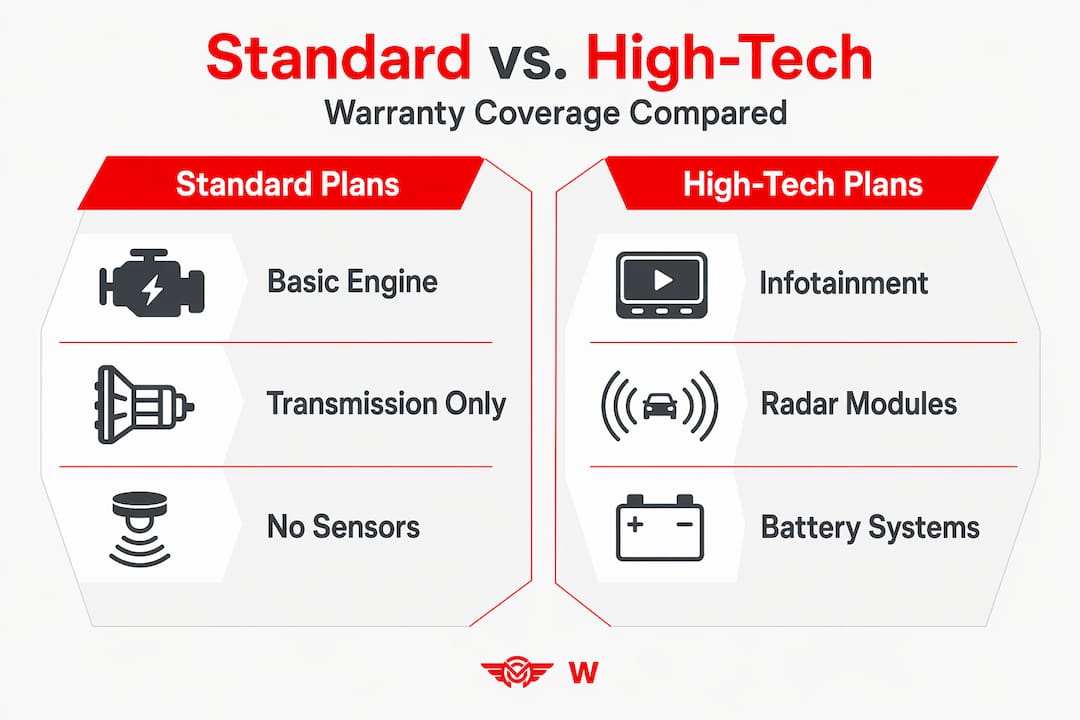
High-tech vehicle coverage is an extended protection plan specifically designed to include the advanced electronic, software, and safety systems that standard warranties routinely exclude. Where a basic warranty stops at the engine, transmission, and drivetrain, high-tech coverage keeps going into the components that define how a modern vehicle actually operates day to day.
Coverage includes infotainment screens, radar and sonar sensors, battery management systems, onboard chargers, electronic control modules, active safety systems, and driver assistance hardware. These are not minor accessories. On a Porsche Cayenne or a Tesla Model S, a single radar module replacement can run well past $2,000 at a dealership. A failed infotainment module on a Range Rover Sport can cost more than a used economy car's monthly payment.
The three warranty types you need to understand
To fully grasp what is high-tech car component coverage, you need to know where it sits in the broader warranty market. There are three main plan structures:
Powertrain plans cover the engine, transmission, and drive axles. That is essentially it. They are the most affordable option, but they leave most electronic modules completely unprotected. If your BMW's iDrive control unit fails or your Mercedes adaptive cruise control radar goes down, a powertrain plan will not help you.
Stated-component plans list every covered part explicitly. If a part is not named, it is not covered. Budget warranties are typically structured this way, and the named parts list rarely keeps pace with the actual electronics in a modern luxury or electric vehicle.
Exclusionary plans work the opposite way. They cover everything on the vehicle except a short list of excluded items. For owners of technology-heavy vehicles, this structure offers the broadest protection available.
Here is a quick breakdown of what high-tech coverage typically protects:
- Adaptive cruise control and radar collision sensors
- Infotainment and navigation display units
- Battery management systems and inverters
- Onboard charging hardware for plug-in and electric vehicles
- Electronic stability and traction control modules
- Lane-keep assist and blind-spot monitoring systems
- Forward-facing camera arrays for autonomous driving features
Pro Tip: When reviewing any plan, ask the provider to specifically confirm in writing that battery management systems, radar sensors, and onboard chargers are covered. If they hesitate or give a vague answer, treat that as a red flag.
Where standard warranties leave you exposed
The most expensive mistake vehicle owners make is assuming that "extended warranty" automatically means "covered for everything." It does not, and the gap between what most people expect and what a standard plan actually covers is where the real financial risk lives.
Consider a few scenarios that play out regularly with higher-end vehicles:
-
Radar sensor failure on a Mercedes-Benz GLE. The radar module that powers automatic emergency braking and adaptive cruise fails at 65,000 miles. The repair costs $2,800 at the dealership. A powertrain plan covers exactly zero dollars of that bill because the component is electronic, not mechanical.
-
Infotainment system crash on a BMW 5 Series. The iDrive screen and control module stop functioning. Replacement comes in at $3,400. A stated-component plan that does not name "infotainment control unit" as a covered part leaves the owner paying out of pocket.
-
Battery management system fault on an electric vehicle. The battery cells themselves are usually durable, but the electronics managing them fail far more often. On some vehicles, a battery management system repair exceeds $5,000. A plan that covers the battery but not the management hardware is effectively covering the least likely failure.
-
Electronic control module failure on a Porsche 911. The engine control unit goes out at 72,000 miles. This is a $4,000 repair. A powertrain plan typically defines coverage around mechanical components, so an electronic module controlling the engine falls into a gray area that most providers resolve in their own favor, not yours.
-
Lane assist camera array on a Ford F-150 with Pro Trailer Backup Assist. The forward camera module fails. Cost: $1,900. Not covered under a standard powertrain extension because cameras are classified as electronic accessories.
The pattern is clear. A radar sensor repair or display module replacement routinely produces four-figure invoices that standard plans do not touch. Reading the specific contract language matters far more than reading a company's marketing copy. If the contract does not name the component or explicitly state it is covered under a broad electronics clause, assume it is excluded.
One more clause that catches owners off guard: waiting periods. Coverage delays of 30 days or 1,000 miles are standard in most vehicle service contracts. If your vehicle develops an issue shortly after you buy a plan, you may find yourself outside the coverage window for a very expensive repair.

Comparing warranty plan types side by side
Choosing between plan types requires understanding what each one actually protects on a modern, technology-loaded vehicle. The table below cuts through the marketing language and shows what each plan structure typically covers and who it suits best.
| Plan type | Mechanical components | Electronic modules | Sensors and cameras | Best suited for |
|---|---|---|---|---|
| Powertrain | Yes | No | No | High-mileage vehicles with basic drivetrains |
| Stated-component | Partially | Only if named | Rarely | Budget-conscious owners of older vehicles |
| Exclusionary | Yes | Yes | Yes | Luxury, EV, and tech-heavy vehicles |
Exclusionary plans are the closest thing to a true bumper-to-bumper warranty you can get after the factory coverage ends. They protect nearly every part except a defined short list. For a BMW M5 owner worried about the vehicle's complex adaptive suspension electronics or a Porsche Taycan owner with a $6,000 onboard charger, exclusionary coverage is not a luxury. It is the only plan that actually matches the vehicle's repair risk profile.
Luxury and electric vehicles have fundamentally shifted repair risk from mechanical to electronic and software systems. A 2023 Mercedes-Benz S-Class has over 100 separate electronic control units. Even one failing outside of factory warranty can cost more than several years of coverage premiums. The math on exclusionary coverage changes significantly when you factor in that reality.
You can explore the specific differences between powertrain plans and broader coverage options to see how the gap in protection adds up over time.
Pro Tip: If you own a used luxury or electric vehicle that is out of its factory warranty period, the probability of an expensive electronic failure is highest in the next three to five years. That is exactly when exclusionary coverage delivers the most value for the price.
How to choose the right high-tech coverage plan
Understanding what is high-tech component coverage is only useful if you can translate that knowledge into a smart buying decision. Here is how to evaluate your options without getting lost in the fine print.
-
Verify specific component coverage in writing. Do not accept "electronics are covered" as an answer. Ask the provider to confirm that battery management systems, inverters, onboard chargers, radar sensors, and infotainment control modules are explicitly covered. Get it in the contract, not in a sales conversation.
-
Check whether the plan pays repair shops directly. High-tech repair bills often reach thousands of dollars. A plan that requires you to pay first and seek reimbursement later puts you at real financial risk. Direct payment to the repair facility is a non-negotiable feature for high-dollar electronic repairs. This is also why direct payment to repair shops is considered a critical feature in any guide to high-tech car coverage.
-
Understand the deductible structure before you sign. A $200 per-visit deductible sounds minor until you have three separate electronic failures in one year. Some plans charge per repair order, others per visit. The difference matters on complex vehicles where multiple systems may fail simultaneously.
-
Look at the waiting period clause. Coverage delays are standard practice, but the length varies. Thirty days or 1,000 miles is typical. If a provider offers shorter waiting periods, that is worth factoring into your comparison.
-
Prioritize contract review over brand popularity. Reading contract fine print and understanding exclusions is more critical than trusting a company's reputation or customer service scores. The contract is the product. Everything else is marketing.
-
Consider your vehicle's specific repair risk. A Honda Civic with 40,000 miles carries a different risk profile than a BMW X7 with 75,000 miles. Used luxury vehicles and electric vehicles are the cases where high-tech coverage can be essential precisely because their electronic repair costs are so high. For those vehicles, the question is not whether to get coverage. It is which plan covers the most.
For a thorough look at what advanced plans include, it is worth reviewing coverage details specific to your vehicle's make and model before committing to any plan.
My take: why the industry still fails high-tech vehicle owners
I have reviewed a lot of warranty contracts over the years, and the one pattern that frustrates me most is how often well-intentioned buyers end up with plans that were never designed for the vehicles they own.
Someone buys a certified pre-owned Mercedes-Benz GLC or a slightly used Porsche Macan, gets offered an extended warranty at the dealership, and accepts it because it sounds like the responsible thing to do. Then, 14 months later, the adaptive suspension control module fails. The repair costs $3,100. The warranty covers nothing because it is a stated-component plan that lists "suspension components" but defines that as physical parts like struts and control arms, not the electronic module managing them.
What I have learned is that the failure is almost never malicious. It is a mismatch. The plan was designed for a different generation of vehicles, and nobody at the dealership thought to flag that it was inadequate for a technology-loaded luxury SUV.
The shift I keep pushing for is simple. Owners of modern vehicles, particularly those with significant electronic and software systems, need to stop thinking about warranty coverage in traditional mechanical terms. The engine and transmission are not where the expensive failures happen on a 2023 BMW or a Porsche Taycan. The failures that cost real money are in the electronics, the sensors, and the software-controlled hardware. A plan that covers the former but not the latter is not really protecting you. It is just giving you the feeling of protection, which is worse.
My recommendation is straightforward. If your vehicle has radar-based safety systems, a large infotainment display, or any kind of electrified powertrain, you need to start your coverage search specifically with exclusionary plans. Anything less is leaving your biggest financial risks uncovered.
— Kenneth
Protect your high-tech vehicle with Rpmwarranty
If you have made it this far, you already know that not all warranty plans are built for modern vehicles. Rpmwarranty offers extended vehicle coverage designed with the complexity of today's cars in mind, including plans that protect electronic modules, advanced safety systems, and high-tech components on vehicles like BMW, Mercedes-Benz, Porsche, and Tesla.

Rpmwarranty's Elite plan is built for owners who need exclusionary-level protection, covering the systems that matter most on luxury and electric vehicles. Getting started takes minutes. You can request a free quote based on your vehicle's specific year, make, and model to find out exactly what level of coverage makes sense for your situation. Nationwide dealer trust and direct repair shop payment mean you will never be left fronting thousands of dollars while waiting for reimbursement. Porsche owners can also explore tailored Porsche coverage designed specifically for the brand's complex technology systems.
FAQ
What does high-tech vehicle coverage include?
High-tech vehicle coverage protects advanced electronic components such as infotainment systems, radar sensors, battery management systems, onboard chargers, and electronic control modules. These are parts that standard powertrain warranties typically exclude entirely.
Is high-tech component coverage worth it for luxury cars?
Yes, especially for used luxury vehicles outside of factory warranty. Luxury cars like BMW, Mercedes-Benz, and Porsche carry repair costs on electronic systems that can easily exceed $2,000 to $5,000 per repair, making specialized coverage cost-effective.
What is the difference between powertrain and exclusionary coverage?
A powertrain plan covers only the engine, transmission, and drive axles. An exclusionary plan covers nearly everything on the vehicle except a short defined exclusion list, making it far more suitable for vehicles with advanced technology and software systems.
Do standard extended warranties cover EV battery management systems?
Not always. Battery cells and battery management systems are often treated differently in contracts. The management hardware and inverters are frequently excluded, even when the battery itself is listed as covered.
How do I know if my current plan covers high-tech components?
Read the contract directly and look for explicit mention of electronic control modules, sensors, infotainment units, and battery management systems. If these components are not named or covered under a clear electronics clause, they are likely excluded.