
TL;DR:
- Cooling system coverage protects specific mechanical components responsible for engine temperature regulation from failure, shielding owners from costly repairs. The coverage depends on the parts explicitly listed in the warranty contract, and proper maintenance documentation is essential for claim approval. Regular inspections, detailed records, and prompt action at the first signs of failure maximize the benefits of cooling system warranties.
Cooling system coverage is the protection extended vehicle warranties provide for the mechanical components that regulate your engine's temperature, shielding you from repair bills that can reach thousands of dollars when parts like the radiator, water pump, or thermostat fail. For owners of vehicles like BMW, Mercedes-Benz, Range Rover, and Porsche, where a water pump replacement alone can cost well over $800 in labor, understanding exactly what your warranty contract covers is not optional. It is the difference between a $100 deductible and a $2,500 out-of-pocket repair. The industry term for this protection is "cooling system coverage" within a vehicle service contract, and the scope of that coverage depends entirely on the parts list in your specific agreement and your documented maintenance history.
What is cooling system coverage in extended warranties?
Cooling system coverage is defined as warranty protection for the mechanical components responsible for managing engine heat, specifically covering failures caused by mechanical breakdown rather than neglect or routine wear. Extended warranties cover cooling system components only when the failure is listed in the contract and caused by a covered breakdown, not by deferred maintenance or improper fluids. That distinction matters more than most owners realize when a claim is filed.
The cooling system in any vehicle, from a Honda Civic to a Porsche Cayenne, performs one critical job: it moves heat away from the engine block and dissipates it through the radiator. When any part of that chain fails, engine temperatures spike fast. Overheating can warp cylinder heads and destroy head gaskets within minutes, turning a $400 thermostat repair into a $4,000 engine rebuild. Cooling system coverage exists precisely to intercept that cost before it escalates.
A cooling system overview in warranty terms means your contract identifies specific parts by name, not just a broad category. Coverage maps individual parts like the radiator, water pump, thermostat, hoses, coolant reservoir, radiator cap, and cooling fans, each with its own labor rules. Knowing which parts appear on your contract's list is the first thing you should verify before assuming you are protected.
Which cooling system parts are covered and which are excluded?
Extended warranties that include cooling system protection typically cover the mechanical components that fail due to internal breakdown. The parts most commonly listed in contracts include the radiator, water pump, thermostat, upper and lower radiator hoses, coolant reservoir, radiator cap, and electric cooling fans. On vehicles like the BMW 5 Series or Mercedes-Benz E-Class, the cooling fan module and auxiliary water pump are also frequently listed in higher-tier plans because these components carry significant replacement costs.
What contracts almost universally exclude is equally important to understand. Routine maintenance services, including coolant flushes, top-offs, and refrigerant recharges for the air conditioning side of the system, are not covered. Coolant flushes are categorized as maintenance and excluded from coverage even when they are directly related to a cooling issue. The logic is straightforward: warranties cover failures, not scheduled services.
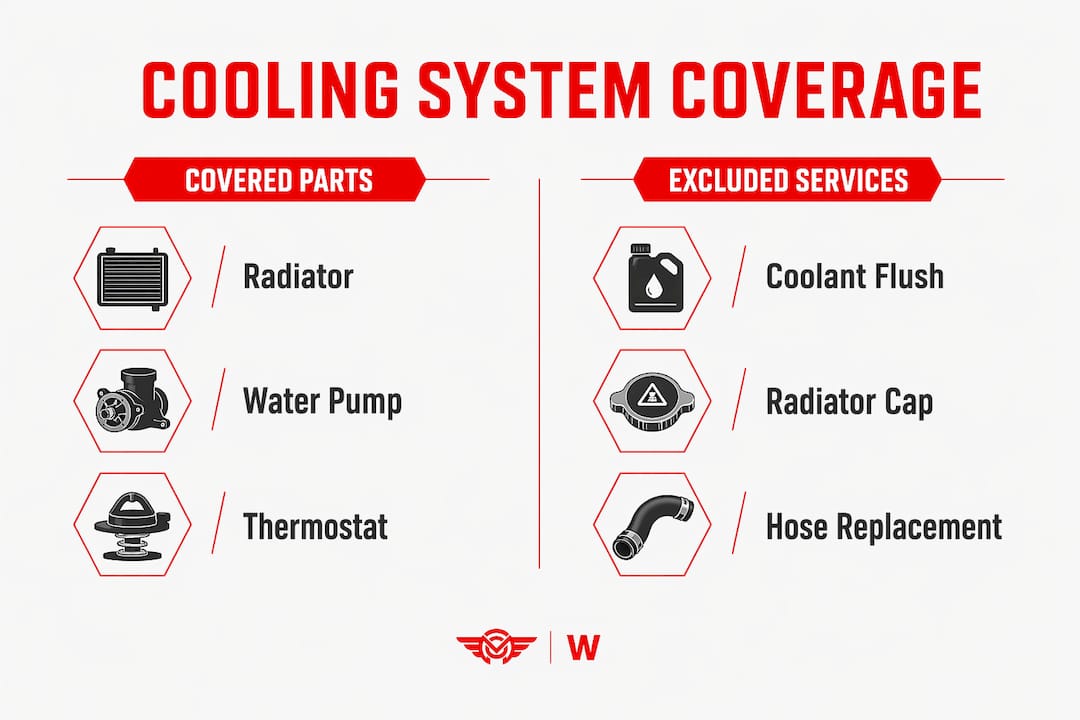
The table below shows the typical split between covered repairs and excluded services in a standard extended warranty cooling system clause.
| Component or Service | Coverage Status | Notes |
|---|---|---|
| Radiator (mechanical failure) | Covered | Includes associated labor |
| Water pump | Covered | Labor-intensive on timing belt engines |
| Thermostat | Covered | One of the most common claims |
| Radiator hoses (burst or failed) | Covered | Excludes cracking from age alone |
| Coolant reservoir | Covered | If failed mechanically |
| Coolant flush or top-off | Excluded | Classified as routine maintenance |
| Refrigerant recharge (A/C) | Excluded | Separate from engine cooling coverage |
| Wear-related hose degradation | Excluded | Normal wear is not a covered failure |
Air conditioning coverage is a separate category from engine cooling system coverage in most contracts. The A/C compressor, condenser, and evaporator are typically listed under a different section of the warranty. Owners of Range Rover Sport or Mercedes-Benz GLE models often confuse the two because both systems share the front of the vehicle, but they operate independently in warranty terms.
Pro Tip: Read your contract's parts list line by line. If a component is not named explicitly, assume it is not covered. "Cooling system" as a broad term in a contract heading does not guarantee every part within that system is included.
How maintenance records affect your cooling system claim
Documented maintenance is the single most powerful factor in whether a cooling system warranty claim gets approved or denied. Warranty providers request detailed maintenance records during claim reviews, and gaps in that paper trail are the most common reason legitimate claims get rejected. This is not a technicality. It is the core mechanism by which warranty companies distinguish between a covered mechanical failure and an owner-caused breakdown.
The specific documentation that matters includes:
- Receipts showing the type of coolant used, with the brand and specification matching the manufacturer's recommendation for your vehicle
- Service records from licensed shops showing coolant level checks and system inspections at manufacturer-recommended intervals
- Any diagnostic reports from prior visits that reference the cooling system
- Records showing that a coolant flush was performed on schedule, even though the flush itself is not covered
Using non-OEM coolant or missing documented maintenance frequently leads warranty providers to deny cooling system claims outright. For a BMW 3 Series, the manufacturer specifies BMW Coolant Antifreeze or an equivalent meeting BMW specification. Using a generic green antifreeze from a gas station gives the warranty company grounds to argue that improper fluid caused or accelerated the failure.
The distinction between maintenance work and a covered repair is also critical. Warranties distinguish between preventive maintenance and failed part repair, and shops should document clearly whether a service visit involved restoring a neglected system or repairing a component that failed mechanically. Ask your mechanic to note on the invoice whether the work performed was a repair of a failed part or a scheduled maintenance service. That single line on a receipt can determine whether your claim is paid.
Pro Tip: Create a dedicated folder, physical or digital, for every cooling system service receipt. Include the date, mileage, coolant specification used, and the shop's name. When a claim is filed, this folder is your strongest asset.
Common cooling system failures that trigger warranty claims
Cooling system failures follow predictable patterns across most vehicle makes, and recognizing the early warning signs gives you the best chance of filing a claim before secondary damage voids your coverage. The most common failures that result in warranty claims are:
-
Water pump failure. The water pump circulates coolant through the engine block and radiator. On Ford F-150 EcoBoost engines and BMW inline-six models, water pump failure is one of the top cooling system claims. Symptoms include a whining noise from the front of the engine, coolant leaks near the pump housing, and a temperature gauge that climbs higher than normal. Water pump replacement requires timing belt servicing on many engines, which significantly increases labor costs and makes warranty coverage especially valuable.
-
Thermostat malfunction. A stuck-open thermostat causes the engine to run cold and reduces fuel efficiency. A stuck-closed thermostat causes rapid overheating. Mercedes-Benz V6 and V8 engines are known for thermostat housing failures that combine the thermostat and housing into a single assembly, raising the replacement cost considerably.
-
Radiator leaks. Plastic end tanks on aluminum radiators are a common failure point on high-mileage vehicles, including Honda Accord and Ford Explorer models. A small leak left unaddressed leads to low coolant levels, overheating, and potential head gasket failure. Driving with a known leak is the fastest way to convert a covered claim into a denied one.
-
Coolant hose failure. Upper and lower radiator hoses degrade over time, but a sudden burst from internal pressure is a covered mechanical failure in most contracts. Age-related cracking and softening, however, is typically excluded as normal wear.
-
Cooling fan failure. Electric cooling fans on vehicles like the Range Rover Evoque and Porsche Macan are expensive to replace. A failed fan causes overheating at low speeds and in stop-and-go traffic, which is when the radiator relies entirely on the fan rather than airflow.
Cooling system failures cascade into engine damage when ignored, making prompt claim filing after warning signs critical to avoiding coverage losses. The moment your temperature gauge moves into the red or you see steam from under the hood, stop driving. Filing a claim after continuing to drive an overheating vehicle gives the warranty company grounds to argue that the engine damage resulted from owner negligence, not the original covered failure.
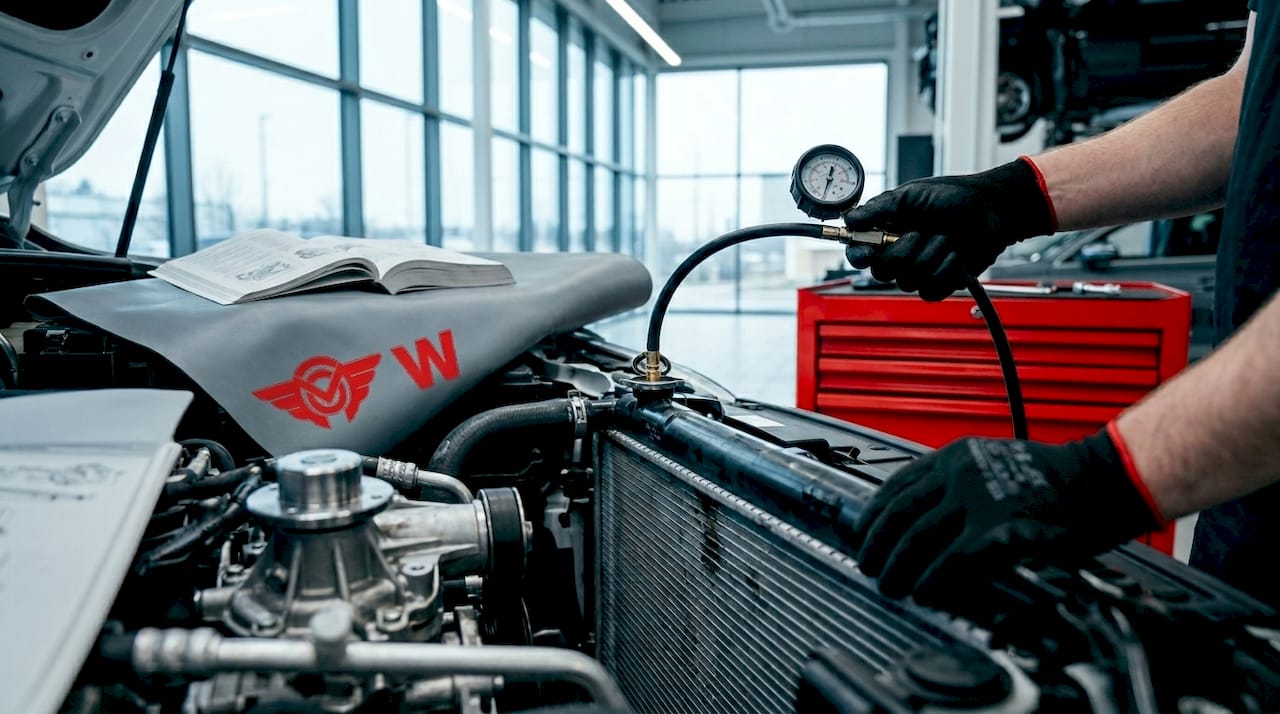
Diagnostic services use pressure testers to find leaks and check system integrity, and these diagnostic costs are typically covered alongside the repair when a covered component is confirmed as failed. Ask the shop to document the diagnostic findings in writing before authorizing any repair.
How to maximize the value of your cooling system warranty coverage
Getting full value from cooling system coverage requires active management on your part. Owning a vehicle with an extended warranty is not a passive arrangement. The following steps give you the best position when a claim arises.
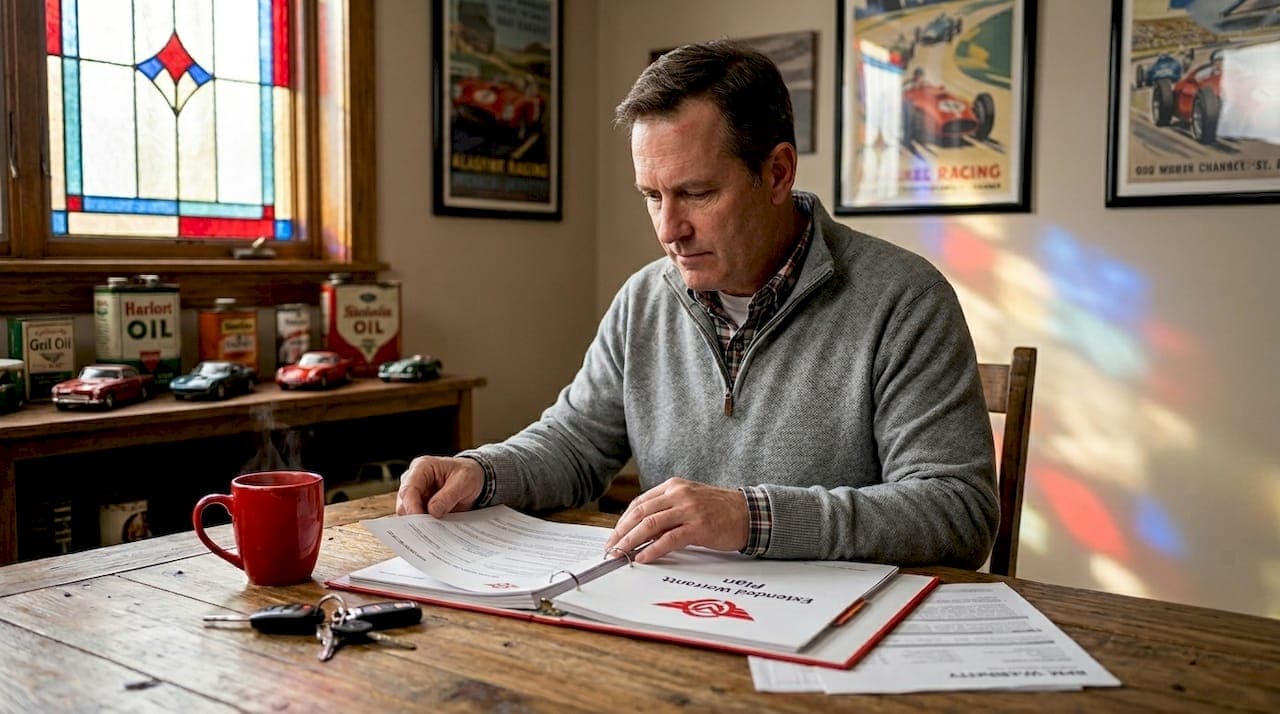
Review your contract before a problem occurs. Pull out your warranty agreement and locate the cooling system section. Identify every part listed by name. Note any mileage or time limits on specific components. Reviewing your warranty contract before a failure occurs prevents the shock of discovering a gap in coverage when you are already at the repair shop.
Schedule proactive inspections. Many cooling system failures give advance warning before they become catastrophic. A pressure test performed during a routine service visit can identify a slow radiator leak or a weakening hose before it fails completely. For Range Rover and BMW owners, annual cooling system inspections are a sound investment given the cost of components on those platforms.
Communicate clearly with repair shops. When you bring your vehicle in for a cooling system issue, tell the service advisor that the vehicle is under an extended warranty before any diagnostic work begins. Ask them to contact the warranty company for pre-authorization before starting repairs. Shops experienced with warranty claims know how to document work in a way that supports approval.
Keep records organized and accessible. A thorough paper trail of OEM coolant use and manufacturer-recommended service intervals is frequently the deciding factor in coverage disputes. Store receipts by date and include the vehicle mileage on each one.
Know when to escalate a denied claim. If a claim is denied, request the denial in writing with the specific contract clause cited. Review that clause against your maintenance records. Many denials are overturned when owners provide complete documentation that was not submitted initially. If the dispute persists, your state's Department of Insurance regulates vehicle service contracts and provides a formal complaint process.
Pro Tip: Before purchasing any extended warranty plan, ask the provider specifically which cooling system components are listed in the plan you are considering. A plan that lists "cooling system" without naming parts gives you far less protection than one that names the radiator, water pump, thermostat, hoses, and fans individually.
Key takeaways
Cooling system coverage pays for mechanical failures of specific named components, and your maintenance records determine whether that coverage holds up when you file a claim.
| Point | Details |
|---|---|
| Coverage is parts-specific | Contracts must name each component; "cooling system" as a general term does not guarantee full coverage. |
| Maintenance records are non-negotiable | Missing receipts or wrong coolant type are the top reasons cooling system claims get denied. |
| Maintenance vs. repair distinction matters | Coolant flushes are excluded; a failed water pump or thermostat is covered when documented as a breakdown. |
| Act fast when symptoms appear | Driving an overheating vehicle converts a covered claim into a denied one due to owner negligence. |
| Review contracts before buying | Identify every named cooling system part in the contract before signing to avoid coverage gaps. |
What I've learned about cooling system coverage after years in this industry
Luxury vehicle owners consistently underestimate how much the maintenance documentation requirement matters until they are standing at a service counter with a $2,200 repair estimate and a denied claim. I have seen it happen with BMW 7 Series owners who used the correct coolant but never kept the receipts, and with Range Rover owners who skipped one coolant service because the vehicle "seemed fine." The warranty company does not care that the vehicle seemed fine. It cares what the paper trail shows.
The nuance that catches premium vehicle owners off guard is that higher-tier vehicles often have more complex cooling systems with additional components, like auxiliary electric water pumps on BMW turbocharged engines or secondary cooling circuits on Porsche PDK transmissions. These components may or may not appear in a standard extended warranty plan. Owners of these vehicles need to read their contracts at a deeper level than someone driving a Honda CR-V, because the cost exposure on a missed component is proportionally higher.
My consistent advice is to treat your warranty contract the way you treat your vehicle's title. Know where it is, read it thoroughly, and understand what it says before you need it. Proactive engagement with your warranty provider, asking questions before a failure rather than after, is the single habit that separates owners who get claims paid from those who absorb the full repair cost themselves. The vehicle maintenance workflow you build around your extended warranty is as important as the warranty itself.
— Kenneth
Protect your engine with Rpmwarranty's cooling system coverage
Rpmwarranty offers extended vehicle warranty plans that include coverage for key cooling system components, including the radiator, water pump, thermostat, and cooling fans, across its Elite, Advanced, and Essential plan tiers. The claims process is straightforward, with nationwide service network access and dedicated support to help you get repairs authorized quickly.
If you drive a BMW, Mercedes-Benz, Range Rover, Ford, Honda, or Porsche, the cost of a single cooling system repair can easily exceed what a full year of extended warranty coverage costs. Rpmwarranty's plans are tailored to your vehicle's year, make, and model, so you get coverage that matches your actual risk. Get a free quote and compare extended warranty plans to find the right level of cooling system protection for your vehicle today.
FAQ
What does cooling system coverage include in an extended warranty?
Cooling system coverage in an extended warranty typically includes the radiator, water pump, thermostat, radiator hoses, coolant reservoir, radiator cap, and cooling fans when they fail due to mechanical breakdown. Routine services like coolant flushes and refrigerant recharges are excluded because they are classified as maintenance rather than repairs.
Why do cooling system warranty claims get denied?
The most common reasons for denial are missing maintenance records, use of coolant that does not meet the manufacturer's specification, and continuing to drive after overheating symptoms appear. Claim denials frequently involve lack of documentation for required maintenance and non-recommended fluids.
Is a coolant flush covered under an extended warranty?
A coolant flush is not covered under most extended warranties because it is classified as routine maintenance. Coverage applies to the repair or replacement of a component that has mechanically failed, not to scheduled fluid services.
How do I know if my water pump is covered?
Check your warranty contract's parts list for "water pump" listed by name. If it appears, coverage applies when the pump fails due to mechanical breakdown, provided your maintenance records are current and you used the manufacturer-recommended coolant. Labor costs for water pump replacement are typically included alongside the part cost when the component is listed in the contract.
What should I do when my temperature gauge spikes?
Stop driving immediately, allow the engine to cool, and contact your warranty provider before authorizing any diagnostic work at a repair shop. Continuing to drive an overheating vehicle risks converting a covered cooling system claim into a denied claim based on owner-caused engine damage.