
TL;DR:
- Ignoring small maintenance tasks can lead to costly repairs and void extended warranties. Establishing a structured, routine workflow with proper documentation helps prevent issues, supports warranty claims, and maximizes resale value. Adapting maintenance intervals for severe conditions and accurately recording all service activities enhances vehicle reliability, warranty validity, and financial returns.
Skipping a single oil change or ignoring a check engine light might feel harmless in the moment, but these small lapses add up to thousands of dollars in avoidable repairs and can quietly kill your extended warranty coverage. Research shows that drivers who stick to maintenance schedules at over 90% adherence reduce major failures by 42%, and cooling system neglect alone has a strong correlation with catastrophic engine failure. This guide gives you a practical, step-by-step maintenance workflow that protects your vehicle's reliability, keeps your warranty claims valid, and puts real money back in your pocket at resale time.
Table of Contents
- Understanding vehicle maintenance workflows
- Essential steps for your maintenance workflow
- Common mistakes and how to avoid them
- Adapting your workflow to special circumstances
- Maximizing value: Documentation, resale, and warranty claims
- What most drivers miss about maintenance workflows
- Protect your wallet with a solid maintenance workflow and extended coverage
- Frequently asked questions
Key Takeaways
| Point | Details |
|---|---|
| Follow a workflow | Using a scheduled process reduces major failures and repair bills significantly. |
| Document everything | Good records help with warranty approval and increase resale value. |
| Adjust for your use case | Driving in tough conditions means you need maintenance more often. |
| Be proactive, not reactive | Investing in preventive care saves you much more than it costs up front. |
Understanding vehicle maintenance workflows
A maintenance workflow is not just a checklist you glance at once a year. It's a repeating, structured process that tells you exactly what to inspect, service, and record on a predictable schedule. Think of it as the operating system for your car's long-term health, running quietly in the background so nothing important falls through the cracks.
Preventive vs. reactive care is the core distinction every owner needs to understand. Preventive care means acting before a part fails. Reactive care means paying for a tow truck after it already has. The difference in cost is staggering, and the difference in stress is even bigger. Building good maintenance tips for reliability into your routine is what separates drivers who rarely face surprises from those who are constantly reacting to them.
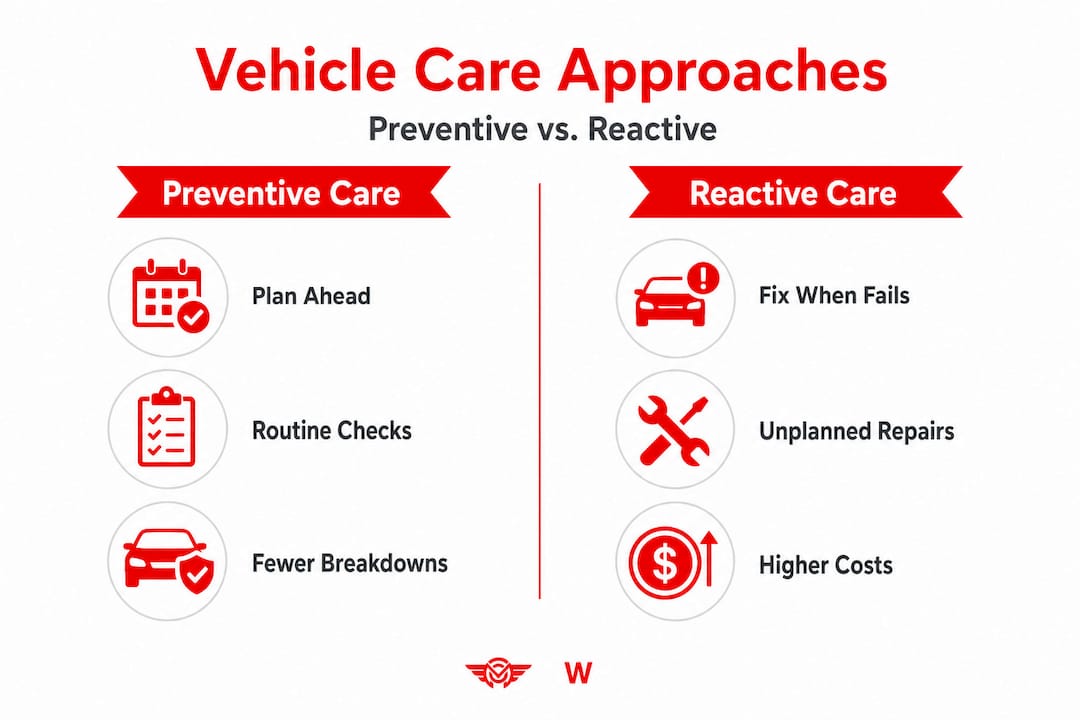
Vehicle maintenance workflows are typically divided into daily and weekly visual checks, monthly inspections, 3 to 6 month service intervals, and annual deep-service appointments covering fluids, tires, brakes, battery, lights, belts, hoses, and filters. Each tier builds on the one before it, so nothing is ever truly overdue.
For owners of luxury or performance vehicles, a luxury car maintenance checklist goes even further, covering specialized systems that standard schedules often miss. And if your odometer is already climbing into six figures, high-mileage maintenance considerations require adjusting those intervals downward to keep aging components in check.
| Maintenance type | Approach | Cost impact | Warranty impact |
|---|---|---|---|
| Preventive | Schedule-driven, proactive | Lower long-term | Supports valid claims |
| Reactive | Symptom-driven, unplanned | Higher, unpredictable | Can void coverage |
Key reasons to commit to a structured workflow:
- Keeps manufacturer and extended warranty claims valid
- Reduces emergency repair frequency and severity
- Builds a paper trail that directly affects resale price
- Catches small issues before they become part replacements
Essential steps for your maintenance workflow
Having defined the overall workflow, let's break down exactly what steps you should follow, with timelines and real examples.
Start by gathering your owner's manual, your extended warranty contract, a maintenance logbook (paper or digital), and a basic scan tool. Without these on hand before you begin, you're working blind. Many owners skip the manual entirely and then wonder why their fluid top-off created a compatibility problem.

Diagnostic methodologies use a structured sequence: verify the complaint, perform a visual inspection, scan OBD codes, test theories based on findings, complete repairs to manufacturer specifications, and verify the fix before closing the task. Following this kind of 9-step roadmap keeps you from guessing and from wasting money on parts that weren't actually the problem.
Here's the sequence to follow every time:
- Visual check (5 minutes): Walk around the vehicle. Look for fluid spots under the car, tire pressure deviations, cracked hoses, and warning lights on the dash.
- Fluid levels (10 minutes): Check engine oil, coolant, brake fluid, power steering fluid, and windshield washer reservoir.
- OBD scan (5 minutes): Even without a warning light, plug in a scan tool monthly to catch pending codes before they become active faults.
- Component inspection (15 to 30 minutes, monthly): Rotate through brake pad thickness, battery terminals, belts, and tire tread depth on a rolling monthly schedule.
- Scheduled service tasks: At the right intervals, change oil, filters, spark plugs, and transmission fluid per manufacturer specs and your driving conditions.
- Verification: After any repair or service, re-check the system you worked on and confirm the fix took hold before logging it as complete.
- Documentation: Record every action, part number, mileage, and date. Keep receipts. This step is what makes everything else defensible.
Safety warning: If you perform DIY brake work or suspension repairs, always use jack stands rated for your vehicle's weight and follow torque specifications exactly. A loose caliper bolt costs far more than the time it takes to double-check.
Pro Tip: For any service you complete yourself, take a photo of the part removed, the new part installed, and the mileage on the odometer. Attach it to your digital log entry. It takes under two minutes and provides warranty-grade documentation if a claim ever comes up.
| Service task | Recommended frequency | DIY possible? |
|---|---|---|
| Engine oil and filter | Every 5,000 to 7,500 miles | Yes |
| Air filter | Every 15,000 to 30,000 miles | Yes |
| Brake pads | Every 25,000 to 60,000 miles | With experience |
| Coolant flush | Every 30,000 to 50,000 miles | Yes, carefully |
| Spark plugs | Every 30,000 to 100,000 miles | Yes |
| Transmission fluid | Every 30,000 to 60,000 miles | Moderate difficulty |
Using your vehicle protection checklist alongside this workflow ensures you never accidentally skip a category. For owners who have also invested in upgraded wheels or suspension components, reviewing forged wheel installation steps confirms your torque and alignment work meets the standards that protect both your investment and your tires.
Common mistakes and how to avoid them
With your workflow steps in place, it's just as important to know what can go wrong and how to prevent expensive mistakes.
The single biggest mistake most drivers make is treating the oil change sticker on the windshield as the only maintenance reminder they need. Mechanics advise against relying on oil stickers alone, and warn that using the wrong fuel grade, ignoring early symptoms, and skipping documentation are the fastest ways to create expensive problems that might also void coverage. Following only that one sticker while neglecting brakes, coolant, and electrical checks is a recipe for a repair bill that far exceeds the cost of consistent upkeep.
Here are the most damaging workflow mistakes and how to sidestep them:
- Ignoring small symptoms. A faint squeal from brakes or a slightly rough idle are signals, not annoyances. Address them at the next scheduled session, not after they escalate.
- Using the wrong fuel grade. This is more common than it sounds, especially when switching between vehicles. The wrong octane causes premature engine wear that builds quietly over time.
- Skipping documentation for DIY work. If you change your own oil and don't record it, your extended warranty provider has no proof the work was done when a related claim arises.
- Delaying cooling system service. Coolant degrades and becomes acidic over time. Neglect here creates the kind of engine damage that costs $3,000 to $8,000 to fix.
- Storing records poorly. Receipts stuffed in a glove box don't survive three summers. Use a dedicated folder, app, or cloud document that's searchable and durable.
Pro Tip: Every time you pay for service at a shop, ask for an itemized receipt with part numbers and mileage noted. Shops are required to provide this, and it becomes instant documentation that avoids warranty pitfalls down the road.
The resale reality: Complete maintenance records consistently add a 5 to 10% premium to resale price. On a $20,000 vehicle, that's $1,000 to $2,000 that most owners leave on the table simply because they didn't keep their receipts organized. Buyers and dealers both factor service history into offers, and a clean logbook signals a well-cared-for vehicle in a way that a fresh detail job never can.
Adapting your workflow to special circumstances
Even a great workflow needs customizing. Let's look at special conditions that require adjustments.
Severe-duty driving is one of the most overlooked variables in vehicle maintenance. Severe-duty conditions include short trips under five miles, frequent towing or hauling, driving in extreme heat or cold, and stop-and-go city driving. If your typical week checks any of these boxes, your service intervals should be roughly 50% shorter than the standard recommendations. That means oil changes closer to 3,500 miles instead of 7,500, brake inspections every 15,000 miles instead of 30,000, and coolant flushes every 20,000 to 25,000 miles. Ignoring this leads to premature failures that manufacturers often won't cover under warranty because the conditions voided the standard recommendation.
For high-mileage or older vehicles, you should also customize your warranty coverage to match the specific components most vulnerable at your vehicle's age and mileage.
Severe-duty workflow adjustments to consider:
- Shorten all fluid change intervals by 30 to 50%
- Add monthly inspection of brake lines and suspension bushings
- Check tire pressure weekly instead of monthly due to extreme temperature swings
- Increase battery load testing to twice per year if temperatures regularly drop below 20°F
- Inspect towing components (hitch, wiring harness, trailer brake controller) before every tow
The "lifetime fluid" myth is another area where drivers get burned. CVT and transmission fluids labeled as "lifetime fills" by manufacturers should realistically be changed every 30,000 to 60,000 miles, regardless of what the badge says. The consequences of skipping this include $3,500 to $7,000 transmission rebuilds that extended warranty coverage may or may not include depending on your plan terms. When in doubt, change the fluid and document it. Records matter more than mileage when it comes to proving due diligence. For vehicles protecting against harsh conditions, external elements also accelerate fluid degradation, making more frequent service non-negotiable.
| Service item | Standard interval | Severe-duty interval |
|---|---|---|
| Engine oil | 5,000 to 7,500 miles | 3,000 to 4,000 miles |
| Transmission fluid | 60,000 miles | 30,000 miles |
| Brake fluid | 2 years | 1 year |
| Air filter | 20,000 miles | 10,000 to 12,000 miles |
| Spark plugs | 60,000 to 100,000 miles | 40,000 to 60,000 miles |
Maximizing value: Documentation, resale, and warranty claims
Once you've customized your workflow, the final step is to document and prove it, which is essential for protecting your investment.
Check engine repairs averaged $554 in 2025, a 33% increase over recent years, driven largely by aging vehicles and deferred maintenance. That trend isn't reversing. The best defense isn't luck or a good mechanic. It's a workflow that catches the precursors to those failures before they happen and a paper trail that makes any warranty claim airtight.
What counts as quality documentation for warranty providers and buyers:
- Dated receipts with part numbers and mileage
- Shop invoices showing labor descriptions and technician notes
- Personal maintenance logs with dates, mileage, and tasks performed
- Photos of before and after states for DIY repairs
- Manufacturer-recommended service records pulled from dealerships
Annual maintenance costs run roughly $500 to $700 for newer vehicles and $1,200 to $1,500 for older ones. Preventive spending returns $3 to $10 for every $1 invested by avoiding the larger repairs that follow neglect. That math is hard to argue with, especially when you factor in the 5 to 10% resale premium that documented service history brings.
Strong documentation also supports essential warranty features by giving your provider exactly what they need to process a claim without delays or disputes. And if you're actively working to reduce car repair costs, a complete service record is one of the highest-leverage tools available. Even premium upgrades like quality wheel finishes add resale value only when paired with a documented history that confirms the vehicle was cared for overall.
What most drivers miss about maintenance workflows
Here's the honest truth: most vehicle owners know they should maintain their cars regularly, and most of them still fall short. Not because they're careless, but because they treat maintenance as a series of isolated tasks rather than a connected process. They get the oil changed when the sticker says to. They fix the brake squeal when it gets embarrassing. But they never build the system that ties everything together.
The mindset shift that actually changes outcomes is thinking of your workflow as something you run rather than something you remember. A process runs on its own momentum. A list depends on you never forgetting. Most people forget.
What we've seen repeatedly is that warranty claims fail not because the owner skipped maintenance, but because they can't prove they didn't. The engine was serviced, the fluids were changed, but there's no receipt, no log entry, and no photo. The claim gets denied or delayed, and the owner feels cheated even though they did the work. Documentation isn't a bureaucratic formality. It's the proof of care that makes your investment recoverable.
The good news is that being systematic doesn't mean being perfect. A workflow that catches 90% of issues on schedule, with solid records for every service performed, outperforms sporadic perfect maintenance that goes undocumented. Start with the auto warranty basics so you understand exactly what your coverage requires, then build your records around those requirements from day one.
The drivers who come out ahead financially aren't the ones who spend the most on maintenance. They're the ones who spend consistently, record everything, and never let a gap in their history become a gap in their coverage.
Protect your wallet with a solid maintenance workflow and extended coverage
You've built the workflow, customized it for your conditions, and understand why documentation is the backbone of every successful claim. Now it's time to make sure your coverage is as strong as your process.
At RPM Warranty, we make it straightforward to match your vehicle with a protection plan that supports the kind of owner you're working to become. A well-documented maintenance history makes claim approvals faster and less stressful because our team has exactly what they need to process your case. Whether you want broad coverage or targeted protection for specific components, you can review protection plans designed for real driving conditions. Get your personalized estimate today with a free warranty quote, or check our warranty FAQs if you want to understand exactly what's covered before you commit.
Frequently asked questions
How often should I follow a full maintenance routine?
Manufacturer-recommended schedules include daily and weekly visual checks, monthly inspections, and annual deep-service intervals, though your specific driving habits and conditions may require more frequent attention.
Does DIY maintenance affect my warranty?
DIY maintenance is acceptable for warranty purposes as long as you keep detailed records, dated receipts for parts, and notes on the work completed to document every service.
What's the top error owners make with maintenance workflows?
Many owners rely solely on the oil change sticker while skipping documentation for other services, which creates gaps in their records that can invalidate warranty claims even when the actual work was done.
How does maintenance impact vehicle resale?
Complete service records can add a 5 to 10% premium to your vehicle's resale price, because documented care signals to buyers and dealers that the car was genuinely maintained, not just cleaned up for sale.