

TL;DR:
- Your auto warranty deductible directly impacts your out-of-pocket repair costs.
- Choosing between per repair and per visit deductibles can save money on multiple repairs.
- Understanding coverage exclusions and negotiating terms improves warranty value and reduces surprises.
Most vehicle owners assume their extended warranty means minimal out-of-pocket costs when something breaks. The reality is more nuanced. Your deductible, the fixed amount you pay before your plan kicks in, directly controls how much you actually spend at the repair shop. Get it wrong and you could pay hundreds more than necessary on a single visit. Get it right and you could save thousands over the life of your vehicle. This guide breaks down exactly how auto warranty deductibles work, compares the two main structures side by side, and shows you how to pick the option that keeps more money in your pocket.
Table of Contents
- What is a deductible in an auto warranty?
- Types of deductible structures: Per repair vs per visit
- What's covered, what's excluded, and how deductibles apply
- How to choose the right deductible: Key tips and pitfalls
- Our take: Why smart deductible decisions drive real auto warranty value
- Next steps: Protect your vehicle with the right coverage
- Frequently asked questions
Key Takeaways
| Point | Details |
|---|---|
| Deductible basics | A deductible is the fixed amount you pay out of pocket for covered repairs before warranty coverage applies. |
| Structure matters | Per-visit deductibles usually save more when multiple repairs are needed than per-repair structures. |
| Coverage counts | Your deductible only applies to repairs covered by your warranty—always check your contract for exclusions. |
| Negotiation opportunity | You can often negotiate both deductible level and deductible type with warranty providers. |
What is a deductible in an auto warranty?
A deductible is the flat dollar amount you agree to pay out of pocket each time you file a warranty claim before your plan covers the remaining repair cost. Think of it like your health insurance deductible. You pay a set amount first, and the plan handles the rest. The key difference is that auto warranty deductibles can work in two distinct ways depending on how your contract is written, and that distinction matters enormously.
Here is a simple example. Say your engine mounts fail and the repair bill comes to $3,892. If your extended warranty plan carries a $200 deductible, you pay $200 and the warranty covers the remaining $3,692. That is a significant financial cushion. According to VSC industry data, the average repair cost covered by a vehicle service contract was $3,892 in 2023, with average claim payouts reaching $4,127 in 2022. Powertrain claims, covering engines, transmissions, and drivetrain components, account for 68% of all VSC claims. That means the parts most likely to fail are also the most expensive to fix.
Here is what a deductible applies to in most plans:
- Approved mechanical breakdowns such as engine or transmission failures
- Electrical system repairs including sensors, modules, and wiring
- Cooling system components like water pumps and radiators
- Powertrain parts, which represent the bulk of claims
- High-tech components such as navigation and driver assist systems (check your contract carefully)
Understanding the VSC deductible rules in your specific contract is the first step to avoiding surprise costs.
Pro Tip: Ask your warranty provider upfront whether the deductible is per repair or per visit before you sign anything. This single question can change your total out-of-pocket costs by hundreds of dollars.
Types of deductible structures: Per repair vs per visit
Understanding the basics, let's see how deductible structures impact real repair bills. There are two primary deductible models used in extended auto warranties, and choosing between them is one of the most important decisions you will make.
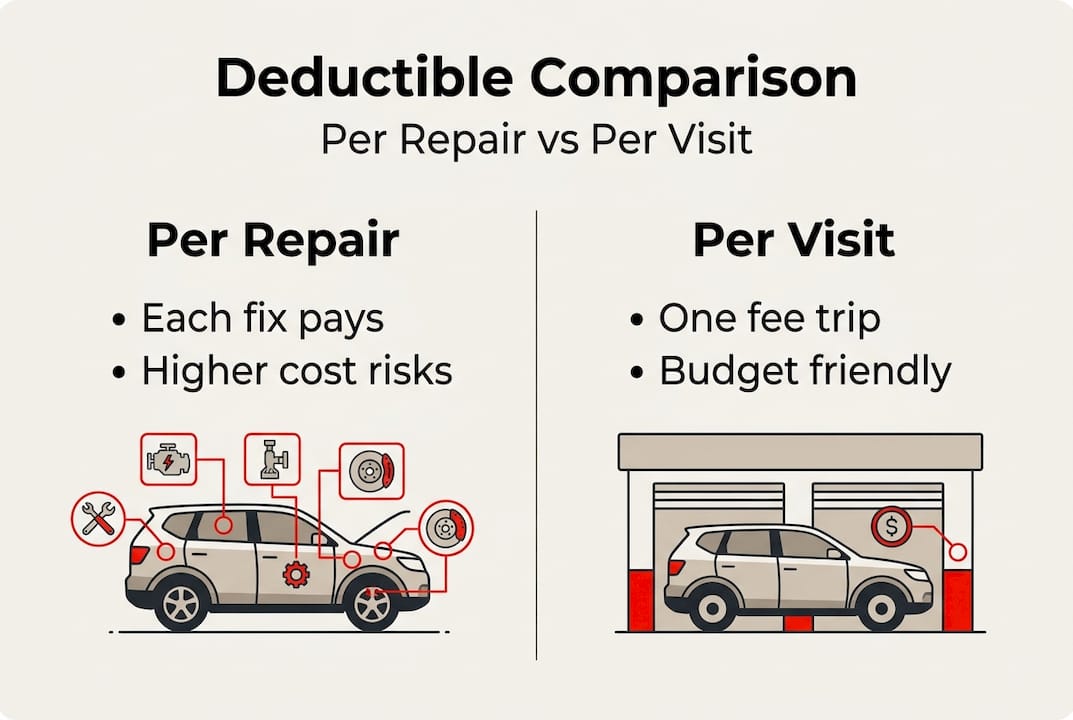
Per repair deductible: You pay the deductible separately for each individual repair completed during a single shop visit. If three components fail and each is a separate repair line item, you pay the deductible three times.

Per visit deductible: You pay the deductible once per shop visit, regardless of how many individual repairs are completed. Three repairs on the same day at the same shop? One deductible charge.
Here is how those two structures compare in a real scenario:
| Scenario | Per repair ($100 each) | Per visit ($100) |
|---|---|---|
| 1 repair on visit | $100 out of pocket | $100 out of pocket |
| 3 repairs on same visit | $300 out of pocket | $100 out of pocket |
| 5 repairs on same visit | $500 out of pocket | $100 out of pocket |
The difference becomes dramatic when your vehicle needs multiple repairs at once. High-tech component claims are rising 34% year over year, and modern vehicles often need several related fixes in a single visit. A per-visit structure protects you in exactly those situations.
Here is a step-by-step way to evaluate which structure fits your situation:
- Review your vehicle's repair history. Older vehicles or those with high mileage tend to need multiple repairs at once.
- Estimate claim frequency. If you expect one repair per year, per repair vs per visit may cost the same. Multiple repairs per visit changes the math fast.
- Compare premium differences. Per-visit plans sometimes carry slightly higher premiums. Run the numbers to see if the premium increase is offset by deductible savings.
- Ask about zero-deductible options. Some plans offer $0 deductibles in exchange for higher monthly premiums. This can make sense for choosing the right deductible if you drive a high-mileage vehicle.
Pro Tip: If your vehicle is over 80,000 miles, a per-visit deductible structure almost always delivers better value. Older vehicles rarely need just one repair at a time.
What's covered, what's excluded, and how deductibles apply
Choosing the right deductible type matters, but so does knowing what your contract covers. A low deductible means nothing if the repair you need is excluded from your plan entirely.
Most extended warranty plans cover approved mechanical breakdowns across major systems. Your deductible applies to those approved claims. But many repairs fall outside that scope, and no deductible applies because the plan simply will not pay.
Common exclusions you need to know:
- Routine maintenance: Oil changes, brake pads, filters, and tire rotations are almost never covered
- Wear-and-tear items: Wiper blades, belts, and clutch components in most plans
- Cosmetic damage: Dents, scratches, and interior wear
- Pre-existing conditions: Damage present before the plan started
- High-tech components: Some advanced driver assistance systems and infotainment modules face exclusions, with a 34% YoY exclusion rate rise for tech-related claims
Reading your contract carefully is not optional. The CA Insurance Guide on VSCs recommends always checking your contract for deductible structure, the obligor (the insurer backing the vehicle service contract provider), and all exclusions before signing.
Always check who backs your warranty. A vehicle service contract is only as reliable as the company obligated to pay claims. Confirm the plan is backed by a licensed insurer, not just the selling dealer.
Familiarize yourself with common warranty exclusions so you are never caught off guard. It also pays to understand how to read your service contract before a repair situation arises. Some states, particularly California, have consumer protections that govern how VSCs must be structured and disclosed. Check whether your state requires backup insurance for the contract provider.
Knowing what is covered and what is excluded tells you exactly how much your deductible will actually cost you over time. That context makes the premium-versus-deductible tradeoff much clearer. For additional details on what specific service contract coverage includes, reviewing multiple plan summaries side by side is a smart move.
How to choose the right deductible: Key tips and pitfalls
Now that you have seen how deductibles and coverage interact, here is how to make the smartest deductible choice for your next warranty.
The biggest mistake most owners make is focusing only on the monthly premium. A low premium with a high per-repair deductible can cost far more over three to five years than a slightly higher premium with a per-visit structure. The math only works in your favor when you account for realistic repair scenarios.
Follow these steps to choose wisely:
- Match deductible to your risk profile. Low mileage, newer vehicle, and strong maintenance history? A standard deductible with a lower premium may be fine. High mileage or a vehicle known for complex repairs? Prioritize a low or per-visit deductible.
- Read the actual contract, not the brochure. The brochure highlights benefits. The contract reveals deductible structure, exclusions, and claim limits. These are the numbers that matter.
- Negotiate. Unlike traditional insurance, VSC prices are unregulated, which means deductible amounts and coverage terms are often negotiable. Ask directly for a lower deductible or better terms before accepting the first offer.
- Plan for tech repairs. If your vehicle has advanced electronics, factor in the rising cost and exclusion risk of those components when setting your deductible expectations.
- Balance premium vs. savings. Use industry deductible statistics to benchmark what typical claims cost and work backward to find the deductible that minimizes your total spend.
Avoid the trap of assuming a zero-deductible plan is always the best deal. Sometimes the premium increase for a zero-deductible plan exceeds what you would actually pay in deductibles over the contract period. Run the numbers. And always address car warranty myths before making a final decision, since misinformation about coverage often leads to poor deductible choices.
Pro Tip: Ask your warranty provider how long claims typically take to process. Faster claims processing means you get your car back sooner, which reduces indirect costs like rental vehicles that can add up alongside your deductible.
Our take: Why smart deductible decisions drive real auto warranty value
Here is something most warranty guides will not tell you. The monthly premium gets all the attention, but over the life of a vehicle, your deductible structure often has a bigger impact on total cost. We have seen owners save significantly by simply switching from a per-repair to a per-visit deductible on a high-mileage vehicle, without changing anything else about their plan.
In 2026, with tech-heavy vehicles becoming the norm, the stakes are even higher. Advanced driver assistance systems, electric components, and connected car features are creating new categories of expensive repairs that many contracts still exclude or apply high deductibles to. Knowing the details of your contract before a repair is not just smart, it is essential.
Never accept the first contract offer. Negotiation is standard in this industry, and the first number you see is rarely the best one. Triple-check plan limits, especially for multi-repair claims, and review essential warranty features to know what a strong plan actually looks like. Ask about claims processing speed, too. A plan that takes weeks to approve a claim adds real costs beyond the deductible itself.
Next steps: Protect your vehicle with the right coverage
Ready to make your deductible work for you? Here is how to take the next step.
At RPM Warranty, we believe deductible flexibility is a core part of any strong extended warranty plan. Whether you drive a high-mileage daily driver or a newer vehicle you want to protect long-term, the right deductible structure can mean the difference between a manageable repair bill and a financial surprise.

Our plans are built to be customized, including deductible options that fit your repair risk and budget. If you own a Volkswagen, explore our tailored Volkswagen warranty options to see how coverage is structured for your specific model. Or skip straight to the numbers and get a free warranty quote to compare plans side by side. The right coverage is closer than you think.
Frequently asked questions
Is a lower deductible always better in an auto warranty?
Not always. Lower deductibles come with higher premiums, so the right choice depends on your repair history and how often you expect to file claims. VSC prices are unregulated, so negotiate for the balance that fits your budget.
Do deductibles apply to all repairs under an extended auto warranty?
Deductibles only apply to repairs that are approved and covered under your plan. Excluded items like routine maintenance are not covered at all, so no deductible applies. Always check your contract for the full list of exclusions.
Which deductible structure saves more: per-visit or per-repair?
Per-visit deductibles typically save more when you need multiple repairs in a single shop visit, since you only pay once. Per-visit structures are especially valuable as high-tech component claims continue to rise.
Can I negotiate my deductible on an extended warranty?
Yes. Extended warranty contracts are not regulated the same way traditional insurance is, so deductible and coverage terms are often open to negotiation before you sign. Always ask before accepting the first offer.