

TL;DR:
- Drivetrain warranties exclude the engine and internal parts, focusing only on transmission, axles, and driveshaft.
- Broader coverage like bumper-to-bumper or powertrain warranties often provide better value and protection.
- Drivetrain failures are rare but costly when they occur, with repairs costing up to $5,000 or more.
Most car owners assume their drivetrain warranty covers everything under the hood. It doesn't. In fact, the engine is almost always excluded from drivetrain coverage, which surprises a lot of people at the worst possible moment: when they're staring at a repair bill. Drivetrain failures are relatively rare, but when they happen, costs can easily top $5,000. Understanding exactly what you're buying before you sign a contract is the difference between real protection and a false sense of security. This guide breaks down coverage details, compares warranty types, and helps you decide whether a drivetrain warranty is actually worth your money.
Table of Contents
- What a drivetrain warranty covers (and excludes))
- Drivetrain versus powertrain and bumper-to-bumper coverage
- How common are drivetrain failures and what repairs cost
- When a drivetrain warranty makes sense (and when it doesn't))
- Expert perspective: Why broader coverage usually wins
- Protect your car with comprehensive warranty options
- Frequently asked questions
Key Takeaways
| Point | Details |
|---|---|
| Covers power delivery parts | Drivetrain warranties protect the parts that send engine power to your wheels, not the engine itself. |
| Engine not included | Unlike powertrain warranties, drivetrain-only contracts do not cover engine repairs. |
| Failures are rare | Drivetrain problems happen less often than electronic or infotainment breakdowns. |
| Costly repairs possible | A major drivetrain repair can cost thousands, so coverage choices matter. |
| Broader coverage is smarter | Experts recommend comprehensive warranties for most drivers to avoid denial surprises. |
What a drivetrain warranty covers (and excludes)
A drivetrain warranty is a service contract that protects the components responsible for delivering power from the engine to the wheels. Notice that phrase: from the engine. The engine itself is not included. According to industry definitions, a drivetrain warranty covers the transmission, transaxle, driveshaft, differentials, and axles, but stops short of the engine block and its internal parts.
This distinction matters more than most drivers realize. If your transmission fails, you're covered. If your engine seizes, you're not. That gap can cost you thousands.
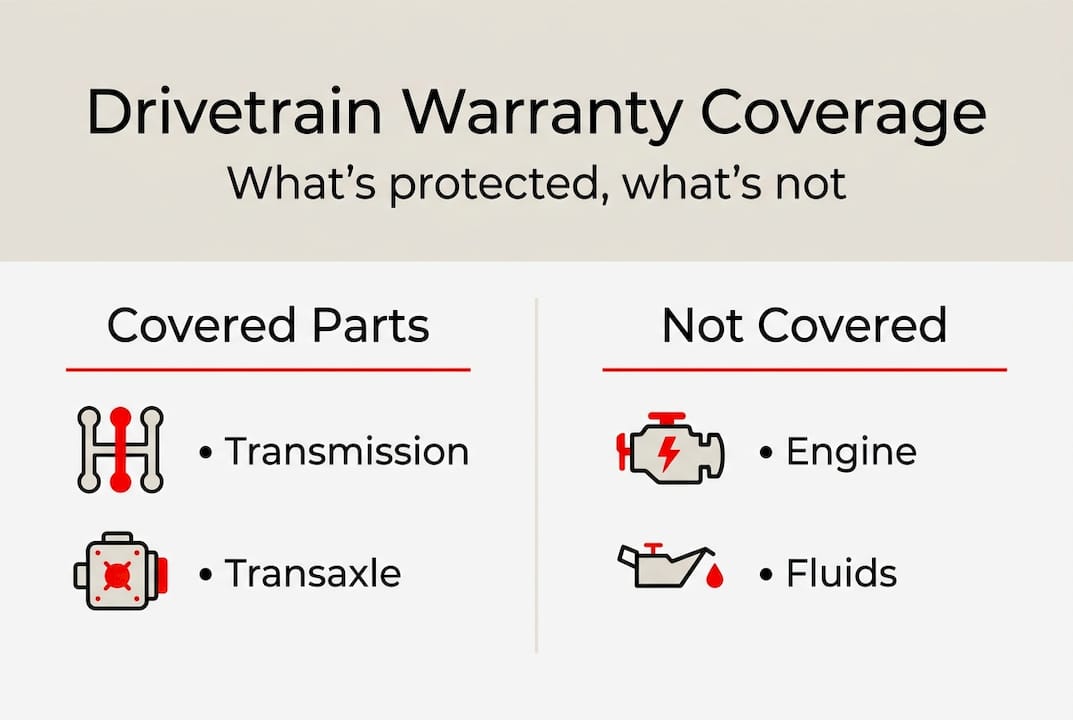
Here's a quick reference for what's typically in and out:
| Covered components | Excluded components |
|---|---|
| Transmission | Engine and engine internals |
| Transaxle | Fluids and filters |
| Driveshaft | Seals and gaskets |
| Differentials | Wear-and-tear items |
| Axles and CV joints | Damage from accidents |
| Transfer case | Modifications or aftermarket parts |
The exclusions list is where many claims fall apart. Common exclusions include wear items like fluids and filters, misuse, lack of maintenance, accidents, vehicle modifications, and secondary damage. Secondary damage is especially tricky: if a failed seal causes your differential to run dry and destroys itself, the warranty may deny the claim because the root cause was a seal, which isn't covered.
Here are the exclusions that catch drivers off guard most often:
- Maintenance neglect: Missing oil changes or skipping scheduled service can void your claim entirely
- Pre-existing conditions: Damage that existed before the contract started is never covered
- Modifications: Aftermarket lifts, tires, or performance parts can invalidate coverage
- Secondary damage: Damage caused by an excluded part is usually also excluded
- Improper use: Towing beyond rated capacity or off-road use on a non-rated vehicle
Pro Tip: Before signing any drivetrain warranty contract, request the full list of covered parts in writing. A reputable provider will hand it over without hesitation. If they can't or won't, walk away.
Drivetrain versus powertrain and bumper-to-bumper coverage
With drivetrain coverage defined, it's important to see how it stacks up against other popular warranty types. The three you'll encounter most often are drivetrain, powertrain, and bumper-to-bumper. They sound similar but protect very different things.
Drivetrain warranties are primarily offered by third-party providers as service contracts. Manufacturers rarely offer standalone drivetrain warranties. Instead, automakers provide powertrain warranties, which include the engine on top of all the drivetrain components. That's a meaningful upgrade.
Some manufacturers go even further. Brands like Hyundai, Kia, Genesis, and Mitsubishi offer 10-year/100,000-mile powertrain warranties, which cover drivetrain components as part of a much broader package. If you own one of these vehicles, you may already have strong protection without spending a dollar on a third-party contract. You can learn more about specific options through our guides on Hyundai extended warranty, Kia extended warranty, and Mitsubishi extended warranty coverage.
| Warranty type | Engine | Drivetrain | Electrical | A/C and heating | Typical source |
|---|---|---|---|---|---|
| Drivetrain | No | Yes | No | No | Third-party |
| Powertrain | Yes | Yes | No | No | Manufacturer |
| Bumper-to-bumper | Yes | Yes | Yes | Yes | Manufacturer or third-party |
Here's a quick rundown of the pros and cons:
- Drivetrain: Lower cost, but narrow coverage and high denial risk
- Powertrain: Better value, includes engine, but still misses electrical and comfort systems
- Bumper-to-bumper: Broadest protection, covers most repair scenarios, typically higher cost
If you want a deeper look at how these two common options compare, our bumper-to-bumper vs powertrain warranty guide walks through the key differences side by side. You can also explore what bumper-to-bumper warranty covers in detail.
Pro Tip: If your budget allows, experts consistently recommend bumper-to-bumper coverage over narrower options. The broader the coverage, the fewer surprises you'll face at the repair shop.
How common are drivetrain failures and what repairs cost
A fair comparison requires understanding not just coverage but actual risk and repair costs. Here's where the data gets interesting and maybe a little counterintuitive.
Drivetrain components have relatively low failure rates compared to electronics or infotainment systems. J.D. Power's 2025 U.S. Vehicle Dependability Study identifies infotainment as the top problem area for vehicle owners, not the powertrain or drivetrain. That's worth sitting with for a moment: the part of your car most likely to break is the touchscreen, not the transmission.

But when drivetrain components do fail, the bills are serious. Here's a realistic look at repair costs:
| Drivetrain component | Estimated parts cost | Estimated labor cost | Total range |
|---|---|---|---|
| Driveshaft replacement | $300 to $1,500 | $150 to $500 | $450 to $2,000+ |
| CV axle replacement | $100 to $400 | $100 to $300 | $200 to $700 |
| Differential repair | $400 to $1,000 | $200 to $500 | $600 to $1,500 |
| Transmission replacement | $1,500 to $4,000 | $500 to $1,200 | $2,000 to $5,000+ |
As repair data shows, a driveshaft replacement alone can run $300 to $2,000 or more for parts, plus $150 to $500 in labor. Transmission replacement can push past $5,000 depending on the vehicle.
"Infotainment continues to be the top problem area for vehicle owners, while powertrain and drivetrain reliability has improved significantly in recent years." — J.D. Power 2025 Vehicle Dependability Study
Drivetrain failures are most likely in these situations:
- High-mileage vehicles over 100,000 miles, especially those with deferred maintenance
- Models with known defects, such as certain CVT (continuously variable transmission) designs prone to early failure
- Vehicles used for towing or hauling beyond their rated capacity
- Four-wheel drive and all-wheel drive systems with complex transfer cases and differentials
- Used vehicles with unknown service histories
The takeaway is that drivetrain risk is real but not universal. Your specific vehicle, mileage, and driving habits matter enormously when evaluating whether added coverage makes financial sense.
When a drivetrain warranty makes sense (and when it doesn't)
With risk and costs in view, you might wonder: When does a drivetrain warranty add real value? The honest answer is: less often than providers might suggest, but there are genuine exceptions.
Here are the scenarios where a drivetrain warranty is worth considering:
- Your vehicle has a known drivetrain defect. Certain models, particularly those with CVT transmissions, have documented reliability issues. A targeted warranty can offset that specific risk.
- Your factory warranty just expired. The window right after manufacturer coverage ends is when unexpected repair costs hit hardest. A warranty after factory coverage can bridge that gap.
- You're buying a used vehicle. Used cars often come without any remaining manufacturer warranty, making third-party coverage more relevant.
- You can't absorb a large unexpected expense. If a $3,000 repair would seriously strain your finances, having coverage provides real peace of mind.
- You drive high mileage annually. More miles means faster wear on drivetrain components, which raises your statistical risk.
On the flip side, watch for these red flags:
- Vague contract language that doesn't specify covered parts by name
- Very low premiums that seem too good to be true, often a sign of narrow coverage
- High deductibles that eat into any claim benefit
- No transferability if you plan to sell the vehicle before the contract ends
- Providers without a track record or verifiable customer reviews
Pro Tip: Your maintenance records are your best friend when filing a drivetrain claim. Keep every receipt for oil changes, fluid flushes, and scheduled service. A single gap in your records can give a warranty provider grounds to deny your claim.
If you're trying to match coverage to your vehicle's age and condition, our guide on choosing a car warranty by year offers a practical framework for making that call.
Expert perspective: Why broader coverage usually wins
Having weighed all sides, here's a take that might surprise you: most drivers who buy drivetrain-only warranties end up disappointed.
It's not because drivetrain warranties are fraudulent. It's because the math rarely works in the buyer's favor. Experts recommend bumper-to-bumper over narrow drivetrain-only coverage precisely because drivetrain failures are uncommon, and when claims do arise, exclusions often lead to denials. You pay premiums for years and then get turned down because the failed seal that caused your differential damage wasn't on the covered parts list.
The vehicles most likely to have drivetrain problems are also the ones with other aging systems that need attention. Buying narrow coverage on a high-mileage vehicle is like insuring only the roof of a house with old plumbing and wiring. The risk you're actually exposed to is broader than what you're protecting against.
Our view is straightforward: if you're going to invest in an extended warranty, a bumper-to-bumper vs powertrain warranty comparison will almost always point you toward broader coverage. The exception is a very specific, documented drivetrain risk on a vehicle that's otherwise in excellent shape. That's a rare scenario, and it requires careful contract review before you commit.
Protect your car with comprehensive warranty options
If you want to align your warranty strategy with expert advice, the right starting point is exploring coverage that actually matches your risk profile.
At RPM Warranty, we offer extended vehicle warranties designed to go beyond narrow drivetrain protection. Our Elite, Advanced, and Essential plans cover engines, transmissions, electrical systems, cooling, and more, so you're not left exposed when something unexpected happens. You can get free warranty quotes in minutes, with no obligation. If you drive a Volkswagen and want to see specific plan options, check out our Volkswagen extended warranty page. The right coverage is out there. Let's help you find it.
Frequently asked questions
What does a drivetrain warranty NOT cover?
Drivetrain warranties generally exclude the engine, fluids, filters, seals, damage from accidents, lack of maintenance, and wear-and-tear items. Always read the full covered parts list before signing.
How are drivetrain and powertrain warranties different?
A drivetrain warranty covers only the parts that deliver power to the wheels, while a powertrain warranty also includes the engine and its internal components, offering broader protection.
Are drivetrain problems common in modern vehicles?
Drivetrain failures are relatively rare compared to electronics and infotainment issues, which J.D. Power consistently identifies as the top problem area for vehicle owners.
When should I consider buying a drivetrain warranty?
Consider it if your vehicle has a known drivetrain defect or your factory coverage has just expired, but always review the contract's covered parts list carefully before purchasing.