

TL;DR:
- Most vehicle owners misunderstand "lifetime warranty," assuming it covers repairs forever, but its actual meaning varies by provider and often ends with ownership or product life. These warranties mainly cover manufacturing defects and specific parts, while excluding routine maintenance, wear, and pre-existing conditions, which can lead to unexpected out-of-pocket costs. To avoid disputes, owners should thoroughly review the contract, document maintenance, and understand the actual scope of coverage before relying on a lifetime warranty.
Most vehicle owners hear the phrase "lifetime warranty" and picture a golden ticket — one that covers every repair, forever, without question. That picture is almost always wrong. As legal experts note, a lifetime warranty is not a standardized term, and its meaning depends entirely on how the provider defines it, not how you imagine it. Before you rely on one of these warranties when a major repair bill lands in your lap, you need to understand exactly what you signed up for, what's excluded, and where the real protection gaps are.
Table of Contents
- What does 'lifetime warranty' really mean?
- What does a lifetime warranty cover — and what doesn't it cover?
- Lifetime vs. extended warranty: What's the difference?
- Risks, claims, and common disputes with lifetime warranties
- Lifetime warranties: What most vehicle owners miss
- How to get vehicle protection that actually works for you
- Frequently asked questions
Key Takeaways
| Point | Details |
|---|---|
| Lifetime warranty is limited | It usually covers the product's life or ownership period, not your lifetime. |
| Coverage exclusions matter | Normal wear, routine maintenance, and accidents are typically not covered. |
| Extended vs. lifetime | Extended warranties have fixed durations; lifetime warranties have conditional terms. |
| Read the fine print | Many disputes arise from unclear or misunderstood contract details. |
| Smart protection strategy | Combine warranties with proactive maintenance to avoid unexpected costs. |
What does 'lifetime warranty' really mean?
The term "lifetime warranty" sounds permanent, but it carries no universal legal definition. The actual meaning is set by whoever writes the contract, whether that's an automaker, parts retailer, or third-party warranty provider. Understanding auto warranty basics is the first step before you can interpret what any specific plan promises.
In practice, there are three common ways providers define "lifetime" in the vehicle world:
| Definition type | What it means in practice | How common is it? |
|---|---|---|
| Product useful life | Coverage lasts until the part fails from defect or becomes obsolete | Very common for parts warranties |
| Ownership period | Coverage lasts as long as the original buyer owns the vehicle | Common in dealer-sold plans |
| Fixed period or mileage cap | "Lifetime" is capped at a set number of years or miles | Less common but exists |
| Buyer's literal life | True coverage for the owner's natural lifetime | Extremely rare |
The last row in that table is what most people assume they're getting. The first three are what they usually receive. This gap between expectation and reality is where costly surprises happen.
"A 'lifetime warranty' is not a standardized term; in practice it usually means a warranty lasting for a defined 'lifetime' specified by the seller or manufacturer — often the product's useful life or the original owner's ownership period — not necessarily for the buyer's literal life forever." — LegalClarity.org
This distinction matters enormously. If you sell your car, an ownership-based vehicle guarantee typically ends the moment the title transfers. The next buyer gets nothing. If the provider defines "lifetime" as the part's useful life, they may argue the part simply reached the end of that life rather than failed from a defect. These definitions open the door to denials that feel completely unfair — but are technically within the contract terms.
Always read the warranty documentation before you purchase. Ask the provider directly: "How do you define 'lifetime' in this contract?" If they can't give you a precise written answer, treat that as a warning sign.
What does a lifetime warranty cover — and what doesn't it cover?
Once you understand what "lifetime" actually means, the next question is coverage scope. Even within their defined timeframe, most lifetime warranties are far more limited than their name suggests.
What lifetime warranties typically cover:
- Manufacturing defects in parts or workmanship
- Specific named components such as engines or transmissions (depending on the plan)
- Replacement of defective parts using original or equivalent components
- Labor costs associated with covered repairs (sometimes, not always)
What lifetime warranties typically exclude:
- Normal wear and tear on brakes, tires, belts, and filters
- Pre-existing damage or conditions present before the warranty started
- Routine maintenance such as oil changes, fluid flushes, and tune-ups
- Damage caused by accidents, floods, or acts of nature
- Cosmetic issues including paint chips, dents, and interior wear
- Modifications or aftermarket parts that may affect original components
- Neglect-related failures tied to skipped maintenance
Extended warranties share a similar exclusion list: coverage that sounds broad rarely equals an automatic repair for every failure, because warranties broadly exclude wear-and-tear, accidents, and routine maintenance regardless of the label. Knowing what's excluded is just as important as knowing what's included. Many vehicle owners only discover these exclusions at the worst possible time, when they're standing at a service counter expecting the warranty to cover a repair that's clearly listed as excluded.

Understanding what's covered under exclusionary warranties can help you map out your actual exposure before you're in a bind. Similarly, specific coverage types like powertrain warranty benefits are worth researching separately, since powertrain coverage is often the most valuable protection for long-term vehicle owners.
Thinking about vehicle maintenance plans separately from your warranty coverage is also a smart move, because maintenance and warranty protection serve very different purposes.
Pro Tip: Before signing any warranty contract, ask the provider to hand you a written list of every item that is specifically excluded. If they resist providing that list, walk away. Legitimate providers give you this information without hesitation.
Lifetime vs. extended warranty: What's the difference?
At first glance, a lifetime warranty sounds superior to an extended warranty. But the comparison isn't that simple once you look at contract structure, claims processes, and what you're actually protected against.
Extended warranties, also called vehicle service contracts, are typically structured with clear start and end dates, defined mileage caps, and explicit deductibles. They are transparent about their time boundaries. Lifetime warranties, by contrast, promise an undefined period but load that period with conditional limitations that can effectively shorten real coverage.
| Feature | Lifetime warranty | Extended warranty |
|---|---|---|
| Duration | Defined by provider (ownership period, part life, etc.) | Fixed period or mileage cap |
| Deductible | Often none stated, but may have hidden fees | Usually stated clearly ($0 to $200 per visit) |
| Transferability | Typically non-transferable | Often transferable for a fee |
| Exclusions | Many, often broadly written | Many, but usually clearly itemized |
| Claims process | Can be vague or disputed | Usually structured and predictable |
| Cost | Varies widely | Varies by plan level and vehicle |
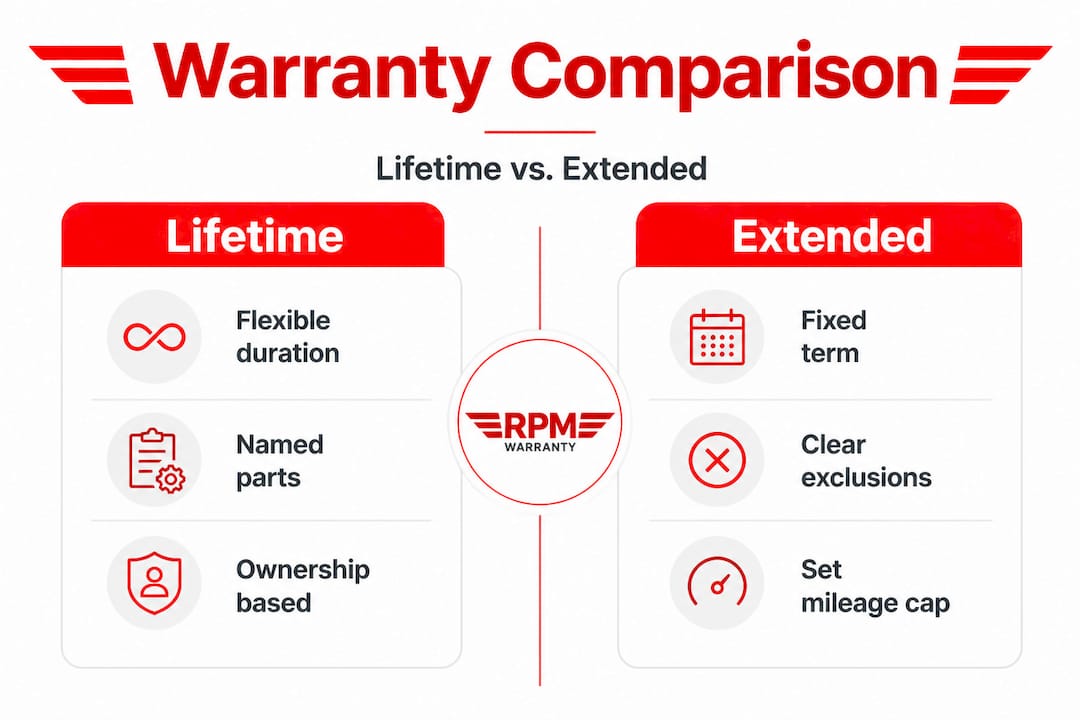
The difference between factory and extended warranties adds another layer to this comparison. Factory warranties come from the manufacturer and have standardized terms. Extended warranties and lifetime plans are typically sold by third parties, which means the terms vary enormously. It's worth taking time to compare warranty coverage examples using real scenarios before committing to any plan.
When deciding what fits your needs, ask yourself these three questions:
- What components am I most worried about? If it's the engine and transmission, look for powertrain-specific coverage with clear terms. A "lifetime" label on a plan that excludes powertrain is nearly worthless for major repairs.
- How long do I plan to own this vehicle? If you trade in every three years, a shorter extended warranty may give you better value than a conditional lifetime plan that ends when you sell.
- How clear is the claims process? A warranty is only valuable when you can actually use it. Ask the provider to walk you through a sample claim scenario before you sign.
Reviewing warranty protection options from multiple angles, including your budget, vehicle age, and driving habits, gives you a much sharper picture than comparing labels alone.
Pro Tip: Don't evaluate warranties by length. A five-year extended warranty with transparent coverage and a fast claims process often beats a "lifetime" plan with vague exclusions and a difficult approval procedure. Depth of coverage matters more than duration.
Risks, claims, and common disputes with lifetime warranties
Understanding the theory of lifetime warranties is useful. Understanding what goes wrong in practice is critical.
The biggest source of claim denials falls into three categories: exclusions you didn't fully read, damage deemed "pre-existing" before coverage started, and vague contract wording that the provider interprets in their favor. Each of these is a legitimate risk that real vehicle owners face regularly.
How to reduce your warranty risk:
- Read every exclusion carefully before signing, not after a repair is needed
- Document all vehicle maintenance with dated receipts and service records
- Ask the provider how they define "pre-existing condition" before coverage starts
- Request an inspection or condition report at the start of coverage to lock in the vehicle's baseline state
- Understand the claims process completely, including who approves repairs and how fast decisions are made
- Ask whether you can use any licensed repair shop or only specific network shops
- Keep a copy of the full warranty contract in your glove box and a digital backup
Third-party warranty plans, including lifetime-style products sold through dealerships, have generated documented disputes when claims are denied based on exclusions, pre-existing conditions, or competing contract interpretations. This is a known and consistent risk area in the vehicle service contract industry. It doesn't mean every provider behaves this way, but it does mean you need to vet your provider as carefully as you read the contract.
Understanding the pitfalls of third-party warranty plans helps you ask the right questions and pick providers with transparent practices and strong customer track records. Look for providers with clear contact information, established claims history, and verifiable reviews rather than flashy marketing language.
One concrete protection strategy: create a simple vehicle maintenance log. Every oil change, tire rotation, and brake job should have a paper receipt with the date and mileage. If a warranty company ever tries to deny your claim by arguing neglect, your maintenance records are your strongest defense.
Lifetime warranties: What most vehicle owners miss
Here is the uncomfortable truth that the industry rarely says out loud. The word "lifetime" in a warranty is primarily a marketing decision, not a consumer protection decision. It creates a feeling of security that often doesn't match the actual contract terms. We've seen this pattern repeatedly, and the vehicle owners who end up frustrated are almost always those who bought based on the label rather than the details.
The smart move is treating a warranty as one layer in a broader protection strategy, not as a complete safety net. Think of it like car insurance. Your insurance policy doesn't cover every problem your car can develop. It covers specific incidents within specific conditions. A warranty works the same way, and expecting more than that sets you up for disappointment.
The vehicle owners who navigate warranties successfully tend to share a few traits. They read the fine print before they need it. They ask specific questions about the claims process, not just about what's covered. They keep meticulous maintenance records. And they hold realistic expectations about what any warranty, lifetime or otherwise, is actually designed to do.
Getting post-factory coverage protection is genuinely valuable, but only when you select a plan that matches your vehicle's real needs and your own driving habits. Don't let a compelling label substitute for careful contract review. The best protection comes from combining proactive maintenance, honest recordkeeping, and a warranty plan you fully understand before you ever need to use it.
How to get vehicle protection that actually works for you
Knowing what lifetime warranties really mean puts you ahead of most vehicle owners, but knowledge alone doesn't cover a $4,000 transmission repair. The next step is finding a plan that's transparent, reliable, and actually designed around your vehicle's specific needs.
At RPM Warranty, we believe vehicle protection should be straightforward. Our Elite, Advanced, and Essential plans cover real components like engines, transmissions, cooling systems, and electrical parts, with clear terms and a claims process you can actually follow. You can get a free warranty quote based on your vehicle's year, make, and model in minutes. No vague promises, no hidden "lifetime" redefinitions. If you want to see exactly what each plan covers before committing, explore our protection plans and compare options side by side. Real coverage, real transparency, and real support when you need it most.
Frequently asked questions
Does a lifetime warranty actually last for my whole life?
No. Most lifetime warranties last for the product's useful life or as long as you own the vehicle, not your literal lifetime. The provider's contract language determines the actual duration.
What types of repairs do lifetime vehicle warranties typically cover?
They generally cover manufacturing defects and specific named components, but warranties typically exclude routine maintenance, wear-and-tear, and accident-related damage. Always verify covered components in writing before purchasing.
Can my lifetime warranty claim be denied?
Yes. Claims can be denied if the failure is listed as an exclusion or if the provider classifies the issue as a pre-existing condition. Clear contract language and documented maintenance records are your best defenses against denial.
How is a lifetime warranty different from an extended warranty?
Extended warranties run for a set period or mileage cap with transparent terms and deductibles, while lifetime warranties often appear broader but carry conditional limitations that can significantly restrict actual coverage.
What should I check before signing up for a lifetime vehicle warranty?
Read the contract specifically for how the provider defines "lifetime," what components are named as covered, what's listed as excluded, and how the claims process works from start to finish.
Recommended
- How warranties shield vehicle owners from costly breakdowns
- Compare warranty coverage: Real examples for car owners
- Extended Vehicle Auto Motorcyle Warranty | Trusted By All Dealers Nationwide
- Beginner's guide to auto warranties: protect your vehicle
- Ultimate Guide to Vehicle Paint Protection in Miami: Keep Your Car Looking New