

TL;DR:
- Car repair costs can reach thousands of dollars after warranty expiration, posing financial risks.
- Third-party warranties offer flexible coverage, lower premiums, and repair shop freedom.
- Proper record-keeping and understanding contract exclusions are key to claim approval.
The average car repair costs around $550, and major jobs like transmission replacements can run $4,000 to $6,000. That's not a typo. For the 1 in 3 drivers who can't cover a $1,000 repair bill out of pocket, a single breakdown can spiral into a financial crisis. Third-party extended warranties have become a popular buffer against these costs, but they come with real trade-offs worth understanding. This article breaks down the actual benefits, the honest drawbacks, and the specific situations where a third-party warranty makes the most sense for your budget and your vehicle.
Table of Contents
- The challenge: Mounting repair costs and financial risk
- What are third-party warranties? How do they compare?
- Advantages of choosing third-party warranties
- The reality: Claim approvals, exclusions, and common pitfalls
- When are third-party warranties not the right choice?
- Our take: The warranty conversation nobody wants to have
- Protect your vehicle before the next repair bill arrives
- Frequently asked questions
Key Takeaways
| Point | Details |
|---|---|
| Repair costs add up fast | Major car repairs can spike into the thousands, putting owners at financial risk. |
| Third-party warranties are flexible | These plans often let you choose coverage levels and repair shops. |
| Choose providers wisely | Approval rates and clear contracts matter most in getting claims paid. |
| Know when to skip coverage | For reliable cars or confident savers, self-insuring may beat buying a warranty. |
The challenge: Mounting repair costs and financial risk
Car ownership is expensive in ways most buyers don't fully anticipate at the dealership. The sticker price is just the beginning. Once your manufacturer warranty expires, every repair bill lands directly in your lap, and those bills tend to grow as your vehicle ages.
Here's a quick look at how repair costs typically break down:
| Repair type | Estimated cost range |
|---|---|
| Minor repairs (brakes, battery) | $150 to $600 |
| Mid-range repairs (AC, alternator) | $600 to $1,500 |
| Major repairs (engine, transmission) | $2,500 to $6,000+ |
| Annual out-of-warranty costs (6 to 10 year-old vehicles) | $1,200 to $2,000 |
For vehicles between six and ten years old, out-of-warranty repair costs spike to $1,200 to $2,000 per year on average. That's a recurring hit, not a one-time event. As components age together, repairs tend to cluster, meaning you might face two or three significant expenses within the same year.
"The financial risk of vehicle ownership doesn't peak when you buy the car. It peaks around year five, when the manufacturer warranty runs out and the first wave of major component failures begins."
The statistics paint a clear picture of why so many drivers feel exposed:
- 1 in 3 drivers cannot afford an unexpected $1,000 repair bill
- Major repairs like engine and transmission work regularly exceed $4,000
- Repair frequency increases significantly after 75,000 miles
- Labor costs alone can account for 50% or more of a total repair bill
For a deeper look at your options before costs catch you off guard, the auto warranties guide from RPM Warranty is a solid starting point. With these numbers in mind, understanding your protection options becomes essential.
What are third-party warranties? How do they compare?
A third-party warranty, also called a vehicle service contract, is coverage you purchase from a company other than your vehicle's manufacturer. Unlike an OEM (original equipment manufacturer) warranty that comes standard with a new car, a third-party plan is bought separately and can be applied to both new and used vehicles.
Here's how the two types compare side by side:
| Feature | OEM warranty | Third-party warranty |
|---|---|---|
| Who provides it | Car manufacturer | Independent company |
| When available | New vehicles only | New and used vehicles |
| Coverage flexibility | Fixed, standardized | Customizable by plan |
| Repair facility choice | Authorized dealers only | Often any licensed shop |
| Transferability | Sometimes | Often yes |
| Cost | Included or fixed | Varies by provider |
The typical process for using a third-party warranty works like this:
- Your vehicle breaks down or needs a covered repair
- You take it to an approved or licensed repair facility
- The shop contacts the warranty provider to confirm coverage
- The provider approves the repair and pays the shop directly
- You pay only your deductible, if one applies
One important reality to understand upfront: the vehicle service contract claim denial rate sits at approximately 22.4%, often tied to missing maintenance records and contract exclusions. That number sounds alarming, but it's largely preventable with the right habits. Knowing which must-have warranty features to look for before you sign helps you avoid the contracts most likely to leave you stranded.
Advantages of choosing third-party warranties
So why do millions of drivers choose third-party coverage over simply saving money or relying on dealer warranties? The reasons are more practical than most people expect.

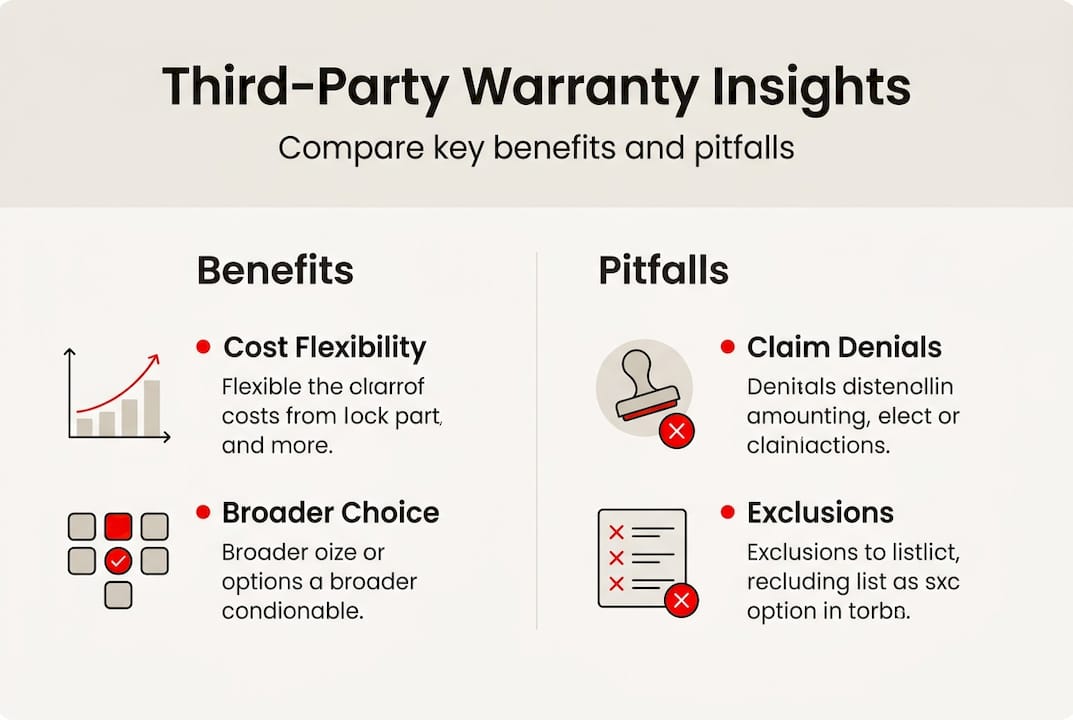
First, the cost flexibility is real. OEM extended warranties are priced by the manufacturer with little room to negotiate. Third-party providers compete for your business, which often translates to lower premiums and more options to match coverage to your actual driving habits and risk tolerance.
Second, repair facility freedom matters more than it sounds. With most OEM warranties, you're locked into authorized dealerships. Third-party plans frequently allow you to use any licensed mechanic, which means you can stick with a trusted local shop rather than driving across town to a dealer.
Here are the core advantages worth considering:
- Lower premiums compared to manufacturer-backed extended warranties
- Customizable plans that cover what you actually need
- Freedom to choose your own repair shop
- Coverage for used vehicles that no longer qualify for OEM plans
- Transferable coverage that can increase resale value
- Roadside assistance often bundled into plans
Pro Tip: When comparing providers, look specifically at claim approval rates. Reputable providers typically approve between 89% and 94% of valid claims. If a provider won't share their approval rate, that's a red flag worth taking seriously.
For guidance on matching coverage to your vehicle's age and mileage, choosing a car warranty by year is a smarter approach than picking a plan based on price alone. You can also review essential protection features to make sure nothing critical gets left out of your plan.
The reality: Claim approvals, exclusions, and common pitfalls
The warranty industry has a reputation problem, and some of it is earned. Not every claim gets paid, and the gap between what drivers expect and what contracts actually cover causes real frustration. Understanding why claims get denied puts you in a much stronger position.
The industry denial rate sits at roughly 22.4%, with about 41% of all disputes tied directly to contract exclusions. In plain terms, many drivers assume their plan covers something it doesn't. The other major cause is missing or incomplete maintenance records.
Here's how to protect yourself and make sure your claim gets approved:
- Keep every maintenance receipt including oil changes, tire rotations, and fluid top-offs
- Read your contract exclusions carefully before signing, not after a breakdown
- Understand your deductible structure so there are no surprises at the shop
- Report issues promptly rather than delaying repairs, which can void coverage
- Use approved repair facilities unless your contract specifically allows any licensed shop
- Confirm coverage before repairs begin by calling your provider directly
Pro Tip: Create a simple folder, physical or digital, where you store every service receipt from the day you buy your plan. A single missing oil change record has been enough to trigger a denial on engine-related claims.
For a reality check on what warranties actually promise versus what they deliver, the warranty myths debunked article cuts through a lot of the noise. And if you want to understand exactly what your contract should spell out clearly, the warranty transparency guide is worth reading before you sign anything.
When are third-party warranties not the right choice?
Honesty matters here. Third-party warranties are not the right move for every driver or every vehicle. There are real situations where the math simply doesn't work in your favor.
If your vehicle is still under the original manufacturer warranty, adding a third-party plan on top creates overlapping coverage you're paying for twice. Similarly, if you drive a brand known for exceptional long-term reliability and you have the financial cushion to absorb an occasional repair, self-insuring can be the smarter financial play.
Some sources point out that payout ratios for extended warranties can run as low as $0.60 for every $1.00 paid in premiums, and a significant number of policyholders never file a single claim. That's money spent on peace of mind rather than actual repairs.
Consider skipping a third-party warranty if:
- Your vehicle is still under OEM coverage with significant time or mileage remaining
- You drive a highly reliable model with a strong long-term track record
- You have a dedicated repair fund with $3,000 or more set aside
- Your vehicle has very high mileage and may not qualify for meaningful coverage
- The plan excludes most of your vehicle's likely failure points based on its age and history
For a practical checklist of situations where extended coverage genuinely pays off, signs you need an extended warranty gives you a clear framework to decide.
Our take: The warranty conversation nobody wants to have
Most warranty articles either sell you hard on coverage or dismiss it entirely as a scam. Both positions miss the point. The real issue is that most drivers make warranty decisions based on emotion rather than data, and that's where things go wrong.
We've seen the pattern repeatedly. Drivers skip coverage on an aging vehicle because they've "never had a problem" with it, then face a $3,800 transmission repair six months later. On the flip side, we've seen drivers pay years of premiums on a vehicle they sell before anything major breaks. Neither outcome makes the product good or bad. It makes the decision smart or uninformed.
The honest truth is that a third-party warranty is a financial tool, not a magic shield. Like any tool, it works best when matched to the right situation. If your vehicle is approaching the 60,000 to 80,000 mile range, you don't have a strong repair fund, and you depend on that car for work or family, coverage isn't just smart, it's responsible. If none of those conditions apply, you may genuinely be better off banking the premium money each month.
What we'd push back on is the idea that extended warranties are inherently a bad deal. For the right driver, in the right situation, they convert an unpredictable financial risk into a manageable monthly cost. That's not nothing.
Protect your vehicle before the next repair bill arrives
If this article has you thinking more seriously about your coverage options, that's exactly the right response. Repair costs are rising, vehicles are more complex than ever, and the gap between what people can afford and what repairs actually cost keeps widening.
At RPM Warranty, we offer Elite, Advanced, and Essential plans built to match different budgets and vehicle needs. The process is straightforward: a quick consultation, plan selection, customization to your vehicle, and a final agreement you actually understand. Coverage includes engines, transmissions, cooling systems, electrical systems, and high-tech components, plus roadside assistance. Get a free quote based on your vehicle's year, make, and model, and see exactly what protection looks like for your specific situation.
Frequently asked questions
Do third-party warranties actually pay claims?
Top providers approve 89 to 94% of valid claims, though the overall industry denial rate sits around 22%. Choosing a reputable provider and maintaining your service records dramatically improves your odds.
What problems cause warranty claims to be denied?
The majority of denials come from missing maintenance records or repairs that fall under contract exclusions, which account for roughly 41% of all disputes. Reading your contract carefully before you need it is the best prevention.
How much do car repairs usually cost without a warranty?
Average repairs run about $550, but major jobs like transmission replacements regularly cost between $4,000 and $6,000, which is where coverage earns its keep.
Is a third-party warranty better than self-insuring?
For reliable vehicles or financially prepared owners, self-insuring can save money since many drivers never file a claim. Third-party plans make more sense when your vehicle is aging, repairs are likely, and your savings buffer is thin.
What's the main advantage of choosing a third-party provider?
Third-party plans offer more flexible coverage and often lower costs than manufacturer warranties, plus the ability to use your own repair shop rather than being locked into a dealership.