

TL;DR:
- Nationwide warranties cover repairs at licensed shops across the U.S., providing flexibility for travelers.
- Coverage typically includes major mechanical parts but excludes routine maintenance and pre-existing damage.
- Proper documentation and understanding exclusions are essential to successfully use and benefit from the warranty.
A single transmission replacement can cost $3,000 to $5,000 out of pocket. Yet many drivers assume their warranty will handle it, only to discover the hard way that coverage ran out months ago or the repair isn't included at all. Nationwide warranty coverage refers to warranties or vehicle service contracts honored at any participating or licensed repair facility across the United States. This guide breaks down what that actually means, what's covered, what's not, and how to decide if this kind of protection makes sense for your vehicle and your budget.
Table of Contents
- What does nationwide warranty coverage mean?
- What do nationwide warranties and VSCs typically cover?
- What isn't covered? Common exclusions and pitfalls
- How do nationwide warranty claims and repairs work?
- Is nationwide warranty coverage worth it? An honest perspective
- Explore your best nationwide warranty options
- Frequently asked questions
Key Takeaways
| Point | Details |
|---|---|
| Covers repairs anywhere | Nationwide warranties let you get major repairs done at licensed shops across the U.S., not just at your local dealer. |
| Read exclusions carefully | Key items like wear and tear or lack of proof can mean denied claims, so check the fine print. |
| Best for high-risk owners | If your car is known for expensive breakdowns or you travel often, nationwide coverage can provide real peace of mind. |
| Keep maintenance records | Proper documentation is essential to avoid denial when you file a claim under your warranty. |
What does nationwide warranty coverage mean?
Let's clear up the confusion first. "Nationwide warranty coverage" is a broad term that drivers hear often but rarely see explained clearly. At its core, it means your warranty or vehicle service contract (VSC) is valid at licensed repair shops anywhere in the country, not just at a single dealership or within one region.
A VSC, which most people call an extended warranty, is a separate service agreement you purchase after your factory warranty expires. It is not technically a warranty under the law, but it functions like one. The key difference from a local shop warranty is flexibility. A local shop warranty only covers repairs done at that specific shop. A nationwide VSC follows you wherever you drive.
There are several types of coverage you might encounter:
- Factory warranties come from the manufacturer and cover defects for a set period, typically 3 years or 36,000 miles for bumper to bumper coverage.
- Dealer-backed warranties are sold at the dealership and often administered by a third party.
- Third-party VSCs are purchased through independent providers and offer the widest flexibility in where you get repairs done.
For drivers who travel frequently, move between states, or simply want the freedom to use their preferred mechanic, nationwide VSCs offer a clear advantage. Coverage transparency matters here too. A plan that's valid everywhere means nothing if the contract is full of vague language.
The FTC advises consumers to read all warranty terms carefully, compare multiple providers, and confirm exactly which shops are authorized to perform covered repairs before signing any agreement.
Put simply, nationwide coverage is worth looking into if you value flexibility and protection beyond what your factory warranty provides.
What do nationwide warranties and VSCs typically cover?
Knowing what a nationwide warranty is gets you halfway there. The other half is understanding exactly what breaks down it will actually pay for.
Most VSCs are designed to kick in after your factory warranty expires. They cover mechanical breakdowns for major systems including engines, transmissions, air conditioning, and electrical components. Terms typically run 12 to 36 months for shop repair warranties, while VSCs often extend to 5 to 7 years or 100,000 miles.

Here is a breakdown of what is commonly covered versus what usually is not:
| Covered items | Not covered items |
|---|---|
| Engine internals (pistons, valves) | Brake pads and rotors |
| Transmission components | Tires and wheels |
| Electrical system parts | Oil changes and filters |
| Air conditioning compressor | Battery (standard) |
| Cooling system components | Interior wear and cosmetic damage |
| Engine warranty repairs | Pre-existing conditions |
Beyond core mechanical repairs, many plans also bundle in useful extras:
- Roadside assistance for breakdowns, lockouts, and flat tires
- Rental car reimbursement while your vehicle is in the shop
- Trip interruption coverage if your car breaks down far from home
- Towing reimbursement to a covered repair facility
Coverage tiers vary widely. A higher-tier plan covers nearly everything mechanical. A basic plan might only protect the powertrain, which means your engine and transmission. Always confirm what tier you are buying before you sign.
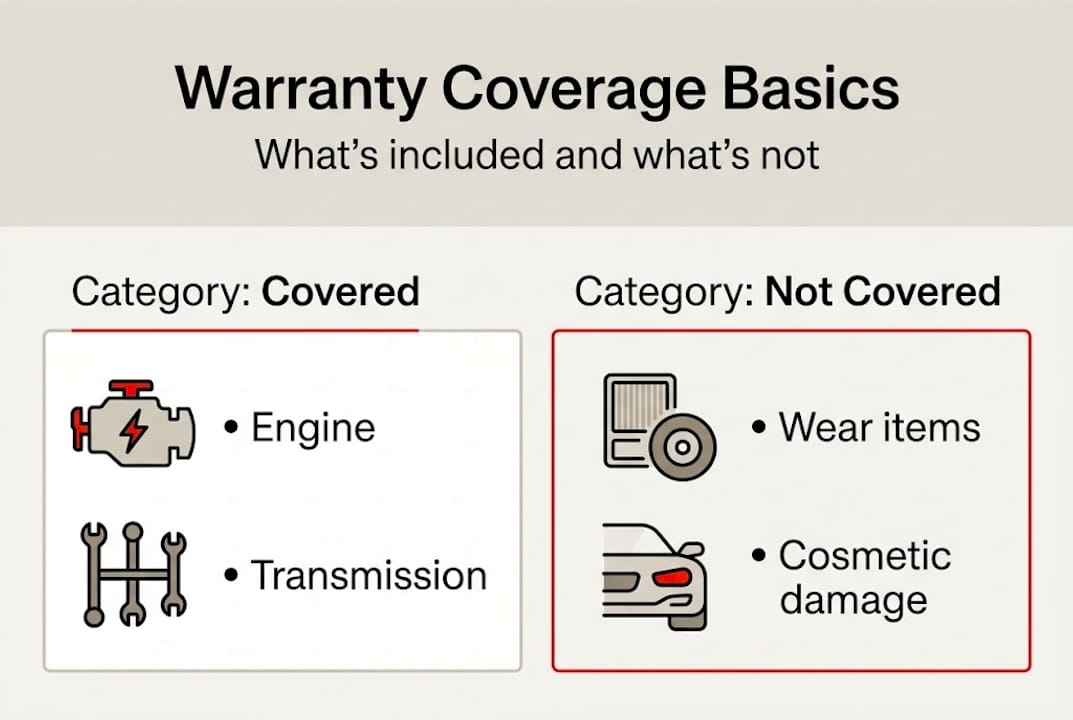
The FTC recommends comparing the total cost of the VSC against the likely cost of repairs given your vehicle's age and mileage.
Pro Tip: Before you finalize any plan, ask for a sample contract and read the exclusions section word for word. The coverage list sounds impressive until you realize the exclusions list is just as long.
What isn't covered? Common exclusions and pitfalls
Here is where many drivers get blindsided. The coverage sounds solid until a claim gets denied. Understanding the exclusions before you need to file a claim is the smartest thing you can do.
The most common categories that are excluded from nearly every plan include:
- Wear and tear items: Brakes, rotors, wiper blades, and belts are considered routine maintenance and almost never covered.
- Pre-existing conditions: If a problem existed before your policy start date, it will not be covered.
- Neglect or lack of maintenance: Missing oil changes or ignoring warning lights can void a claim entirely.
- Accidents or collision damage: That belongs in your auto insurance policy, not your warranty.
- Modifications: Aftermarket lifts, performance upgrades, or non-factory parts can void your warranty on affected systems.
High-mileage and older vehicles often face additional limits. Some providers will not cover cars over 10 years old or past 150,000 miles. Others exclude certain states entirely, including California, Washington, and Alaska.
Here is a quick look at common denial triggers:
| Denial trigger | Real-world example |
|---|---|
| No maintenance records | Oil change skipped, engine sludge forms |
| Pre-existing damage | Transmission slipping at time of purchase |
| Unauthorized repair shop | Mechanic not on approved network |
| Excluded component | Turbocharger not listed in base plan |
| State exclusion | Policy invalid in buyer's home state |
To avoid most denials, follow these steps:
- Keep every oil change receipt and service record from day one.
- Read the exclusions section of your contract before purchase.
- Confirm your state is covered under the specific plan you are buying.
- Check that your usual mechanic is an approved repair facility.
- Get a pre-purchase vehicle inspection to document existing conditions.
According to industry data, claim denial rates in the extended warranty space range from 15% to 35%, often tied to maintenance records and pre-existing conditions.
Pro Tip: Treat your maintenance log like a financial document. It is your best defense if a claim is ever challenged.
How do nationwide warranty claims and repairs work?
Knowing what is covered is useful. Knowing how to actually use your coverage when something breaks is what matters most in the moment.
Under most nationwide VSC plans, you can take your vehicle to any licensed repair facility. Many plans specify ASE-certified shops or shops within a managed network. Before you drop your car off, call your warranty provider first. This step is critical.
Here is how the process typically works:
- Call your provider as soon as the problem appears. Pre-authorization is required in almost every plan before repairs begin.
- Describe the issue clearly and provide your contract number. The provider may ask for recent maintenance records at this stage.
- Take the vehicle to an approved licensed repair shop. The mechanic will diagnose the problem and submit a repair estimate.
- The provider reviews the claim and authorizes covered repairs. They may send an inspector for large claims.
- Payment is made directly to the shop by the provider. In some plans, you pay first and submit receipts for reimbursement.
- Keep all documentation: repair orders, invoices, and authorization numbers for your records.
Direct pay is the most convenient model because you never have to front a large bill. Reimbursement models require you to pay upfront, which can be a problem if the repair bill is $2,000 or more.
VSC claims require pre-approval, proof of maintenance, and use of licensed or ASE-certified shops. Skipping any of these steps is the fastest way to get a claim denied.
If you are not sure whether your situation calls for extended coverage, reviewing the signs you need extended warranty protection can help you decide before a breakdown forces the decision.
Pro Tip: Always call for pre-authorization before any repair starts, even if the shop says it is not necessary. One unauthorized repair can void coverage for the entire claim.
Is nationwide warranty coverage worth it? An honest perspective
Here is the truth most warranty providers will not say out loud: a nationwide VSC is not a guarantee. It is a financial product, and like all financial products, it is designed to be profitable for the seller.
Industry data shows the loss ratio for extended warranties sits around 42%, meaning providers pay out roughly 42 cents in claims for every dollar collected. That gap funds sales commissions, administration, and profit.
So who should seriously consider a nationwide VSC? Drivers with high-mileage vehicles approaching the end of factory coverage, people who travel frequently across states, and anyone who cannot afford a $4,000 surprise repair bill benefit the most. The flexibility of getting repairs done anywhere is genuinely valuable if you are often far from home.
Who might be better off skipping it? If you drive a vehicle known for reliability, have low mileage, or have savings set aside for repairs, self-insuring by saving the monthly premium cost might beat paying for a plan that excludes the repairs you are most likely to need.
The biggest misconception we see is that buyers expect total protection. They picture a warranty as a shield against every repair. In reality, it is more like a targeted safety net. The third-party warranty pros and cons are real on both sides, and the right choice depends entirely on your vehicle, your habits, and your financial situation. Go in with clear expectations, read every word of the contract, and the decision becomes a lot cleaner.
Explore your best nationwide warranty options
If you have weighed the coverage, the exclusions, and the claims process and decided that having a solid plan in place makes sense for your situation, the next step is finding a provider you can actually trust.
RPM Warranty offers nationwide coverage plans built around transparency and real flexibility. From the Elite plan covering nearly every major system to the Essential plan for core powertrain protection, there is a tier for every budget. You can review all available protection plans and compare them side by side before committing to anything. Have questions before you get started? The RPM Warranty FAQs walk through the most common concerns so you know exactly what you are getting into.
Frequently asked questions
What's the difference between a nationwide warranty and a vehicle service contract?
A nationwide warranty is most often a vehicle service contract (VSC) that allows repairs at licensed shops across the country, rather than restricting you to a single dealer or region.
How much does nationwide warranty coverage cost?
The average cost runs between $1,500 and $4,000 depending on your vehicle's age, mileage, coverage length, and the provider you choose.
Can I use a nationwide warranty if I move or travel out of state?
Yes. Most nationwide VSCs allow repairs at any licensed facility in the U.S., which makes them especially practical for frequent travelers or anyone who has recently relocated.
Are there any states where nationwide warranty coverage isn't valid?
Some providers exclude certain states like California, Washington, and Alaska. Always check your specific contract for state-level restrictions before purchasing.
What are the most common reasons claims get denied?
Claim denials most often happen due to excluded items like wear and tear parts, missing maintenance records, or damage that existed before the policy began.