

TL;DR:
- Most drivers mistakenly believe extended warranties start immediately upon signing, but waiting periods delay coverage and can lead to costly out-of-pocket repairs. These periods, typically 30 days or 1,000 miles, are essential to prevent pre-existing condition claims and vary depending on the provider, vehicle use, and inspection requirements. Understanding and properly timing the start of coverage protects against gaps and unnecessary expenses during early vehicle failures.
Most drivers assume their new extended warranty kicks in the moment they sign the contract. That assumption can be expensive. Early failures are typically not reimbursed under new coverage, meaning a breakdown in the first few weeks could leave you paying every repair dollar out of pocket. Warranty waiting periods are one of the most overlooked details in any auto service contract, yet they directly determine when your protection actually begins. Understanding how they work before you buy could save you hundreds or even thousands of dollars.
Table of Contents
- What is a warranty waiting period?
- How waiting periods impact coverage and repair costs
- Aligning warranty terms: Manufacturer vs. extended coverage
- Tips for navigating and negotiating warranty waiting periods
- Most drivers underestimate waiting periods—here's what that really costs
- Get reliable coverage without the guesswork
- Frequently asked questions
Key Takeaways
| Point | Details |
|---|---|
| Understand waiting periods | Many extended warranties delay claims for a set time or mileage, so coverage is not instant. |
| Watch for hidden gaps | Misaligned contract start dates can leave you without coverage or create unnecessary overlap. |
| Ask the right questions | Always check contract details and clarify when your protection begins and under what conditions. |
| Real costs can add up | Repairs during waiting periods are generally out-of-pocket, which can affect your budget. |
| Review coverage before buying | Carefully compare service contract terms with your manufacturer’s warranty for seamless protection. |
What is a warranty waiting period?
With the need for clarity established, let's break down precisely what a warranty waiting period means for vehicle owners.
A warranty waiting period is a defined window of time, or a set number of miles, that must pass before your extended warranty coverage becomes active. Think of it like a health insurance deductible period. You've paid for the plan, but the policy hasn't fully "opened" yet. During this window, any mechanical failure is your financial responsibility, full stop.
Most extended auto service contracts impose a waiting period of 30 days and 1,000 miles, whichever comes first. Some providers use only a time-based trigger, while others use mileage alone. A few plans have zero waiting periods, but those tend to require a pre-purchase vehicle inspection to verify no existing issues.
"You can't make claims right away under many plans, and some require inspection for pre-existing conditions."
The core reason waiting periods exist is simple: fraud prevention and risk management. Without them, someone could buy a contract the same day their transmission starts slipping, file a claim the next week, and the warranty provider would pay for damage that existed before the contract was signed. The waiting period is the insurer's buffer against pre-existing conditions.
Here's what typically triggers the start of the waiting period clock:
- Contract signing date — the most common trigger; your 30 days begins the moment you sign
- Purchase or delivery date — some dealers tie it to when you take physical possession of the vehicle
- Registration date — less common but used by certain third-party providers
- Inspection completion date — used when providers require a shop inspection before approving coverage
Understanding auto warranty basics helps you ask smarter questions at every stage of this process. If your contract clock starts at signing but you don't pick up the car for five days, those five days still count. Always clarify the trigger event with the provider in writing.
What happens if your car breaks down during the waiting period? The short answer: you pay. The warranty provider will deny the claim, pointing directly to the contract's effective date language. This is not a technicality you can argue around. It's a defined contractual term.
How waiting periods impact coverage and repair costs
Now that you know what waiting periods are, it's crucial to see how these timelines play out in real-life coverage and costs.

Let's say you purchase an extended warranty on a Tuesday and four days later your check engine light comes on. The diagnostic reveals a failing fuel injector. That repair might cost $400 to $900 depending on your vehicle. Because your waiting period is 30 days and you're only on day four, a claim submitted within the waiting period is typically denied, impacting your repair costs for exactly this kind of early failure. That's the entire bill coming out of your pocket.
This scenario plays out constantly, and it's one of the biggest sources of frustration for new warranty holders. The issue isn't that the provider is acting in bad faith. The issue is that most buyers never read the waiting period clause before signing.
Here's a comparison of how different waiting period structures affect your exposure window:
| Waiting period type | Typical length | Your risk window | Best suited for |
|---|---|---|---|
| Time-based only | 30 days | Covers all mileage in 30 days | Low-mileage drivers |
| Mileage-based only | 1,000 miles | Covers first 1,000 miles driven | Infrequent drivers |
| Combined (time + mileage) | 30 days OR 1,000 miles | Whichever arrives first | Most consumers |
| No waiting period | None | Requires pre-purchase inspection | Verified condition vehicles |
| Extended waiting period | 60 days or 2,000 miles | Higher out-of-pocket risk | Rare; compare carefully |
Pro Tip: If you drive 50 to 60 miles per day for work, you might hit 1,000 miles in fewer than three weeks. The mileage trigger could end your waiting period faster than the 30-day clock, which actually works in your favor. Ask your provider which trigger applies.
The costs that are not covered during a waiting period include:
- Any mechanical failure that occurs before the waiting period ends
- Failures that a provider deems "pre-existing," even if they appear after the waiting period
- Consequential damage (damage caused by an uncovered failure that then damages other parts)
Understanding warranty eligibility by vehicle age is also key here. Older vehicles may face stricter inspection requirements before coverage is approved, and some providers will exclude components that show wear before the contract starts. Budget planning matters too. Until your waiting period ends, set aside a modest emergency fund of $500 to $1,000 specifically for potential repair costs. It's a small safety net that prevents a short coverage gap from becoming a financial crisis.
Aligning warranty terms: Manufacturer vs. extended coverage
Understanding coverage timing is just as important as knowing costs. Let's look at how your manufacturer's warranty lines up with extended contracts.
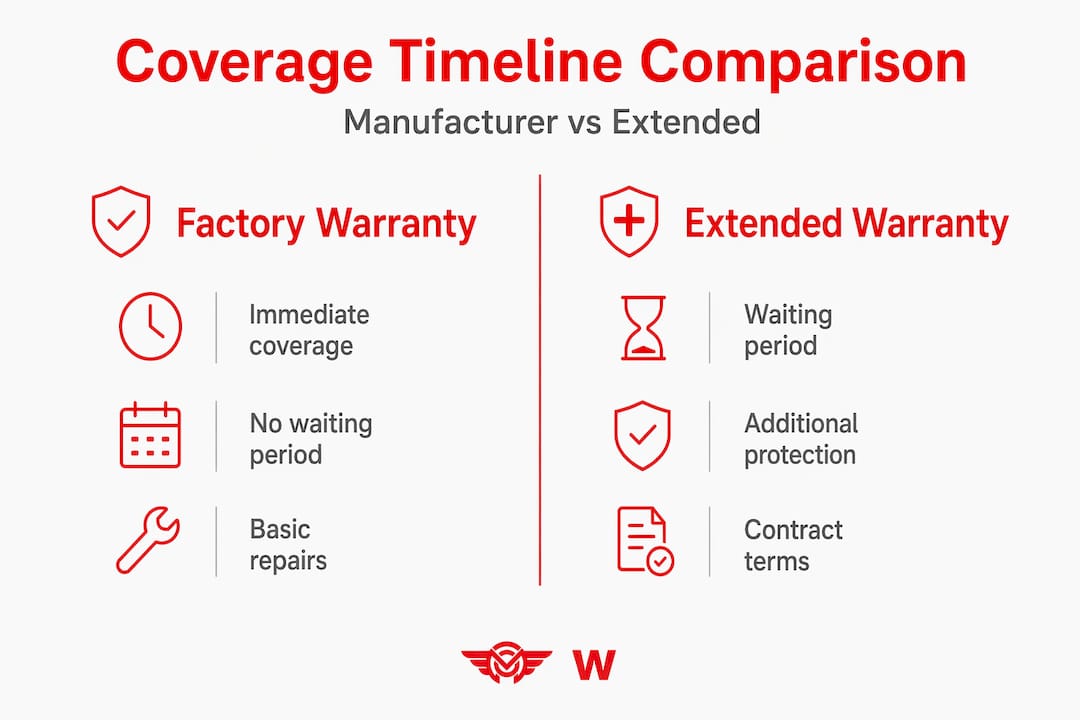
One of the most common and costly mistakes vehicle owners make is purchasing an extended service contract too early, while the factory warranty is still active. As the FTC clearly states, it's not helpful to buy a service contract that starts before your manufacturer coverage expires, and you must compare written dates of both.
Why? Because you'd be paying for overlapping coverage that adds zero value. If your factory bumper-to-bumper warranty covers everything through month 36, and your extended contract begins at month 24, you've essentially paid for 12 months of redundant protection. That money is gone.
The flip side is just as dangerous: a permanent gap in coverage. If your factory warranty expires in March and your extended contract doesn't begin until May, you have a two-month window with zero protection. Any failure in that window is entirely your expense.
Here's a breakdown of common factory warranty timelines compared to extended contract start options:
| Coverage type | Typical duration | Best extended contract start point |
|---|---|---|
| Bumper-to-bumper (new car) | 3 years / 36,000 miles | Month 30 to 33 (with waiting period factored in) |
| Powertrain warranty (new car) | 5 years / 60,000 miles | Month 54 to 57 |
| Certified pre-owned coverage | Varies (12 to 24 months) | 30 to 60 days before expiration |
| Used car (no factory coverage) | None | Immediately, with waiting period awareness |
To ensure smooth, uninterrupted protection, you need to do three specific things:
- Pull both written contracts and line up the dates side by side. Don't rely on memory or a sales rep's verbal summary.
- Factor in the waiting period when calculating your extended contract start. If your factory warranty ends in March and the extended plan has a 30-day wait, your contract should begin no later than late February.
- Confirm the exact trigger event for both expiration and activation. "Three years" from the factory could mean from manufacture date, not purchase date.
Learning to compare factory and extended warranties side by side is one of the highest-value skills any vehicle owner can develop. And if the contract language feels dense, our guide on reading service contract terms walks you through the exact clauses to watch for.
Tips for navigating and negotiating warranty waiting periods
You can avoid costly mistakes by proactively reviewing and negotiating the terms. Here's how to make warranty waiting periods work in your favor.
Most vehicle owners approach an extended warranty purchase the same way they'd buy a cable subscription. They skim, sign, and assume they're covered. That's the wrong approach. Warranty contracts are legal documents, and the waiting period clause is one of the most consequential sections in the entire agreement.
Here's a step-by-step process for handling waiting periods like a pro:
- Request the full contract in writing before you pay. Reputable providers will always share the actual agreement, not just a brochure. If a provider hesitates, that's a red flag.
- Locate the "effective date" and "waiting period" clauses specifically. These are usually in the first few pages under definitions or coverage activation.
- Calculate your exact coverage start date on a calendar. Mark the trigger date, add 30 days (or the applicable period), and note when you're actually protected.
- Ask specifically: does mileage or time end the waiting period first? Get the answer in writing, not verbally.
- Ask if a pre-purchase inspection can reduce or eliminate the waiting period. Some providers offer immediate coverage for vehicles that pass a certified inspection.
- Compare at least two or three providers' waiting period terms. The length and structure vary, and you have leverage during the shopping phase.
Pro Tip: If a provider offers a shorter waiting period as part of a promotion or upgrade package, always confirm that the offer is documented in the signed contract, not just noted in an email or verbal conversation.
Regulators reinforce this approach. The FTC emphasizes comparing coverage start and end dates and understanding all terms in writing before committing. This is not bureaucratic advice. It's practical protection.
Additional questions to ask your provider before signing include:
- Is there a mileage limit that ends the waiting period early?
- Does a pre-existing condition exclusion extend beyond the waiting period?
- What documentation is needed if a repair arises on day 31?
- Are wear-and-tear failures excluded separately from the waiting period?
Review our detailed guide on essential questions to ask about warranty waiting periods before your next conversation with a provider. If you're still unsure about the right time to buy, this resource on timing your extended warranty purchase explains exactly when to act based on your vehicle's current coverage status.
Most drivers underestimate waiting periods—here's what that really costs
Taking it beyond the basics, let's dig into why this issue is so commonly misunderstood and what practical steps really protect your wallet.
Here's an uncomfortable truth from years of watching contract disputes play out: the vast majority of denied claims involve situations where the vehicle owner simply didn't know when their coverage actually started. Not fraud. Not fine print tricks. Just a genuine lack of awareness about a term that was in plain sight the whole time.
The real financial impact goes beyond one denied repair. When a claim is denied during a waiting period, many drivers assume the warranty is "broken" or that the provider is acting unfairly. They make decisions based on that frustration, sometimes canceling coverage they'll need later or refusing future warranty offers out of distrust. One misunderstood clause can affect years of protection decisions.
Deciding if extended warranty protection makes sense for your situation is a solid starting point, but that decision only matters if you follow through with actual contract clarity.
The practical fix is almost embarrassingly simple: set a calendar reminder the day you sign. Mark the exact date your waiting period ends. Note the mileage on that same day. From that point forward, you know you're covered. A five-minute calendar entry could save you from a $1,500 transmission argument with a claims adjuster.
The other thing we'd push back on is the assumption that the sales representative will volunteer all of this information. Some will. Many won't, not because they're dishonest, but because they're focused on the sale and assume you'll read the contract. The burden of understanding falls on you as the buyer. Don't outsource that responsibility.
Treating your warranty contract the same way you'd treat a lease agreement, with line-by-line attention and specific written confirmations for anything verbal, is the highest-impact habit any vehicle owner can develop.
Get reliable coverage without the guesswork
Having equipped you with insider knowledge, here's how to find extended coverage that matches your expectations.
Knowing that waiting periods exist is half the battle. The other half is finding a provider who is upfront about them from the start, no buried clauses, no vague verbal assurances.

At RPM Warranty, our plans are built on transparency. Whether you're exploring the protection plans that fit your vehicle's age, mileage, and budget, or you want clear answers before committing, we make the process straightforward. Our Elite, Advanced, and Essential tiers each come with clear effective dates and plain-language coverage terms. If you have specific questions about how waiting periods apply to your situation, our warranty FAQs section covers the most common scenarios vehicle owners face. No guesswork, no surprises after you sign.
Frequently asked questions
Do all extended vehicle warranties have waiting periods?
Most extended warranties include a waiting period, but lengths vary by provider. Some plans have immediate coverage, but waiting periods are common, so always confirm the exact terms before signing.
What happens if my car breaks down during the waiting period?
If your car needs repairs during the waiting period, your extended warranty will not cover the cost. Failures early in the waiting period are not reimbursed under new coverage, leaving you fully responsible for the bill.
How do I know when my warranty coverage actually starts?
The service contract's written terms specify whether coverage begins on the contract date, after inspection, or after a set mileage or time trigger. The FTC advises reviewing the contract to compare effective dates before assuming coverage is active.
Can I negotiate or choose a shorter waiting period?
Some providers offer more flexible waiting period terms, including reduced periods for vehicles that pass a pre-purchase inspection. Always get any negotiated terms documented in the signed contract rather than relying on verbal promises.