

TL;DR:
- Extended warranties provide emotional peace of mind by reducing stress and uncertainty when unexpected vehicle repairs occur. Their value depends on individual factors such as vehicle reliability, financial cushion, and personal risk tolerance, making the decision highly personal. Careful review of exclusions, limits, and coverage details ensures the warranty aligns with one's needs and expectations.
Most people think about extended warranties in purely financial terms: will the coverage pay out more than it costs? That framing misses the bigger picture. The real value of a warranty often isn't the money you save when something breaks. It's the anxiety you don't carry every time you hear an unfamiliar noise from under the hood. This guide cuts through the confusion and helps you decide whether the emotional and financial comfort of extended warranty coverage genuinely fits your situation as a vehicle owner.
Table of Contents
- The real reasons warranties deliver peace of mind
- What affects the peace-of-mind value of a warranty?
- Peace of mind isn't one-size-fits-all: Limits, exclusions, and fine print
- Is the comfort worth the cost? The financial and psychological tradeoff
- Why the comfort of a warranty is about more than math
- Get real peace of mind with a warranty that fits you
- Frequently asked questions
Key Takeaways
| Point | Details |
|---|---|
| Reduces repair bill anxiety | A warranty turns unpredictable, expensive repairs into manageable, regular costs. |
| Value depends on your needs | The comfort a warranty brings varies based on your car’s reliability and your financial readiness. |
| Check for key exclusions | Understanding what’s not covered in the fine print is essential for true peace of mind. |
| Emotional benefit versus cost | Sometimes the sense of security is just as important as the financial return. |
The real reasons warranties deliver peace of mind
When your manufacturer's warranty expires, a quiet shift happens. Every rattle, every warning light, every unexpected shudder at highway speed carries a new weight. You start doing mental math on repair bills you haven't gotten yet. That ongoing stress is exactly what a well-chosen extended warranty is designed to interrupt.
Extended car warranties reduce financial risk and stress from unexpected repairs, turning uncertain, potentially large bills into a predictable cost. That predictability is the core of the peace-of-mind benefit. You pay a known monthly or upfront amount, and in return, a major engine or transmission failure doesn't crater your budget overnight.
But there's more to it than just the dollar exchange. Warranties shield owners from breakdowns in ways that go beyond pure reimbursement. The claims process, the approved repair network, the roadside assistance feature: these elements reduce the mental work of figuring out what to do when things go wrong at 11 p.m. on a Tuesday.
"The peace-of-mind mechanism isn't only 'free repairs.' It's also reduced uncertainty around claims about where to go and what paperwork or approval steps are required, because claims administration determines whether repair bills actually get paid."
Here are the key ways warranties reduce stress beyond just covering repair costs:
- Predictable monthly costs replace the fear of a sudden $2,500 transmission bill
- Roadside assistance removes the panic of being stranded without a plan
- Approved repair networks mean you don't have to guess which shop to trust
- Streamlined claims reduce the back-and-forth that makes breakdowns feel chaotic
- Coverage documentation gives you leverage in repair conversations with mechanics
If you're newer to how these plans work, a solid auto warranties explained overview can help you see the full picture before you commit to anything.
Peace of mind is frequently cited by warranty experts as the primary benefit owners report, even above direct financial recovery. That alone tells you something important: drivers aren't just buying coverage. They're buying calm.
What affects the peace-of-mind value of a warranty?
Not every car owner gets the same comfort from the same warranty. The emotional payoff depends heavily on several intersecting factors, and being honest with yourself about each one will help you make a smarter decision.
According to extensive research on extended car warranties, whether the peace of mind is worth it depends on the owner's vehicle reliability, expected future repair exposure, how long they plan to keep the car, and their ability to absorb an out-of-pocket bill. The emotional value genuinely varies from person to person.
| Factor | Higher peace of mind | Lower peace of mind |
|---|---|---|
| Vehicle reliability | Older, high-mileage models | Brand-new, low-mileage vehicles |
| Financial cushion | Limited emergency savings | Strong savings buffer |
| Ownership duration | Keeping car 5+ years | Trading in within 2 years |
| Repair cost history | Previous large, surprise bills | No major out-of-pocket history |
| Stress tolerance | Anxiety about uncertainty | Comfortable with financial risk |
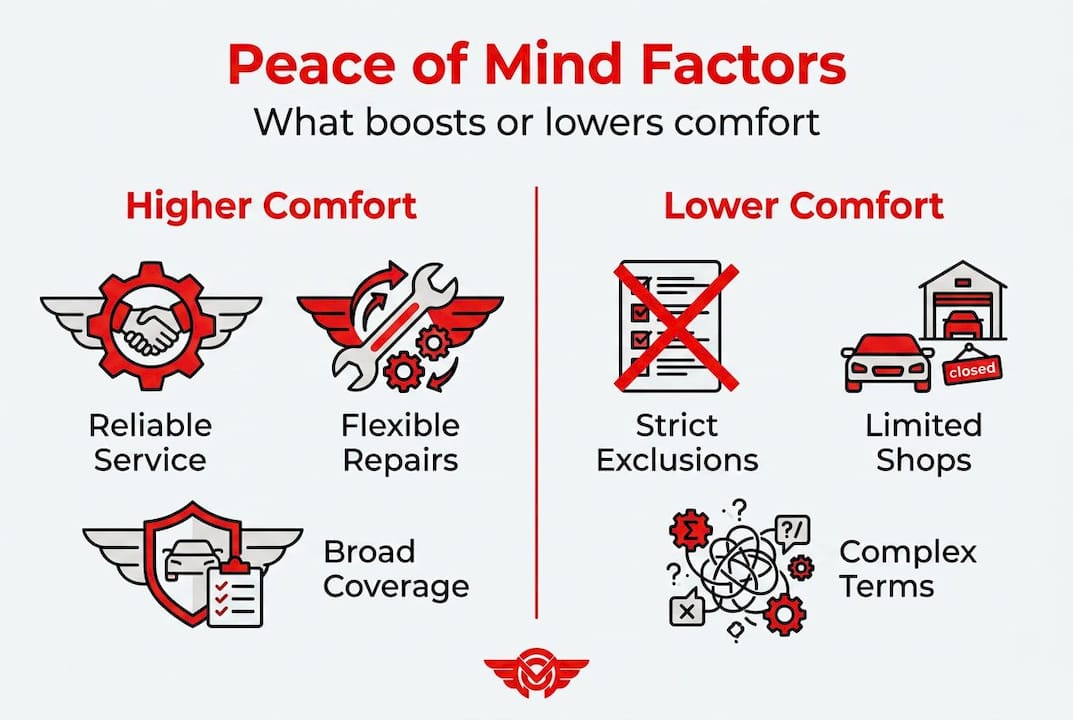
Timing is one of the most underappreciated factors. Peace of mind is most valuable when the warranty period overlaps the window when your specific vehicle is most likely to experience costly failures. If you're still inside your factory coverage window or you have a healthy emergency fund, the emotional lift from a warranty will feel smaller.
Look at your own situation honestly:
- Does the thought of a $3,000 repair bill genuinely keep you up at night?
- Is your car a high-mileage model known for expensive component failures?
- Would losing your vehicle to an unplanned repair affect your job or family?
- Do you plan to keep the car well past 100,000 miles?
If most of those answers are yes, then the car warranty peace of mind features you're paying for carry real emotional weight. If most answers are no, you might be buying comfort you don't actually need.
Pro Tip: Watch for signs you need an extended warranty, such as your factory coverage expiring soon on a car you plan to keep for several more years. That overlap window is exactly when buying coverage makes the most emotional and financial sense.
Think about post-factory warranty importance as a bridge. Once the manufacturer steps back, you carry all the risk. Extended coverage picks up exactly where that protection ends.
Peace of mind isn't one-size-fits-all: Limits, exclusions, and fine print
Here's the uncomfortable reality. A warranty that sounds reassuring on paper can produce the opposite feeling the moment you actually need it and discover the repair isn't covered. That surprise is avoidable, but only if you read carefully before you sign.

Many plans have exclusions, claim limitations, and waiting periods, so coverage may not apply exactly when you need it most. That gap between what you expected and what you get is the number one reason car owners feel let down by warranty plans.
Consumer Reports emphasizes restrictions around what repairs are covered and where work can actually be performed. Some warranties restrict you to specific repair networks. Others require pre-authorization before work begins. Miss a step and the claim can be denied.
| Common exclusion type | What it means for you |
|---|---|
| Preexisting conditions | Issues present before coverage starts won't be paid |
| Waiting periods | Coverage doesn't activate for 30 to 60 days after purchase |
| Maintenance neglect | Skipped oil changes can void related claims |
| Wear and tear items | Brakes, belts, and tires are often excluded |
| Specific repair networks | You may not be able to use your preferred mechanic |
The peace-of-mind value you expect shrinks fast if any of these apply to you in the moment of crisis. Here are the key things to verify before signing anything:
- Exclusion list: What is explicitly not covered? Ask for this in writing.
- Waiting period: How many days or miles before coverage is active?
- Repair authorization: Do you need approval before the shop starts work?
- Approved shops: Is your usual mechanic in the network?
- Deductibles: Is there a per-visit cost that reduces the financial benefit?
Pro Tip: Use a warranty exclusions guide to cross-reference what your plan covers against your vehicle's most common failure points. This 15-minute exercise can prevent a major disappointment later.
If reading the fine print feels overwhelming, go in with a list of essential warranty questions to ask before you commit. A reputable provider will give you direct, clear answers. Vague or evasive responses are a red flag worth taking seriously.
Is the comfort worth the cost? The financial and psychological tradeoff
This is where most people get stuck. You want peace of mind, but you also don't want to overpay for something you may never use. The honest answer is that the math doesn't always favor the buyer, and that's okay if you go in with clear expectations.
On average, consumers may pay more for extended warranty coverage than they receive in direct claim benefits, even if they experience genuine psychological comfort along the way. That framing shifts the question from "will I save money?" to "is the reduction in stress worth the premium I'm paying?"
Here's a useful framework for making that call:
- Estimate your worst-case repair cost. A transmission replacement can run $3,000 to $5,000. An engine rebuild can hit $7,000 or more. Compare that to your warranty cost over the ownership period.
- Assess your emergency fund honestly. If a $2,500 repair would wipe out your savings or require high-interest credit, the warranty cost is essentially insurance against a financial spiral.
- Factor in your vehicle's failure probability. Older vehicles, luxury models with expensive parts, and high-mileage cars have statistically higher repair exposure. The numbers shift in your favor.
- Put a dollar value on your stress. This sounds vague, but it's real. If avoiding worry about repair costs improves your daily quality of life, that's a genuine benefit with genuine value.
"Evaluate extended warranties as risk management for high-cost 'tail events,' not as a guarantee of savings. If your expected out-of-pocket risk is low, the psychological benefit may not justify the premium."
Choosing coverage by vehicle year is one of the smartest ways to align cost with actual risk. A five-year-old vehicle with 80,000 miles sits in a very different risk window than a two-year-old car still under factory coverage. Understanding that distinction helps you buy coverage at the right moment, not too early and not too late.
If you're deciding between keeping factory protection and upgrading, a factory vs. extended warranty comparison lays out the specific differences in coverage scope, flexibility, and cost structure. The right answer depends on your car's age and your personal risk profile.
Why the comfort of a warranty is about more than math
Here's what most warranty conversations miss entirely: the decision isn't really about statistics. It's about you, your car, your finances, and your specific relationship with uncertainty.
We talk to vehicle owners every day who have done the spreadsheet math and convinced themselves a warranty isn't worth it on paper, then spent the next two years tense every time the check engine light flickered. The anxiety cost them something real, even without a major breakdown. That's a form of loss that never shows up in a warranty comparison chart.
On the other side, some drivers with reliable vehicles and solid savings genuinely don't feel anxious about repair risk. For them, an extended warranty might deliver less emotional value, and that's a completely valid reason to pass on it.
What most people overlook is how personal history shapes this decision. If you've had a major, wallet-crushing repair in the past, your gut reaction to "what if it happens again" is more intense than someone who hasn't been through it. That fear is rational, and paying a premium to protect against repeating that experience is a reasonable choice.
The features that create true peace of mind in a warranty aren't just about the dollar limits on coverage. They include how easy the claims process actually is, whether roadside assistance is included, and how responsive customer support turns out to be during a stressful breakdown. A warranty that checks all those boxes can genuinely change how you experience car ownership, not just how you pay for repairs.
Our opinion is straightforward: if you lose sleep over potential repair costs or you're driving a vehicle past its peak reliability window without an emergency fund to catch a big bill, the peace of mind from quality extended coverage is worth every dollar. If neither of those describes you, buy the coverage that fits your actual risk level rather than the most expensive option.
Get real peace of mind with a warranty that fits you
Weighing the full picture of costs, exclusions, emotional value, and personal risk tolerance is exactly the kind of thinking that leads to a smart warranty decision. You shouldn't have to guess about coverage details or wonder if your plan actually fits your vehicle and your situation.
At RPM Warranty, we built our plans around the idea that peace of mind should feel real, not just promised. Whether you drive a luxury vehicle needing tailored protection or you want to see the full range of options side by side, we make it simple. You can compare our protection plans across Elite, Advanced, and Essential tiers to find the right level of coverage for your vehicle's year, make, model, and your personal budget. Get a free quote and take the first step toward driving without that background hum of financial worry.
Frequently asked questions
Do extended warranties really reduce stress about repair costs?
Yes, they convert unpredictable repair bills into a known, manageable expense, which directly eases anxiety for owners who worry about surprise costs. Extended warranties reduce financial stress by making large, uncertain bills predictable.
Do all warranties give the same peace of mind?
No. The emotional value varies by person depending on the owner's vehicle reliability, expected repair exposure, and ability to handle an out-of-pocket emergency. The same plan can feel essential to one driver and unnecessary to another.
What are key limits or exclusions to watch for in warranties?
Many plans exclude preexisting conditions, specific components, and include waiting periods before coverage activates. Exclusions and waiting periods can leave you uncovered at exactly the wrong moment if you haven't read the fine print.
Is a warranty's peace of mind always worth the price?
Not always. It depends on your risk tolerance, emergency savings, and realistic repair probability for your specific vehicle. Treating warranties as risk management for high-cost unexpected events, rather than a savings guarantee, is the clearest way to judge the value.