
TL;DR:
- Labor costs in warranties depend on published labor times, hourly rates, and reimbursement policies that vary by manufacturer and state. Increasing vehicle technology has significantly raised diagnostic and repair hours, making comprehensive coverage more essential. Carefully reviewing labor caps, exclusions, and state-specific laws ensures you select a warranty that provides meaningful protection against rising repair costs.
When you see "warranty covers labor," it sounds simple enough. But the reality hiding behind those three words can lead to genuinely shocking repair bills if you are not prepared. Labor reimbursement policies differ by manufacturer, by state, and even by the specific technology inside your vehicle. Understanding how labor costs are calculated, what your warranty actually promises to pay, and where the gaps tend to hide is the kind of knowledge that separates car owners who feel protected from those who feel blindsided at the dealership service counter.
Table of Contents
- How labor costs are calculated in warranty repairs
- Why labor costs matter more with today's high-tech vehicles
- What's typically covered, and what's not, in warranty labor
- State laws and dealer reimbursement: How your location changes labor coverage
- How to evaluate labor coverage when shopping for warranties
- A smarter way to judge warranties: What most guides miss
- Get superior labor coverage with trusted extended warranties
- Frequently asked questions
Key Takeaways
| Point | Details |
|---|---|
| Labor rates vary | State laws and dealer policies mean warranty labor payouts differ widely. |
| Tech increases labor costs | Modern vehicles drive up average labor hours, making labor coverage more valuable. |
| Know what’s excluded | Labor for wear-and-tear and maintenance is usually not covered by warranties. |
| Review terms carefully | Fine print on time caps and excluded repairs impacts your out-of-pocket costs. |
| Comparison is key | Smart shoppers compare labor payout rules, not just the headline price or coverage length. |
How labor costs are calculated in warranty repairs
Now that you know why labor costs are confusing, let's dive into how these costs are actually calculated in warranty claims.
A warranty labor charge is not just the mechanic's hourly rate multiplied by time spent under the hood. Three distinct components combine to create the total labor bill: the published labor time (a standardized estimate of how long a repair should take), the hourly labor rate (what the shop charges per hour), and the reimbursement policy (who pays how much of that total). These three factors interact in ways that can either protect you well or leave you holding a partial bill you did not expect.
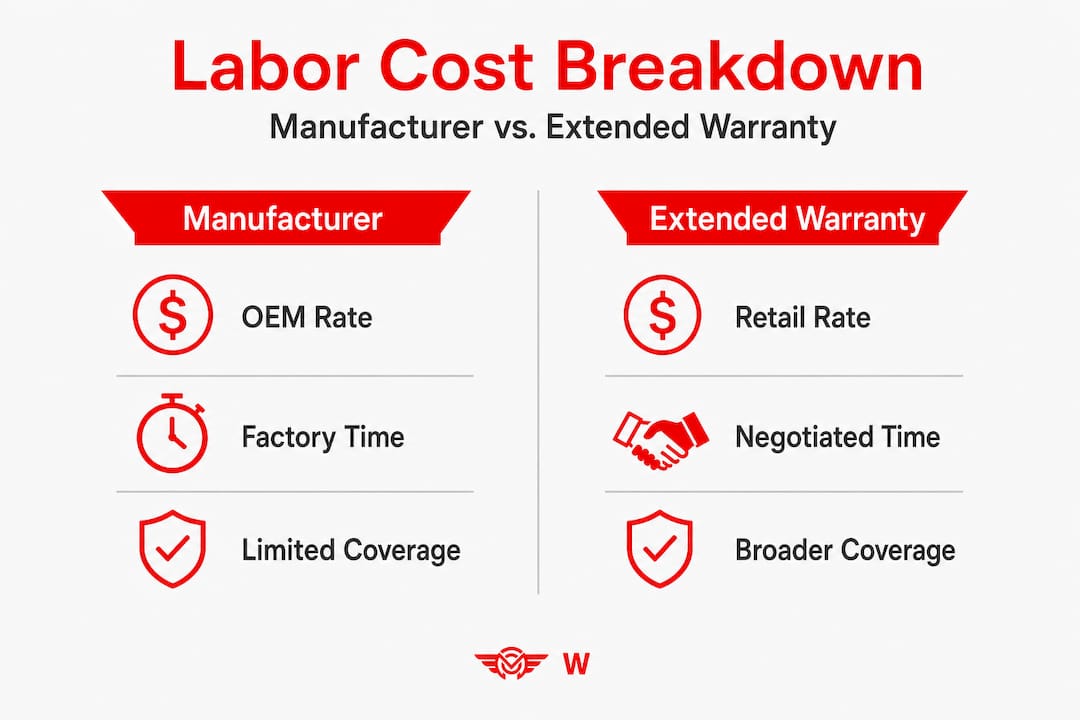
Manufacturers often set their own reimbursement rates for dealers, and those rates are frequently lower than what a shop charges retail customers. This gap matters because when the manufacturer underpays, someone else absorbs the difference. Sometimes it is the dealer, and sometimes it gets passed along to you through fees or service charges. Some states like New Jersey and Minnesota require manufacturers to reimburse dealers at retail labor rates and times, using dealer-specific multipliers based on customer-paid repairs, which helps close this gap.
Common labor cost components in a warranty claim:
- Published labor time: The flat rate hours assigned to a specific repair procedure by a recognized labor guide.
- Shop hourly rate: The amount the dealership or repair facility charges per hour of work.
- Warranty reimbursement rate: The rate the warranty provider actually pays the shop, which may be capped.
- Labor time multipliers: Adjustments some states allow to make reimbursement more accurate for complex repairs.
- Out-of-pocket difference: Any gap between what the warranty pays and what the shop charges.
"Not all labor reimbursement is created equal. The rate a warranty pays a shop often reflects political, legal, and contractual realities more than the actual cost of the repair."
| Component | Manufacturer warranty | Extended warranty |
|---|---|---|
| Labor rate source | OEM-set rate (often below retail) | Contract-specified, may match retail |
| Labor time basis | Flat-rate published guide | Flat-rate guide, sometimes capped |
| State law impact | High in regulated states | Varies by provider |
| Consumer visibility | Low | Higher with transparent providers |
Pro Tip: Before signing any warranty contract, ask the provider directly: "Do you reimburse labor at retail rates, and is the labor time capped?" If they cannot answer clearly, that is a red flag worth taking seriously.
Understanding OEM labor coverage gives you a useful baseline for comparing what manufacturer warranties promise versus what extended plans can offer beyond factory expiration.
Why labor costs matter more with today's high-tech vehicles
With the mechanics of labor rates in mind, it is essential to see how modern car technology has made these costs soar and why warranties matter even more now.
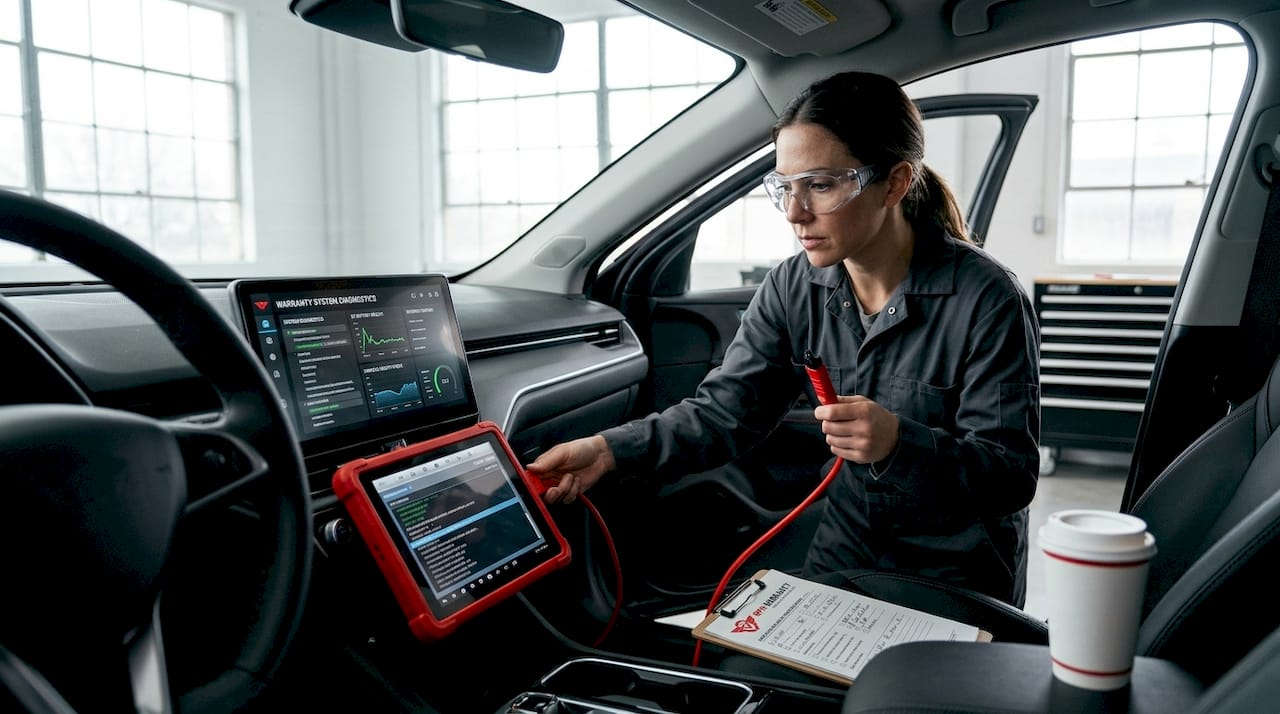
Today's vehicles are not just mechanical devices. They are rolling computers packed with electronic control modules, advanced driver assistance systems (ADAS), battery management systems in hybrids and EVs, and an ever-growing network of sensors and actuators. Each of these systems adds hours to diagnosis and repair. A technician working on a traditional combustion engine transmission might spend two hours on a repair. That same category of work on a modern EV powertrain can take four to six hours because of the need to recalibrate sensors, reset software, and observe strict safety protocols around high-voltage components.
Industry-wide warranty costs exceeded $67 billion globally last year, with U.S. dealers billing over $30 billion, driven by complex repairs in EVs and ADAS systems. That number is not a coincidence. It reflects the real cost of fixing technology that requires specialized training, proprietary tools, and significant technician time. Labor is no longer a secondary line on the repair invoice. In many modern vehicle repairs, labor accounts for 60 to 70 percent of the total cost.
Why technology drives up labor costs:
- ADAS calibration after sensor replacement requires specialized alignment equipment and software.
- Battery pack diagnostics in EVs demand certified technicians working under strict safety protocols.
- Electronic module replacements often require manufacturer-specific programming before the part works.
- Diagnostic scanning on modern vehicles sometimes takes longer than the actual repair.
- Wiring and data bus issues in feature-rich vehicles are notoriously time-consuming to trace.
| Vehicle type | Average labor hours per major repair | Estimated labor cost at $150/hr |
|---|---|---|
| Traditional ICE (internal combustion engine) | 2 to 4 hours | $300 to $600 |
| Modern hybrid | 3 to 6 hours | $450 to $900 |
| Full EV | 4 to 8 hours | $600 to $1,200 |
| ADAS-equipped vehicle | 3 to 7 hours | $450 to $1,050 |
Understanding EV warranty coverage value is increasingly important as these vehicles age out of factory coverage faster than many owners expect.
What's typically covered, and what's not, in warranty labor
After seeing why labor costs are rising, it is crucial to understand what your warranty will and will not actually cover when it comes to labor.
Standard extended warranty contracts cover labor costs tied to defects in materials or workmanship. In practical terms, this means if a part fails because it was manufactured improperly or because the vehicle was built with a flaw, the warranty pays for both the part and the technician time to replace it. That coverage also usually extends to the diagnostic labor required to identify the failure, as long as the diagnosis confirms a covered component is at fault.
Empirical benchmarks show labor as a major repair factor; warranties mitigate this but exclude wear items, and value hinges on high-tech coverage amid rising complexity costs. That nuance matters more than most shoppers realize.
Labor typically covered by extended warranties:
- Diagnostic time when a covered system is confirmed as failed.
- Technician hours to remove and replace a failed engine, transmission, or electrical component.
- Programming or recalibration time when tied to a covered part replacement.
- Towing to a repair facility in many plans with roadside assistance included.
Labor typically NOT covered:
- Oil changes, filter replacements, and all scheduled maintenance items.
- Brake pads, rotors, wiper blades, tires, and other wear items.
- Repairs caused by owner neglect or failure to maintain service records.
- Failures resulting from modifications, accidents, or environmental damage.
- Labor time that exceeds the plan's maximum hourly or time cap for a specific repair.
Pro Tip: Read the "exclusions" section of any warranty contract before the "coverage" section. Most of the surprises that cost consumers money are written into the exclusions, not buried in the coverage terms.
Knowing the difference between covered and excluded labor is the foundation for evaluating any extended warranty's real-world value. Also, understanding engine labor coverage specifically can help you judge whether a plan protects your highest-risk components properly.
State laws and dealer reimbursement: How your location changes labor coverage
Not all labor reimbursement is created equal. Let's look at how your state or dealer's location may affect the labor coverage in your warranty.
Where you live directly affects how warranty labor costs are handled between manufacturers and dealerships. Several states have passed laws requiring manufacturers to reimburse dealers at retail rates, not discounted warranty rates. This might sound like a dealer benefit, but it actually trickles down to you as a consumer. When dealers are fairly reimbursed, they have fewer incentives to cut corners, drag out warranty repairs, or push back on covered claims.
Some states like New Jersey and Minnesota require manufacturers to reimburse dealers at retail labor rates and times, using dealer-specific multipliers based on customer-paid repairs. States without these protections often see dealers absorbing the reimbursement shortfall, which creates subtle pressure to limit warranty repairs or discourage customers from pursuing claims.
What state-level labor laws may mean for you:
- Dealers in protected states have less financial incentive to discourage warranty claims.
- Retail-rate reimbursement laws tend to produce faster repair turnarounds.
- OEMs in unprotected states may use lower reimbursement caps, indirectly reducing service quality.
- Independent shops may handle warranty work differently than franchised dealerships depending on your plan.
- Consumers should verify whether their state has enacted dealer reimbursement protections before assuming parity.
"State law can be the deciding factor in whether your warranty functions as advertised. A contract that looks the same in two states can deliver completely different outcomes depending on who pays the dealer and how much."
Understanding warranty transparency by state helps you know what to expect in your region and where the soft spots in coverage tend to appear.
How to evaluate labor coverage when shopping for warranties
To wrap up, let's put this all together with practical steps and a comparison for choosing the right level of labor coverage.
Shopping for an extended warranty based on price alone is one of the most common and costly mistakes vehicle owners make. The total cost of a plan means very little if the labor coverage terms are weak, capped at rates that do not reflect your local market, or written with exclusions that eliminate most of the situations where you would actually need to file a claim.
Edge cases like state-specific reimbursement laws may indirectly benefit consumers via fairer dealer incentives, but contrasts exist between OEM tight controls and retail realities. This is exactly why reading the fine print on labor terms is not optional.
Step-by-step process for evaluating warranty labor coverage:
- Request the full sample contract, not just the marketing summary or plan brochure.
- Locate the labor reimbursement section and confirm whether rates are fixed or capped.
- Ask specifically whether labor time is based on published flat-rate guides without internal caps.
- Identify every exclusion and test it against your vehicle's most common failure points.
- Ask the provider for a sample payout scenario on a real repair, such as a transmission replacement, with an itemized breakdown.
- Compare two plans side by side using that scenario to see which actually pays more.
| Evaluation factor | Strong labor coverage | Weak labor coverage |
|---|---|---|
| Labor rate | Retail or near-retail | Internally capped below market |
| Labor time | Published flat rate | Provider-capped hours |
| Diagnostic labor | Covered for confirmed failures | Limited or excluded |
| EV/ADAS components | Explicitly included | Vague or excluded |
| State compliance | Acknowledges state-specific rules | One-size-fits-all approach |
| Exclusion list | Short and specific | Long and broadly worded |
Pro Tip: Ask any warranty provider whether they have paid claims on EV battery diagnostics or ADAS recalibration. Real providers with strong labor coverage will have examples ready. Providers who deflect or redirect are telling you something important.
Thinking carefully about choosing smart warranty coverage based on your vehicle's age and risk profile is the smartest move you can make, and pairing that with a solid understanding of auto warranty deductibles gives you the full picture before you commit.
A smarter way to judge warranties: What most guides miss
Most articles on warranty labor coverage stop at the surface level: check the hourly rate, compare the deductible, and move on. That approach misses where the real money traps live.
In our experience, the single biggest source of consumer frustration with extended warranties is not the labor rate itself. It is capped repair times. A plan may advertise coverage at retail labor rates, but if the contract limits a transmission replacement to four hours when the published flat-rate guide says seven, you are paying three hours out of pocket regardless of the rate. That gap can cost hundreds of dollars on a single claim.
The second major trap is vague exclusion language. Phrases like "electronic system failures caused by external factors" sound reasonable until a technician attributes your module failure to a power surge or moisture, both of which may qualify as external under a loose definition. Broadly worded exclusions give providers the room they need to deny claims that you assumed were clearly covered.
Our perspective is direct: do not evaluate a warranty on what it covers. Evaluate it on what it cannot deny. Read the exclusion list with the same attention you would give a contract you were signing for a major financial commitment, because that is exactly what it is. For EVs and tech-heavy vehicles especially, ask for written confirmation that labor for sensor calibration, software updates tied to part replacement, and battery management diagnostics falls within coverage.
Understanding why after-factory coverage matters as your vehicle ages is a critical part of this picture. The older and more complex your car, the more important transparent labor terms become.
Get superior labor coverage with trusted extended warranties
Labor costs are now one of the largest variables in any major vehicle repair, and a warranty that does not address them clearly is a warranty that may not deliver when you need it most.

At RPM Warranty, our plans are built around transparency. You can explore our protection plans and compare Elite, Advanced, and Essential coverage options side by side to see exactly how labor is handled for your vehicle type. Whether you drive a traditional sedan, a hybrid, or a full EV, RPM Warranty offers nationwide coverage with clear labor terms, straightforward claims processing, and plans tailored to your year, make, and model. Get a free quote and see what real labor coverage looks like before your next repair bill surprises you.
Frequently asked questions
What labor costs are usually excluded from extended warranties?
Extended warranties typically exclude labor for routine maintenance, wear items like brakes and wiper blades, and any damage caused by neglect or owner error. As industry benchmarks confirm, labor is a major repair factor, but wear items remain outside the scope of even strong warranty contracts.
Can labor reimbursement rates vary depending on my state?
Yes, your state's laws can significantly affect how much a manufacturer reimburses a dealer for warranty labor. States like New Jersey and Minnesota mandate retail-rate reimbursement, which can translate to better service quality and fewer disputes for consumers in those regions.
Why are labor costs higher for EVs and cars with advanced technology?
Modern systems like ADAS and EV battery packs require more technician time, proprietary tools, and certified expertise than traditional mechanical repairs. Warranty costs driven by complex EV and ADAS repairs have pushed U.S. dealer billing past $30 billion annually, reflecting how much these systems add to total repair labor hours.
How can I compare labor coverage between two warranty offers?
Ask both providers for sample payout scenarios on a high-cost repair like a transmission or ADAS sensor replacement, then compare the itemized labor payments side by side. Review labor rate caps, maximum repair time limits, and exclusion clauses in both contracts before making any decision.