

TL;DR:
- Most vehicle warranties end once mileage or time limits are reached, often unexpectedly.
- Understanding these limits, exclusions, and maintenance requirements is essential to avoid costly claim rejections.
Most vehicle owners assume their warranty is a simple safety blanket that lasts until the calendar says it's expired. That assumption costs real money. Your coverage can end the moment your odometer crosses a threshold you weren't tracking, even if you still have two years left on your contract. As mileage limits and time frames explain, coverage ends at whichever cap is reached first, not the last. Understanding exactly how warranty limits work, from mileage thresholds to exclusion clauses to maintenance requirements, is the difference between a plan that saves you thousands and one that leaves you paying out of pocket.
Table of Contents
- What are warranty limits and why do they matter?
- Types of warranty limits you need to watch for
- Hidden exclusions and how to spot them in your contract
- What really happens when a warranty claim is denied
- Practical steps to make warranty limits work for you
- The uncomfortable truth about warranty limits most people overlook
- Get coverage that fits: explore extended warranty options
- Frequently asked questions
Key Takeaways
| Point | Details |
|---|---|
| Coverage ends at first limit | Warranty coverage stops at whichever comes first: the stated years or mileage cap. |
| Routine maintenance excluded | Oil changes, brake pads, and similar routine items are standard exclusions in most warranty contracts. |
| Exclusions can void claims | Hidden exclusions or improper documentation are top reasons for denied claims. |
| Documentation is protection | Accurate records and receipts are essential for successful warranty claims. |
| Review contracts carefully | Always read and revisit your contract to spot limitations before problems arise. |
What are warranty limits and why do they matter?
Now that you see why missing a warranty cutoff can be costly, let's look at what these limits actually are and why they're so crucial to understand before you ever need to use them.
A warranty limit is the point at which your contract stops paying for covered repairs. It sounds simple, but the reality is layered. Limits don't just apply to how long you've owned the car. They apply to how far you've driven it, how you've used it, what you've done to maintain it, and sometimes even what kind of roads you've driven on.
The Federal Trade Commission's guidance on auto warranties is direct about this: warranty limits commonly include exclusions for normal wear and tear and routine maintenance, plus limits tied to how the vehicle was used, maintained, or modified. That's a lot of variables working against you if you're not paying close attention.
Here are the most common types of limits you'll encounter in a standard warranty contract:
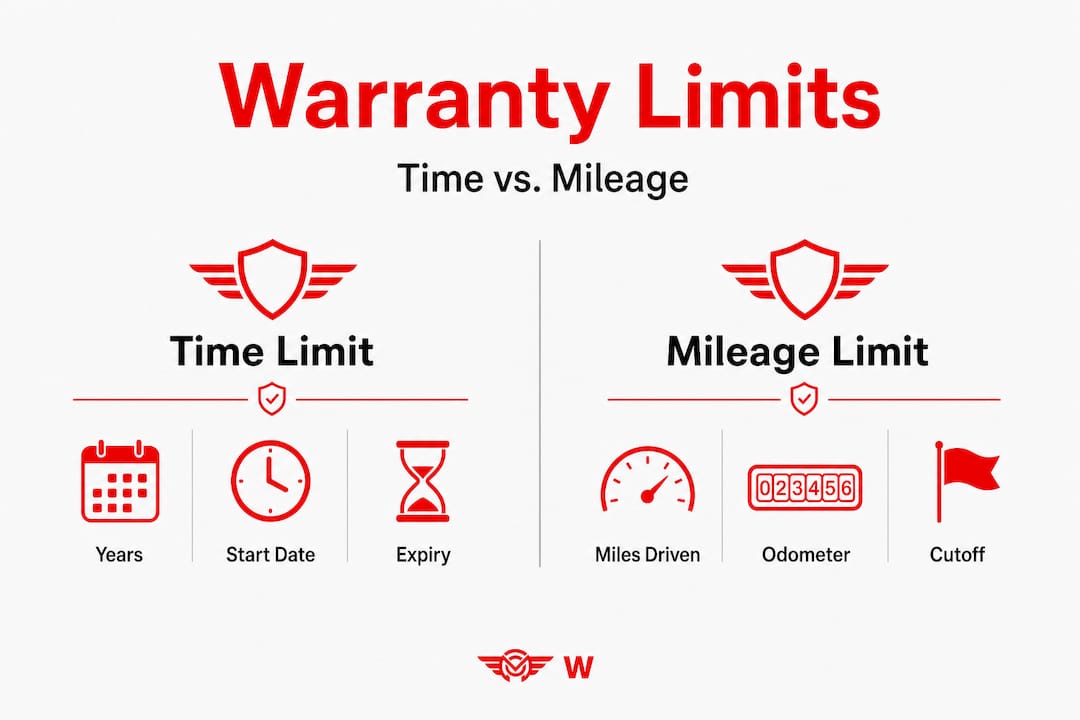
- Time limits: Coverage ends after a set number of years, regardless of mileage.
- Mileage limits: Coverage ends after a set number of miles, regardless of time elapsed.
- Usage limits: Commercial use, rideshare driving, or off-road use may void or restrict coverage.
- Maintenance compliance: Failure to follow the required service schedule can make claims ineligible.
- Modification restrictions: Aftermarket parts or performance upgrades may reduce or eliminate coverage.
"A warranty is only as strong as your understanding of its conditions. Many claims fail not because the repair wasn't valid, but because the owner didn't know what the contract actually required."
Understanding these limits upfront is the single best move you can make as a vehicle owner. For a broader view of how all of this works, the auto warranties explained guide is a solid starting point.
Types of warranty limits you need to watch for
With the basics defined, it's important to recognize the different categories of limits and how they operate in real contracts, because the details can be surprisingly specific.
Time and mileage: the two hard stops
Almost every warranty contract has two primary cutoffs: a time limit and a mileage limit. Coverage ends when either one is reached. This is the part that trips people up the most. If your contract says "5 years or 60,000 miles," and you hit 60,000 miles in year three, your coverage is over. Full stop. The contract's coverage trigger is whichever limit comes first, not the last one standing.
This matters especially for high-mileage drivers, people who commute long distances, or anyone who took a long road trip and didn't realize how quickly the numbers add up.
Exclusion lists: what the contract won't touch
Every warranty comes with a list of items and situations it won't cover. Some exclusions are expected. Others are buried so deeply in the fine print that most owners never read them. Understanding covered and excluded warranty items is essential before you sign anything.
Here's a comparison of a typical versus a more restrictive exclusion list:
| Category | Typical contract | Restrictive contract |
|---|---|---|
| Normal wear and tear | Excluded | Excluded |
| Accidental damage | Excluded | Excluded |
| Environmental damage | Excluded | Excluded |
| Electrical component failures | Often covered | May be excluded |
| Seals and gaskets | Often covered | May require add-on |
| Rental car reimbursement | Included | Additional fee |
| Roadside assistance | Included | May not be included |
The gap between a typical contract and a restrictive one isn't just in price. It's in how much protection you actually have when something goes wrong.
Maintenance compliance: the silent coverage killer
One of the most overlooked limits is the maintenance requirement. If your contract says you must follow the manufacturer's recommended service schedule and you skip an oil change or delay a transmission service, the provider may deny your claim. This applies even if the skipped service wasn't directly related to the part that failed.
How does vehicle age affect warranty eligibility? Older vehicles often face stricter maintenance compliance checks before coverage kicks in. Providers are more cautious with high-mileage or older cars.
Pro Tip: Always read the "start trigger" language in your contract. Some warranties begin on the purchase date. Others begin on the in-service date (when the vehicle was first sold new). That difference alone can shorten your actual coverage window by months or even a year or more.
Hidden exclusions and how to spot them in your contract
Beyond the broad limits, hidden exclusions are where owners get blindsided. These aren't always obvious, and they're often written in language that sounds neutral until you try to use them.
Where exclusions hide
Most contracts front-load the benefits section to make the coverage sound generous. The exclusions are typically placed in a separate section, often labeled something like "What is not covered" or "Exclusions and limitations," and written in dense, legalistic language. Some exclusions are buried inside footnotes or referenced by clause numbers that require cross-referencing other parts of the document.
Here's a step-by-step process for finding hidden exclusions before you sign:
- Read the entire exclusions section first, before you read the benefits. This reframes your understanding of what the coverage actually includes.
- Look for phrases like "resulting from," "caused by," or "related to" because these signal that even a covered part may not be paid for if the cause of the failure falls outside coverage.
- Check for modification language in multiple sections. It often appears in the exclusions list AND in a separate terms section.
- Look up any referenced clause numbers to make sure the cross-referenced language doesn't add new restrictions.
- Compare the exclusions list to your actual driving habits. If you drive for rideshare, tow regularly, or live in a harsh climate, flag those specific areas and ask questions before signing.
The FTC's guidance on auto warranties reinforces that limits tied to how a vehicle was used, maintained, or modified are standard practice, not the exception.
Common hidden exclusions to watch for:
- Environmental damage: Floods, hail, rust from road salt, and heat damage are almost universally excluded.
- Owner modifications: Lift kits, tuning software, aftermarket exhaust systems, and performance chips can void coverage on related components.
- Improper use: Using a passenger car for commercial hauling or frequent off-road driving may disqualify you from certain claims.
- Pre-existing conditions: Damage or wear that existed before the contract started is excluded, and providers may use inspection reports against you.
Knowing what's not covered isn't pessimistic. It's the smart way to shop. And once you've signed, take the time to carefully review your contract again so nothing catches you off guard later.
What really happens when a warranty claim is denied
Understanding exclusions is one thing. But what if your claim is denied anyway? Here's the practical reality of what happens next and what you need to be prepared for.
When a claim is denied, the battle almost never comes down to whether the mechanical failure was real or serious. It comes down to definitions. The provider will cite a specific clause in your contract as the reason for the denial. They may argue the failure was caused by wear and tear, improper maintenance, a modification, or something else listed in the exclusions.
According to the FTC's guidance on auto warranties, after a denial, the practical battleground is whether the claimed cause fits the contract's covered definition and whether you can prove causation and compliance with requirements like maintenance records. This is exactly why disputes almost always start with the denial letter's stated clause and your documentation.
What to do after a denial:
- Read the denial letter carefully. It must state the specific clause or exclusion used to justify the denial. If it doesn't, that's a red flag.
- Pull your maintenance records. If the denial involves a claim that you didn't maintain the vehicle properly, your service receipts are your first line of defense.
- Compare the denial language to your contract. Sometimes denials rely on broad language, but your specific situation may not actually fall under the cited exclusion.
- Escalate through the provider's dispute process. Most contracts include a formal dispute resolution process. Use it, and document every communication.
- Consider involving your state's consumer protection office if the denial feels unjustified or the provider is unresponsive.
Having clear documentation for claims is your best protection before a denial ever happens. Equally important are the key contract protections that give you leverage during disputes.
Pro Tip: Keep a dedicated folder, either physical or digital, for every oil change receipt, tire rotation record, transmission service invoice, and repair order. Date them, and store them somewhere you can access quickly. If a dispute arises, this folder can mean the difference between a paid claim and a rejected one.
Practical steps to make warranty limits work for you
Armed with knowledge about how denials work, let's move from theory into practical strategies that every vehicle owner can apply starting today.
Track your mileage and time limits proactively
- Record your mileage at contract start. Note the exact odometer reading when your warranty begins and calculate your projected mileage per year based on your typical driving habits.
- Set a calendar reminder at 80% of the limit. If your contract covers 60,000 miles, set an alert at 48,000 miles. This gives you time to review your coverage, make any pending claims, and plan your next steps.
- Review your contract annually. Vehicle use patterns change. A new job with a longer commute, a cross-country move, or a change in driving habits can dramatically alter when you'll hit your limits.
- Log every major repair, even ones not covered under warranty. A detailed repair history helps establish your vehicle's condition and can support future claims.
Ask the right questions before buying or renewing:
- What triggers the start of coverage, the purchase date or the in-service date?
- Does the contract cover wear items like belts, hoses, and seals, or just catastrophic failures?
- What maintenance schedule must I follow to stay compliant?
- Are there any modifications currently on my vehicle that could affect coverage?
- What is the dispute resolution process if a claim is denied?
The FTC's consumer guidance reminds owners that limits tied to maintenance, use, and modification are standard in most contracts, so ask about all three upfront.
If you're ready to customize your warranty to match how you actually drive, or want to compare real coverage across different plan options, doing your homework before signing pays off.
The uncomfortable truth about warranty limits most people overlook
Most guides stop at explaining what limits are and how to track them. Here's the part most people miss entirely.
Vehicle owners tend to treat warranties the same way they treat smoke detectors: install them, assume they work, and forget about them. But a warranty is not a set-and-forget device. It's closer to an insurance policy, and like any insurance policy, its real value depends on how actively you manage it.
Think about what happens when your life circumstances change. You take a new job with a 45-minute commute each way. Your mileage doubles. You start using your truck to haul equipment for a side business. You install a lift kit because you took up off-roading. Each of these changes has real implications for your warranty coverage, and if you never revisit your contract, you won't know until a claim gets denied.
The owners who get the most out of their warranties treat each renewal or new contract as a living document. They review it when their driving habits change. They ask their provider about updates when they make modifications. They keep their maintenance records current and accessible. And because of that, they rarely face surprise denials.
There's also a strategic dimension that most drivers ignore: how warranties shield vehicle owners from financial exposure isn't just about individual repairs. It's about managing the total cost of ownership over time. A well-managed warranty, reviewed annually and supported by solid documentation, can turn a reactive expense into a proactive financial tool. Informed owners don't just avoid denials. They maximize the value of every dollar they put into coverage.
Get coverage that fits: explore extended warranty options
Applying this mindset is much easier when you have expert help and flexible coverage options tailored to your specific vehicle and driving habits.
Understanding warranty limits is the foundation. Building the right coverage on top of that foundation is the next step. At RPM Warranty, we offer extended auto warranty plans designed to give you clear terms, transparent exclusions, and coverage that matches how you actually drive. Whether you need comprehensive protection or a targeted plan for specific components, we make it simple to find and compare your options. You can get a free warranty quote for your exact year, make, and model today, or browse our warranty coverage FAQ to get quick answers about what's covered, how claims work, and what to expect.
Frequently asked questions
What happens if I hit the mileage cap before the time limit on my warranty?
Your coverage ends immediately when you reach the mileage cap, even if the time period has not expired. Coverage ends at whichever limit is reached first.
Are oil changes, brake pads, and wiper blades covered under most warranties?
No. Routine maintenance items like oil changes, brake pads, and wiper blades are almost always excluded. The FTC confirms that normal wear and maintenance are standard exclusions in most warranty contracts.
What documentation should I keep to avoid claim denial?
Always keep organized maintenance records, service receipts, and copies of your warranty contract. Claim disputes commonly hinge on whether you can prove compliance with maintenance requirements and that the failure matches a covered cause.
Can modifying my vehicle void my warranty?
Yes. Modifications not approved by the manufacturer or warranty provider often void portions or all of your coverage. The FTC notes that limits tied to vehicle modifications are common in standard warranty contracts.