

TL;DR:
- Warranty agreements are detailed legal contracts with specific coverage limits and exclusions.
- They generally cover major systems like engine, transmission, and electrical components within set time or mileage.
- Owners must follow maintenance requirements and understand exclusions like wear items, routine repairs, and neglect.
Most vehicle owners assume a warranty is a warranty. Sign the agreement, drive off the lot, and if something breaks, the repair is covered. That assumption can cost you thousands of dollars. The reality is that warranty agreements are detailed legal contracts filled with specific inclusions, hard limits, and exclusions that can leave you holding a repair bill you never expected. Understanding exactly what your agreement covers before a breakdown occurs is what separates vehicle owners who are protected from those who are caught off guard. This guide breaks down every critical element you need to review.
Table of Contents
- What is a car warranty agreement?
- Core inclusions in a standard warranty agreement
- Common exclusions and owner responsibilities
- Extra benefits and options in extended warranties
- Manufacturer vs. third-party warranties: Key differences to know
- Why understanding warranty agreements protects your wallet
- Discover tailored warranty protection for your vehicle
- Frequently asked questions
Key Takeaways
| Point | Details |
|---|---|
| Define your coverage | Every warranty agreement spells out exactly which parts and systems are covered and for how long. |
| Know what's excluded | Routine maintenance and wear-and-tear items are almost never covered by standard warranties. |
| Owner obligations matter | Skipping required maintenance or unauthorized repairs can void your car warranty. |
| Extra perks may vary | Perks like roadside assistance or rental reimbursement are only sometimes included with extended warranties. |
| Compare before buying | Check differences between manufacturer and third-party plans before choosing extended coverage. |
What is a car warranty agreement?
A car warranty agreement is a legally binding contract. It spells out exactly what repairs or replacements a provider will pay for, under what conditions, and for how long. If a covered component fails due to a defect, the provider steps in. If that component fails for another reason, such as an accident, neglect, or normal wear, you likely pay out of pocket.
As explained in the Car Warranty Guide, "a warranty agreement is a contract between the vehicle owner and the manufacturer or third-party provider promising to repair or replace defective parts for a specific period or mileage." That phrase "specific period or mileage" is important. Every warranty has a timer or odometer limit attached to it. Once either threshold is crossed, coverage ends.
Warranty providers fall into two main categories: manufacturers and third-party companies. Manufacturer warranties come standard with a new vehicle purchase. Third-party providers, often called extended warranty companies, sell separate contracts that continue protection after the factory warranty expires or add layers of coverage to an existing plan. Understanding auto warranty basics helps clarify which type of coverage you already have and what gaps may exist.
Here is a quick look at how the two provider types compare at a high level:
| Feature | Manufacturer warranty | Third-party extended warranty |
|---|---|---|
| When it applies | New vehicle purchase | After factory coverage or alongside it |
| Who pays for repairs | Manufacturer network | Third-party provider |
| Customization | Limited | Often more flexible |
| Cost to buyer | Included in vehicle price | Separate monthly or lump-sum fee |
Key takeaway: A warranty agreement is not a blanket promise to cover everything that breaks. It is a contract with very specific boundaries. Reading those boundaries before you sign is your best financial defense.
The purpose of a warranty agreement is simple: protect you from unexpected repair costs on covered components within the contract's defined limits. The word "defined" is doing a lot of heavy lifting there.
Core inclusions in a standard warranty agreement
With a definition in place, it is essential to understand what specifically is included in most warranty agreements.
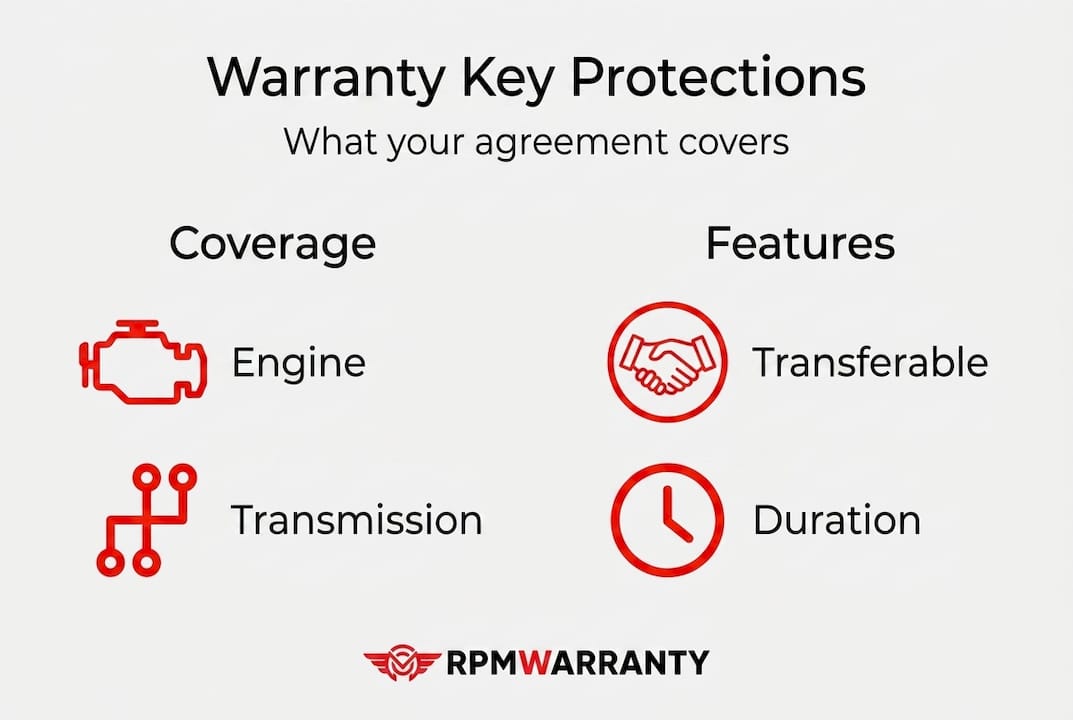
Standard warranty agreements typically cover the systems most likely to experience mechanical failure: the engine, transmission, drivetrain, and major electrical systems. These are also the most expensive systems to repair, which makes coverage here especially valuable. Engine and drivetrain coverage can protect against repair bills that easily run into the thousands of dollars.
The duration of coverage is defined in two ways: time and mileage. A common manufacturer powertrain warranty might last 5 years or 60,000 miles, whichever comes first. Extended warranties from third-party providers often extend that window, sometimes to 10 years or 100,000 miles. According to what a car warranty covers, coverage duration and deductibles are set terms in the contract, extended warranties often include per-repair deductibles, and many plans are transferable to a new owner when you sell the vehicle.
Deductibles deserve special attention. In extended warranty contracts, you often pay a set fee per repair visit, typically between $100 and $200, before the plan kicks in. Some plans offer disappearing deductibles or zero-deductible options for an added premium. Understanding how warranty deductibles work can help you calculate your actual out-of-pocket risk more accurately.
Typical inclusions in a standard extended warranty plan:
- Engine components: Pistons, crankshafts, camshafts, and internal lubricated parts
- Transmission: Gears, seals, and transmission case components
- Cooling system: Water pump, radiator, and thermostat in many plans
- Electrical systems: Alternators, starters, and wiring harnesses
- High-tech components: Some plans cover infotainment, navigation, and advanced driver-assistance systems
Pro Tip: When choosing the right coverage for your vehicle's age and mileage, always ask for an itemized list of covered components. A vague "powertrain coverage" description may not include the specific part that fails on your vehicle.
Transferability is another valuable feature. If you sell your vehicle while the warranty is still active, transferring coverage to the buyer can increase the resale value of your car. Not all plans allow this, so check the fine print before assuming you have this option.
Common exclusions and owner responsibilities
Just as important as knowing what is included is understanding major exclusions and your legal obligations as an owner.
The Federal Trade Commission states that common exclusions include normal wear and tear such as brake pads, tires, and wipers, as well as routine maintenance like oil changes, accidents, misuse, neglect, pre-existing conditions, aftermarket modifications, and cosmetic damage. That list is longer than most vehicle owners expect.
Here is a numbered breakdown of the most frequently overlooked exclusions:
- Wear items: Brake pads, rotors, belts, and wiper blades wear out with normal use. No warranty covers them because wearing out is their intended behavior.
- Routine maintenance: Oil changes, tire rotations, coolant flushes, and air filters are your responsibility as an owner, not the warranty provider's.
- Pre-existing conditions: If your vehicle had a mechanical issue before the warranty started, that problem is excluded. This is especially relevant when buying a used vehicle with an added extended warranty.
- Aftermarket modifications: Installing non-factory parts, performance upgrades, or lift kits can void coverage on related systems.
- Accidents and collision damage: Warranty agreements are not insurance policies. Physical damage from crashes is handled by your auto insurance, not your warranty.
- Neglect: If you drove your vehicle with low oil for 5,000 miles and the engine seizes, that is neglect. The claim will likely be denied.
Owner responsibilities are equally important. As noted in the Car Warranty Guide, owners must follow the manufacturer's maintenance schedule, use authorized service centers as required by the contract, and keep records of all service to avoid voiding coverage.
Critical reminder: Your warranty is only as strong as your maintenance record. A provider can legally deny a claim if you cannot prove the vehicle received scheduled service. Keep every receipt.
Understanding what voids a warranty is something many owners only discover after a claim is denied. Do not wait for that moment. Review your responsibilities before you need to file.
Pro Tip: Many common warranty myths lead owners to believe that taking their car to any certified mechanic is fine. But some extended warranty contracts require repairs at specific authorized shops. Verify this before any repair appointment.
Extra benefits and options in extended warranties
While standard agreements cover the basics, extended warranties often offer additional perks worth considering.
Many extended warranty plans go beyond mechanical repair coverage to include services that help you stay mobile during a breakdown. According to a breakdown of what is included in extended warranties, additional perks such as roadside assistance, rental car reimbursement, and trip interruption coverage are sometimes included but are not guaranteed in every plan.
Here is what these add-on benefits typically look like in practice:
- Roadside assistance: Covers towing, flat tire changes, battery jump-starts, and lockout services. This is one of the most practically useful benefits, especially for long commuters or highway drivers.
- Rental car reimbursement: If your vehicle is in the shop for a covered repair, some plans reimburse you for a rental car at a daily rate, often between $30 and $50 per day.
- Trip interruption coverage: If your vehicle breaks down more than a certain distance from home, usually 100 miles or more, this benefit covers lodging and meal expenses up to a set limit.
- 24/7 claims support: Some providers offer round-the-clock phone access for claims, which matters when a breakdown happens on a weekend or holiday.
- Nationwide repair network: Access to a large network of certified repair facilities so you are not stranded in an unfamiliar city without options.
Statistic to consider: AAA reports that vehicle owners average more than one roadside emergency per year. If your extended warranty includes roadside assistance, that single benefit can more than pay for a portion of your plan's cost in a difficult year.
Not every plan bundles these perks into the base price. Some providers offer them as optional add-ons. Before signing, review the extended warranty FAQs to understand which benefits are built in and which cost extra. Also think honestly about your driving habits. If you drive long distances frequently or rely on your vehicle for work, roadside assistance and rental coverage could be worth significantly more to you than to someone who drives five miles to the office each day. Check when to consider extended warranties based on your specific situation.
Manufacturer vs. third-party warranties: Key differences to know
Knowing the difference between types of providers is crucial for choosing the right warranty agreement.
The FTC notes that extended warranties differ from manufacturer warranties and recommends comparing any third-party contract carefully to your existing factory coverage before buying, since they may overlap and the added cost may not be justified.
Here is a detailed comparison:
| Feature | Manufacturer warranty | Third-party warranty |
|---|---|---|
| Coverage scope | Defined by manufacturer | Varies widely by provider |
| Repair network | Authorized dealerships | Often broader or more flexible |
| Claim process | Direct through dealership | Through provider hotline or app |
| Customization | Limited or none | Can often tailor coverage |
| Cost | Included in vehicle price | Separate purchase; monthly or lump sum |
| Reliability | High (backed by OEM) | Varies; research provider reputation |
Manufacturer warranties, also called factory warranties, are the most straightforward. The automaker defines the terms, the dealership handles the claim, and the process is well established. The downside is that once the factory warranty expires, you are on your own unless you purchase additional protection.
Third-party warranties, sometimes called service contracts or aftermarket warranties, are more flexible but require more research. A provider that sounds reputable may have slow claims processing, low payout limits, or a long list of fine-print exclusions. Understanding post-factory warranty coverage options becomes essential as your vehicle ages out of its original coverage window.
Key questions to ask any third-party provider:
- Which specific parts and systems are covered?
- What is excluded and how is exclusion determined?
- Who processes and pays the repair shop directly?
- How is a disputed claim resolved?
- Is the provider backed by an A-rated insurance company?
Warranty transparency from a provider is a strong positive signal. If a company is vague about what is covered or pushes you to sign before reading the full contract, that is a red flag.
Why understanding warranty agreements protects your wallet
Here is an uncomfortable truth about extended warranties: the math does not always favor the buyer. Many vehicle owners purchase coverage and never file a meaningful claim. That does not make every extended warranty a bad deal, but it does mean the decision requires honesty.
As the Car Warranty Guide points out, there are genuinely contrasting views on extended warranties. For high-mileage or older vehicles with a history of costly repairs, a well-chosen plan can be financially smart. For newer vehicles or those with strong reliability records, some financial advisors suggest self-insuring instead, setting aside a monthly amount into savings to cover potential repairs.
The smarter approach is not to ask "should I buy a warranty?" but rather "what is my actual risk exposure?" A 2019 vehicle with 80,000 miles heading into its peak failure years is a very different situation than a 2024 vehicle still under factory coverage. Know your vehicle's reliability history, research common failure points for your make and model, and then price out what a major repair would cost without coverage.
Watch out for pressure sales tactics and overpriced plans. Some third-party providers target vehicle owners with aggressive phone or mail campaigns. A legitimate provider gives you time to read the contract, compare options, and ask questions. Reviewing warranty myths and pitfalls before you engage with any provider helps you spot manipulative practices early.
The bottom line is this: a well-matched warranty agreement adds genuine financial protection. A poorly chosen one is an expensive monthly payment for coverage you may not actually need or cannot realistically use.
Discover tailored warranty protection for your vehicle
Understanding your warranty agreement is the first step. The next step is finding a plan that fits your vehicle, your budget, and your actual risk profile.
RPM Warranty offers extended vehicle warranty options built around your specific vehicle's year, make, and model. Whether you are looking for top-tier coverage or a budget-friendly essential plan, their protection plans include clear terms, nationwide repair network access, and responsive claims support. No vague language and no surprises buried in the fine print. If you are ready to compare your options and see what coverage looks like for your situation, get a free warranty quote today and find the plan that gives you real peace of mind behind the wheel.
Frequently asked questions
Are oil changes and brake pads covered under a car warranty?
No, routine maintenance items like oil changes and brake pads are excluded from warranty coverage because they are considered normal wear items, not mechanical defects.
What happens if I skip scheduled maintenance?
Skipping required maintenance can void your warranty entirely, since providers require maintenance records as proof that the vehicle was properly cared for before approving a claim.
Do extended car warranties cover roadside assistance?
Some extended warranties include roadside assistance, but it is not always guaranteed in every plan, so always verify which perks are included before signing.
Can I get my car repaired at any shop and keep my warranty?
Not always. Many contracts require authorized service centers for covered repairs, and using an unauthorized shop can result in a denied claim or voided coverage.